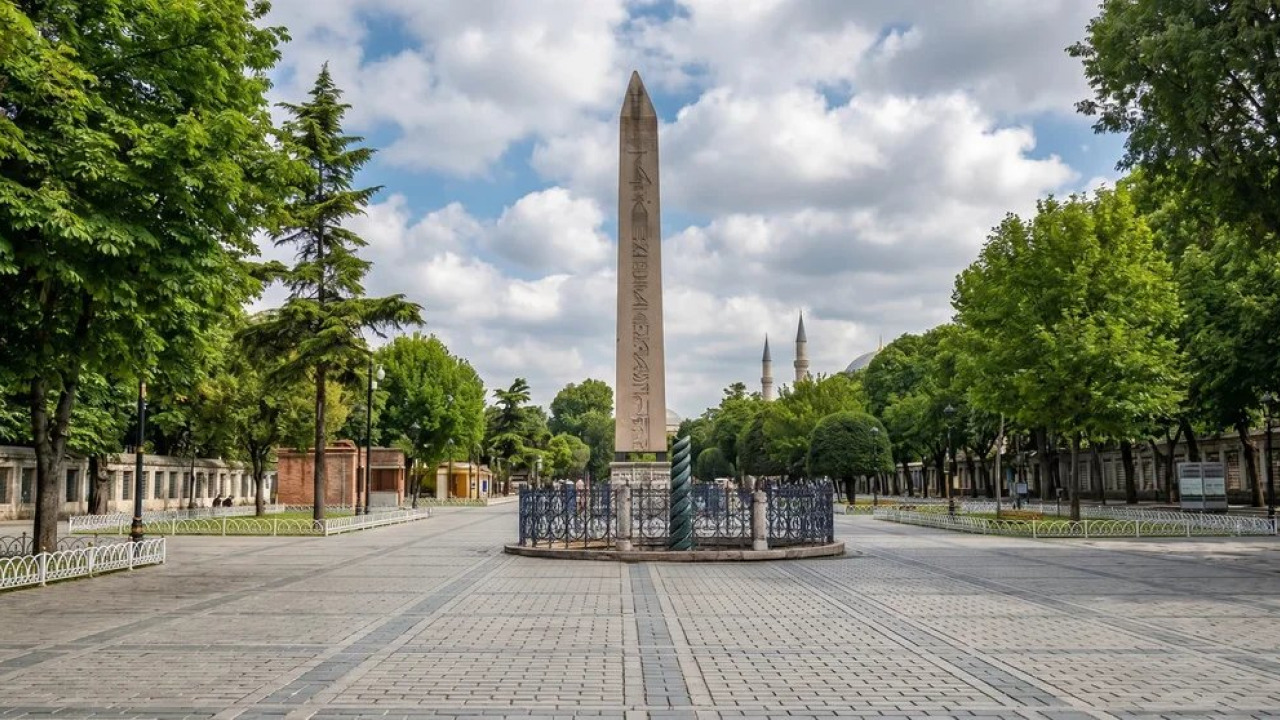

Visiting Sultanahmet Square is a straightforward experience with no tickets, queues, or closing times to worry about. This iconic public space is open all day, and its three ancient monuments are conveniently lined up from north to south. If you start from the German Fountain at the northern end, you'll first encounter the Obelisk, then, just a few steps further, the Serpentine Column, and finally, the Walled Obelisk at the end of the line. All three monuments have their original bases nestled within stone-walled pits, well below the ground level you walk on today. This guide presents the square not as a scattered list of sites, but as a linear journey with a fascinating difference in ground levels, explaining what to look for at each monument, why the ground has risen over centuries, how long the walk takes, and how this brief but impactful stop fits into your day.
Quick Facts
| Topic | Information |
|---|---|
| Location | Fatih district, Sultanahmet; the open area west of the Sultanahmet Mosque |
| Visiting Status | Public square; no entrance gate, ticket, or closing time |
| Monument Line-up | North to south: German Fountain, Obelisk, Serpentine Column, Walled Obelisk |
| Ground Level Difference | Roman-era track level is approximately 4.5 meters below today's surface |
| Transport | T1 Kabataş-Bağcılar tram line, Sultanahmet station (between Gülhane and Çemberlitaş) |
| Western Border | Museum of Turkish and Islamic Arts (İbrahim Pasha Palace), open daily according to muze.gov.tr |
| Protection Status | Part of Istanbul's Historic Areas, a UNESCO World Heritage site (1985) |
| Time for Monument Line-up | Approximately 45 minutes to 1 hour, starting from the northern end |
What to See in the Square: The Three Sunken Monuments and Their Line-up
In Sultanahmet Square, you'll often find yourself looking down rather than up. All three monuments stand on the spina axis, the central barrier of the Roman Hippodrome. However, that axis belongs not to today's surface, but to the racing track level, approximately 4.5 meters below. Centuries of rubble, ash from fires, and infill have raised the ground level, leaving the monument bases below. The stone-walled pits excavated to reveal this difference make it visible: lean over the railing and look down, and you'll glimpse the monument's true starting point. For those looking to compare guided walking tours in the heart of the peninsula, check out our Istanbul city center cultural tours page.
The Obelisk (Obelisk of Theodosius)
The Obelisk is the pink granite monument in the northern half of the square, and its story spans two distinct eras. Its monolithic shaft was carved in Egypt for Karnak; its arrival in Istanbul and erection in the Hippodrome took place in 390 AD during the reign of Emperor Theodosius I. Hieroglyphs depicting the campaigns of Pharaoh Thutmose III and his offerings to the god Amun-Ra run continuously on all four faces of the shaft. Sources list the shaft's height between 18.5 and 19.6 meters; with its base, the monument reaches approximately 25 meters.
The real details, however, are found below. The marble base upon which the monument rests features intricate carvings on all four sides, depicting the emperor, his family, and court officials watching races from their lodge, foreign envoys presenting gifts, and the intricate pulley system used to erect the obelisk. The base also bears two separate inscriptions in Latin and Greek, which do not perfectly align on the number of days it took to erect the monument – a reflection of the capital's bilingual administrative structure at the end of the 4th century. Since the reliefs are within the pit, they can only be read by leaning over the railing.
The Serpentine Column
The Serpentine Column stands a few steps south of the Obelisk, a bronze monument composed of three intertwined serpent bodies. Its original function was a victory offering: after defeating the Persian army in the Battle of Plataea in 479 BC, the Greek city-states cast this monument from their spoils and erected it at the Temple of Apollo in Delphi, inscribing the names of thirty-one participating cities on its body. The column's arrival in Constantinople dates to 324 AD, coinciding with the city's establishment as the new capital; thus, it is the second imported piece in the square's line-up after the Egyptian Obelisk.
The monument is officially described as an eight-meter-tall column; however, the section standing today is shorter than this, as the three serpent heads that once supported a golden tripod are no longer in place. Most sources date the detachment of the heads from the column to around 1700; a fragment belonging to one of the heads is part of the Istanbul Archaeological Museums' collection. As the museum's exhibition halls are periodically undergoing restoration, it's advisable to check the museum's own announcements before your visit to confirm if the fragment is on display.
The Walled Obelisk
The Walled Obelisk, located at the southern end of the square, takes its name from the cut-stone masonry of its shaft. At approximately 32 meters tall, it is the most massive structure in the line-up. The monument's original construction date is not definitively known; an inscription on its base records that Emperor Constantine VII Porphyrogennetos had the monument restored and covered with gilded bronze plates in the 10th century.
The regular rows of holes on its stone surface are where those plates were affixed: the monument isn't bare, but rather stripped of its former glory. The plates were removed and melted down during the Fourth Crusade in 1204. In the same plunder, four bronze horse statues from the Hippodrome were also transported by ship to Venice and placed on the facade of St. Mark's Basilica; a portion of the emptiness in the square today is due to these transported pieces.
The German Fountain and the Milion Stone
The octagonal-domed structure at the northern end of the line-up is the German Fountain, inaugurated in 1901 as a gift from German Emperor Wilhelm II to Sultan Abdülhamid II. Step under the dome and look up: you'll see the golden mosaic floor and the monograms of the two rulers. This fountain marks the 20th-century end of the square's historical line, not the Roman one, making it chronologically the youngest stop on your tour.
If you take a few steps from the square's northeastern corner towards Hagia Sophia, you'll spot the remaining fragment of the Milion Stone on the sidewalk. This was the starting point of all imperial roads in the Eastern Roman Empire, and distances to other cities from the capital were measured from this very spot. The same corner also overlooks the exit of the Basilica Cistern; if you plan to venture underground on the same day, be aware that visiting the Basilica Cistern requires a separate ticket and has its own queue system.
The Sphendone: The Wall Beneath the Southern Curve
At the southern end of the square, the ground noticeably slopes downwards. Beneath this incline lies the massive substructure wall known as the Sphendone, which supported the Hippodrome's semicircular southern end. It is believed that construction of the Hippodrome began around 200 AD during the reign of Emperor Septimius Severus, and the structure was expanded by Constantine between 324 and 337 AD. Spectator capacity varies by source: while news reports based on expert opinions mention 30,000 to 40,000 people, official promotional pages speak of a structure with a capacity of 100,000.
Today, buildings belonging to the Sultanahmet Vocational and Technical Anatolian High School and Marmara University stand atop the Sphendone, and the interior of the wall is not open to visitors. You'll notice its curve by looking down from the southern end; quiet streets leading down to the Küçük Ayasofya Mosque (Little Hagia Sophia) begin at the lower level of the same slope.
| Monument | Material & Size | Origin & Arrival in Square | Details to Observe On-Site |
|---|---|---|---|
| The Obelisk | Pink granite; approx. 25 meters with base | Carved in Karnak, erected 390 AD | Hieroglyphs on four sides and the racing scene on the base |
| The Serpentine Column | Bronze casting; officially 8 meters, remaining section shorter | Plataea offering 479 BC, brought 324 AD | Coiled body and the upper end where the heads broke off |
| The Walled Obelisk | Cut-stone masonry; approx. 32 meters | Inscription records 10th-century restoration | Mounting holes where bronze plates were removed |
| The German Fountain | Octagonal dome, golden mosaic | Opened in 1901 | Mosaic inside the dome and two monograms |
The Same Ground Witnessed Races, Rebellions, and Festivities
The serene appearance of the square today belies the many different functions the ground you walk on has served. The monuments remained, but the nature of the crowds around them transformed.
| Period | Square's Function | What Remains Today |
|---|---|---|
| Roman and Early Byzantine | Chariot racing track, monument line-up on the spina | Sunken bases of monuments and the ground level difference at the southern end |
| 6th Century | Political arena for fan factions | Written sources; no standing structures from the grandstands |
| Ottoman Period | Horse Square (At Meydanı): javelin throwing, festivities, and wedding celebrations | Facade of İbrahim Pasha Palace and festival miniatures |
The Nika Revolt and the Barricaded Gates
The Nika Revolt, which erupted in 532 AD, began when the Hippodrome's chariot racing factions united against tax policies and the administration. The rebels burned down much of the city and proclaimed a new emperor within the Hippodrome. The revolt was suppressed when the imperial army secured the Hippodrome's exit gates; sources speak of over thirty thousand dead within the arena. Today, no standing examples of those gates remain, so the lasting trace of the event is not the square's structure, but its sheer scale: the entire area, approximately 450 meters long and 130 meters wide, could be filled with crowds simultaneously.
At Meydanı (Horse Square): The Same Three Monuments in Miniatures
After the conquest, the racing function ceased, but the area continued to serve as the city's main open space, known as At Meydanı (Horse Square). The circumcision festival held for Sultan Murad III's son in 1582 was depicted in the Surname-i Hümayun; in the miniatures, behind the parading guild processions, the Obelisk, Serpentine Column, and Walled Obelisk appear in their current order. This name still lives on: the official address of the Museum of Turkish and Islamic Arts on the western edge of the square is At Meydanı Sokak (Horse Square Street), and the neighborhood where the museum is located is also called Binbirdirek.
How to Get to Sultanahmet Square and Where to Start Your Visit
The Sultanahmet station on the T1 Kabataş-Bağcılar tram line opens directly onto the northern end of the square; the station is located between Gülhane and Çemberlitaş. This entry point also dictates the direction of your visit: when you enter the square from the station, you're at the 20th-century end of the line-up; as you walk south, the age of the stones increases.
- Alight at Sultanahmet station on the T1 tram line; the line operates between 06:00 and 00:00.
- Walk from the station to the northern end of the square, step under the dome of the German Fountain, and admire the mosaic.
- Turn south and approach the pit of the Obelisk, circling its base to read the reliefs on all four sides.
- Move a few steps south to the pit of the Serpentine Column and observe the coiled body from above.
- Reach the Walled Obelisk at the end of the line-up, examining the rows of holes on its stone surface up close.
- From the point where the ground slopes down at the southern end, look towards the curve of the Sphendone; the Museum of Turkish and Islamic Arts on the western edge is just a few steps away from this point.
Arriving by Sea: Three Stops from Eminönü
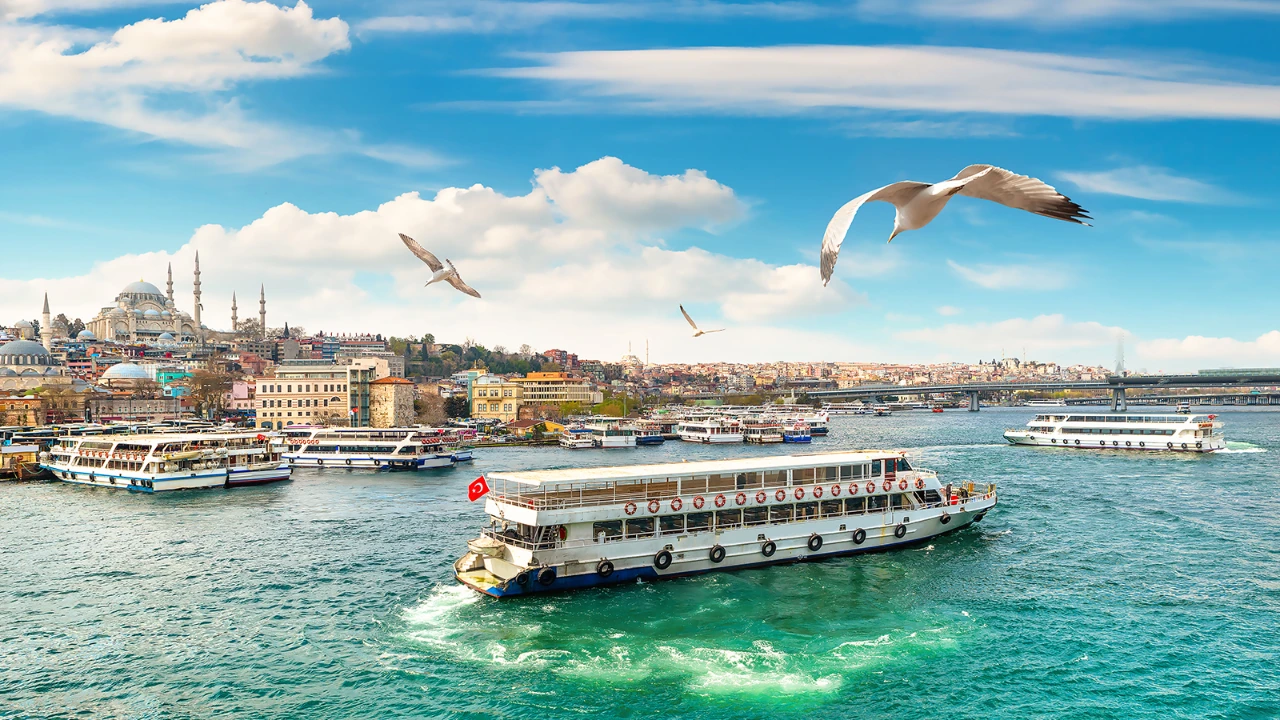
For those connecting a sea journey to the square, the land entry point is Eminönü: you'll exit the ferry terminal and board the T1 tram at the stop in the same square; Sultanahmet is the third stop after Sirkeci and Gülhane. A program returning from a Bosphorus or Golden Horn tour can connect to the tram line this way; since the square is explored on foot and has no closing time, it can also be saved for the end of the day.
Light and Seasons in an Open-Air Square
The square is not a building: there are no shaded porticoes, enclosed halls, or courtyards to shelter from the rain. Therefore, seasonal preference here is less about comfort and more about visibility, as the legibility of the monuments directly depends on the light.
| Period | Open-Air Conditions | Impact on Monument Reading |
|---|---|---|
| April-June | Heat not yet intense, days are longer | Morning light illuminates base reliefs from the side |
| July-August | No shade structures, midday hours are challenging | Direct light flattens reliefs, early hours are best |
| September-October | Heat subsides, crowds thin | Soft light highlights granite and bronze textures |
| November-March | Rain and wind are directly felt | Hieroglyph lines become more distinct on wet granite |
The Best Light for Reading the Reliefs
The figures on the Obelisk's base are in low relief; when direct midday light eliminates shadows, the scene flattens, and the envoys and spectators become indistinguishable. Early morning and late afternoon are the two windows when light comes from the side, giving depth to the reliefs. In the evening, as the monuments and surrounding structures are illuminated, the perspective changes: by day, you observe the texture of the stone; by night, the silhouette.
How Long Does a Visit to Sultanahmet Square Take?
Starting from the northern end, seeing the three monuments, the German Fountain, and the reliefs on the Obelisk's base takes approximately 45 minutes to 1 hour; reading the inscriptions and taking photos will extend this time slightly. Given its size, the square is not a main destination for the day, but rather a connecting link between two other stops.
There are no cafes, ticket booths, or locker facilities within the square itself; benches and the areas around the fountains are used for breaks, while dining options begin on the streets surrounding the square. The distinction regarding cost is clear: entering the square and observing the monuments from the outside is free, while the surrounding enclosed structures have their own admission fees. The Museum of Turkish and Islamic Arts is on the western border of the square and, according to muze.gov.tr, is open daily from 09:00 to 18:45.
For larger structures in the vicinity, such as Hagia Sophia's layered past, ticket prices are divided by visitor type: Turkish citizens, MuseumPass holders, and foreign visitors have separate rates. Factor this division into your budget planning, and obtain the exact figures from the official website of the structure you intend to visit. Those considering seeing the square as part of a guided program can compare Istanbul cultural tours options.
Practical Tips for Your Visit to the Square
Visiting an open-air site has its own unique considerations; the following tips will make your walk more comfortable.
- Do not lean on the pit railings or drop anything inside; there is no access to the base area.
- Avoid touching the monument bodies; the granite and bronze surfaces already bear enough old visitor etchings.
- There is no shade in the square; in summer, a hat and water are essential, while in winter, a windproof outer layer will make your visit more comfortable.
- The ground is paved with stone and slopes towards the south; flat-soled shoes will make walking more comfortable.
- During crowded hours, the area around the railings can become congested; walking the line-up from south to north in reverse can help avoid queues.
- When photographing the base reliefs, look for an angle that frames the inside of the pit rather than just the monument's shaft.
To Sum Up: Reading the Square as a Timeline
A visit to Sultanahmet Square is more than just seeing four structures in sequence; along the same north-to-south line, the pharaonic era of Egypt, the classical Greek world, the Byzantine Empire, and the early 20th century stand side-by-side. If you understand the ground level difference from the outset, the pits become not a deficiency, but the square's true narrative. The Sultanahmet Mosque to the east and Topkapi Palace to the north are also part of the same UNESCO component area listed in 1985, ensuring this short walk naturally connects to the rest of your day's itinerary.
Frequently Asked Questions 5
Is there an entrance fee for Sultanahmet Square?
No. The square is a public urban space; there is no entrance gate, ticket, or closing time, and the monuments can be freely observed and photographed from the outside. Enclosed structures surrounding the square, however, have their own admission fees, with separate rates for different visitor types.
Why are the monuments in Sultanahmet Square located in pits?
The monuments haven't moved; rather, the ground level has risen. The Roman-era chariot track level is approximately 4.5 meters below today's surface. Centuries of rubble, ash, and infill have elevated the square. The stone-walled pits, opened through excavations, are maintained to keep the original seating level of the bases visible.
Who erected the Obelisk, and when?
The granite shaft was carved in Egypt for Karnak, in the name of Pharaoh Thutmose III. Its erection on the spina axis of the Hippodrome took place in 390 AD during the reign of Emperor Theodosius I, with the scene of its raising depicted in the reliefs on its base.
Where are the serpent heads of the Serpentine Column?
The three heads are not on the column today. Most sources date their detachment to around 1700, and a fragment belonging to one of the heads is part of the Istanbul Archaeological Museums' collection. As exhibition layouts change, it's advisable to check the museum's current announcements to confirm if the fragment is on display.
How do I get to Sultanahmet Square by tram?
Alight at Sultanahmet station on the T1 Kabataş-Bağcılar line; the station is located between Gülhane and Çemberlitaş and opens onto the northern end of the square. Those arriving by sea can board the same tram line from the Eminönü ferry terminal and alight at the third stop after Sirkeci and Gülhane.