
The term "hans around the Grand Bazaar" often groups two distinct experiences under one roof, a nuance many travelers only discover once they've set out. Zincirli Han is a tidy, self-contained courtyard within the bazaar's enclosed labyrinth. Büyük Valide Han, on the other hand, stands outside the bazaar, down a sloping street, a colossal trading complex still bustling with active workshops. One offers a fifteen-minute architectural snapshot; the other is an immersive visit to a working hub filled with dust, noise, goods being moved, and people at work. This guide will lay out both options, clarify which might best suit your itinerary, and explain the correct walking order.
This trip is ideal for travelers who:
- Want to experience Ottoman commercial architecture not from a book, but from a living, breathing building.
- Are looking for free, self-guided explorations without the crowds and queues of a typical museum.
- Are curious about craft, jewelry making, and workshop culture, and open to engaging with artisans.
This trip might be challenging for:
- Those expecting information panels, directional arrows, and a neatly organized visitor route.
- Visitors using wheelchairs, strollers, or those with knee issues; the area is full of steep slopes and high stone thresholds.
- Travelers whose itinerary revolves around panoramic rooftop photos; the "rooftop issue" we'll discuss below won't meet this expectation.
Quick Facts
| Topic | Information |
|---|---|
| Location | Fatih district; Zincirli Han is inside the bazaar, Büyük Valide Han is in Mercan on Çakmakçılar Yokuşu (Çakmakçılar Slope) |
| Commissioned by Büyük Valide Han | Kösem Sultan, mother of Murad IV; to provide income for her foundation |
| Construction Period | Büyük Valide Han between 1632-1640; Zincirli Han according to the inscription on its south gate, 1708 |
| Grand Bazaar Profile (Istanbul Metropolitan Municipality record) | 11 gates, 61 streets, 4,400 shops, 2,195 workshops, 2 bedestens, 40 hans |
| Grand Bazaar Opening Days | General merchant hours Monday-Saturday 08:30-19:00; according to IMM records, closed on Sundays and public holidays |
| Büyük Valide Han Visiting Hours | No declared visiting hours; courtyards are lively on weekdays, depending on merchant and workshop schedules |
| Admission Fee | Entrance to both han courtyards is free; separate tariffs apply for various visitor types at nearby paid museums, check muze.gov.tr for current rates |
| Rail Transport | T1 Kabataş-Bağcılar tram; Beyazıt-Kapalıçarşı, Çemberlitaş, and Eminönü stops |
| Recommended Duration | 2-3 hours for both hans; half a day including surrounding streets |
Büyük Valide Han vs. Zincirli Han: What to Expect from Each?
The short answer: if you're seeking architectural harmony and an easy first impression, opt for Zincirli Han. If scale and a living, breathing production environment are more your speed, Büyük Valide Han is your destination. These two structures aren't from the same century, aren't on the same scale, and don't even operate on the same schedule. The table below will help you make a quick decision.
| Criterion | Büyük Valide Han | Zincirli Han |
|---|---|---|
| Location | Outside the Grand Bazaar, on Çakmakçılar Yokuşu | Within the northern section of the Grand Bazaar, inside the market |
| External Access | Direct street access via a large gate on the slope | An inner han with no direct exit to the outside |
| Construction | Kösem Sultan's foundation, 1632-1640 | According to its inscription, 1708 |
| Layout | Three separate courtyards, approximately 210 rooms | Two-story layout surrounding a courtyard |
| Current Industry | Textile, casting, and various manufacturing workshops | Shops on the ground floor, jewelry workshops upstairs |
| Visit Pace | Slow, requires attention, dusty in places | Quick, can be observed while sitting in the courtyard |
| Operating Schedule | Depends on merchant and workshop schedules, quieter on weekends | Follows the Grand Bazaar's schedule, closed on Sundays |
The last row in the table is key for planning. Zincirli Han becomes inaccessible when the bazaar gates close. Büyük Valide Han, being on a street, operates on a different rhythm. If you plan to visit both on the same day, choosing a weekday morning is the simplest way to find both open and bustling.
Büyük Valide Han: Kösem Sultan's Three-Courtyard Foundation
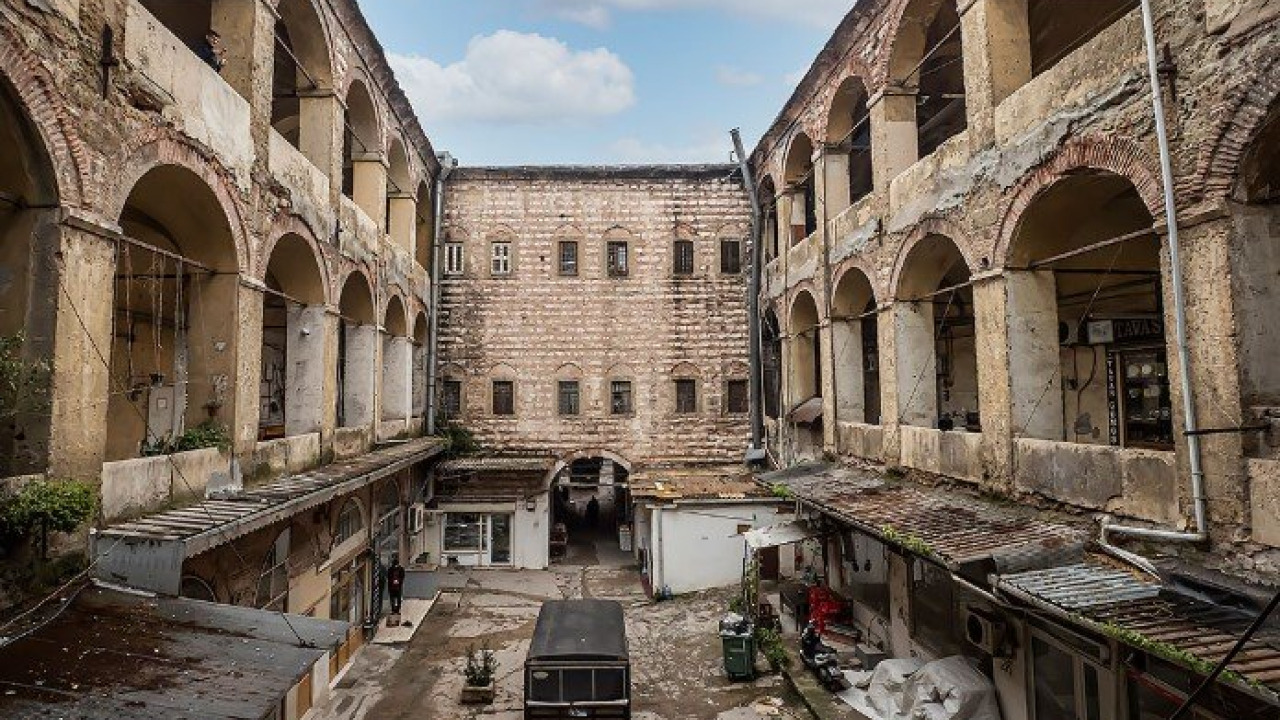
Büyük Valide Han was commissioned by Kösem Sultan, mother of Murad IV, between 1632 and 1640 to generate income for her charitable foundations. Located in Mercan, on Çakmakçılar Yokuşu (Çakmakçılar Slope), its rear section extends towards Uzunçarşı. The logic behind its construction wasn't to create a lodging facility, but a continuous income-generating trade machine: warehouses and stables on the lower floors, merchant rooms upstairs, and open courtyards where goods changed hands.
Three Courtyards and Approximately 210 Rooms
The han features three distinct courtyards. According to the Türkiye Diyanet Vakfı İslam Ansiklopedisi (Turkish Religious Affairs Foundation Encyclopedia), the triangular-planned first courtyard at the entrance is followed by a nearly square second courtyard, measuring approximately 63 by 66 meters; a rectangular third courtyard is located at the very back. The same record states there are around 210 rooms. The lower-floor spaces have barrel vaults, while the upper-floor rooms are domed, each featuring a fireplace and wall niches. Keeping these numbers in mind as you wander the courtyards is helpful: what stands before you isn't just a building, but a small city with its own internal "streets."
The Courtyard Tower and Mesjids
The most striking feature of the han is a tower older than the han itself. According to the same record, this square tower, standing in the corner of the third courtyard, with a 12 by 12-meter base and approximately 25 meters high, dates back to the Byzantine period and is referred to as the Eirene Tower in historical sources. The record also notes that the tower is currently in a dilapidated state, meaning its interior is not organized for visits; it's to be viewed from the courtyard. This illustrates how the Ottoman han incorporated a structure erected centuries before, rather than demolishing it. The Mescid-i Îrâniyân (Iranian Mosque) in the center of the large courtyard served the community of Iranian merchants who conducted business in the han. This detail explains why the han was considered more than just a place of trade: it housed worship, accommodation, and oversight. For those who wish to explore such layered history with a guide, our Istanbul city center cultural tours offer similar itinerary concepts.
The Rooftop Issue: Why You Should Skip It
Many social media posts about the han feature photos of the dome views from the rooftop, but the situation here has definitively changed. In 2016, the Ministry of Culture and Tourism prohibited access to the roof to protect the structure. Despite this, continued unauthorized visits led to the collapse of one of the rooftop domes on December 30, 2017. There is no official viewing terrace or ticket office at the han. Plan your visit around the courtyards and workshop floors; if you come expecting rooftop access, you'll not only be disappointed but also attempting to enter a prohibited area.



Is Zincirli Han Inside the Grand Bazaar?
Yes, it is. Don't let the word "near" in the title mislead you: Zincirli Han is an inner han located in the northern section of the Grand Bazaar, with no direct exit to the outside. This means you can't access it directly from the street; you must enter the bazaar and walk through it. Understanding this distinction will completely change your visit order; those who mistake them for neighbors and try to wander between them will lose valuable time.
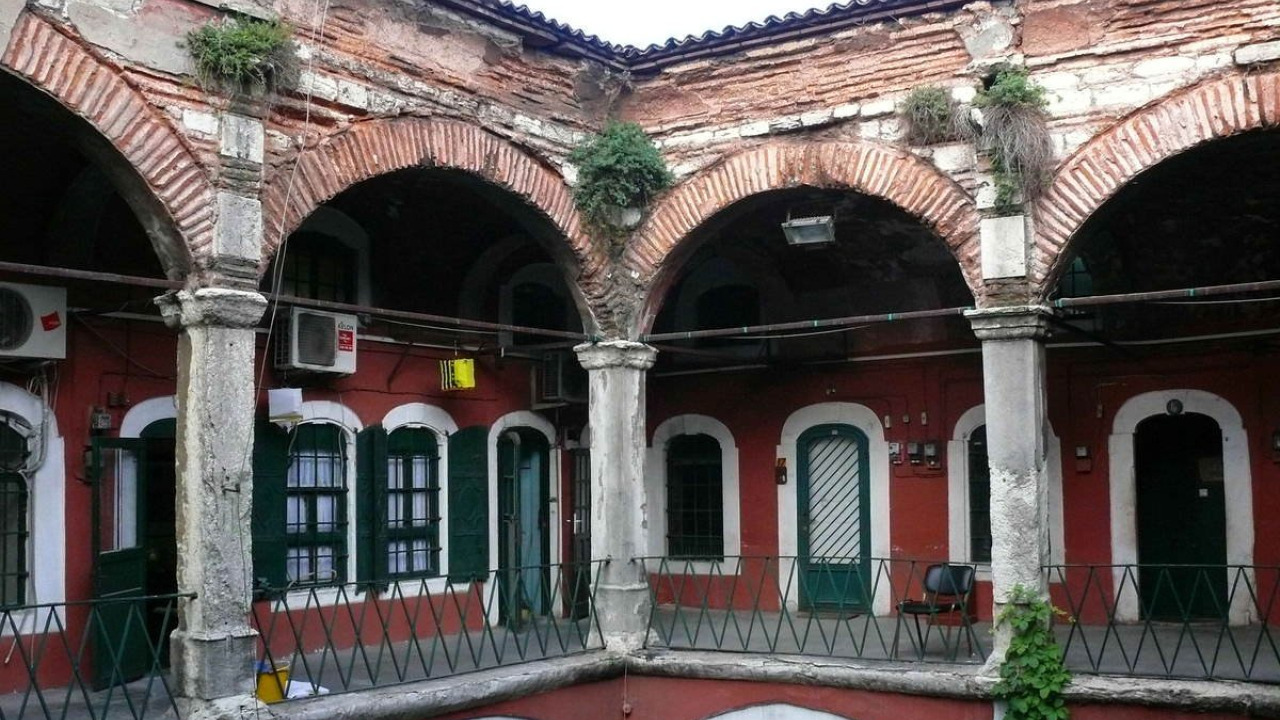
The 1708 Inscription and Inner Han Layout
According to the inscription above the han's southern entrance, the structure was built in Hijri 1120, corresponding to 1708 AD. Its layout is simple: a two-story section surrounds a transverse rectangular courtyard, with a fountain and seating area in the center. The rubble stone and brick-arched facades, terracotta-toned walls, and dark green shutters make the han instantly recognizable in photographs. This architectural integrity is why Zincirli Han stands out among the 40 hans listed in the Grand Bazaar's IMM record; while many hans within the bazaar have been subdivided over time, its courtyard layout remains clearly discernible.
Jewelry Workshops and Ground Floor Shops
Today, the functional division is by floor: ground-floor shops handle sales, while master jewelers' workshops operate upstairs. Throughout its history, the han also housed carpet making, coppersmithing, carpet repair, and antique dealing; today, the focus is predominantly on jewelry and precious metal production. Even a few minutes spent sitting in the courtyard allows you to observe the production chain: an apprentice descending from upstairs, a small package delivered to a shop below, a piece placed on a scale. For those curious about the general history and shopping culture of the bazaar, our article The Historical and Commercial Heart of the Grand Bazaar delves into its fascinating story.
How to Get to the Hans: The Bazaar-to-Slope Route
The correct order is downhill: first Zincirli Han inside the bazaar, then exit the bazaar and head downhill to Büyük Valide Han. If you do it in reverse, you'll face a strenuous climb back up Çakmakçılar Yokuşu (Çakmakçılar Slope). If you start from the T1 tram's Beyazıt-Kapalıçarşı stop, the steps are as follows:
- Get off at the Beyazıt-Kapalıçarşı stop and enter the bazaar through its Beyazıt-side gate; the stop is adjacent to the bazaar, Beyazıt Mosque, and Istanbul University.
- Inside the bazaar, follow Kuyumcular Caddesi (Jewelers' Street); its continuation, Acı Çeşme Sokak, will lead you to Zincirli Han's courtyard.
- After exiting the han, walk north towards Örücüler Kapısı (Weavers' Gate) and exit the bazaar through this gate.
- Follow Uzunçarşı Caddesi (Long Bazaar Street), which starts in front of the gate; after the Mercan Caddesi junction, the road becomes Çakmakçılar Yokuşu, and Büyük Valide Han is located on this slope.
- After visiting the han, if you continue down the slope, you'll reach the Eminönü waterfront via the Mahmutpaşa line.
Public Transport Options
The T1 Kabataş-Bağcılar tram line is 19.3 kilometers long, has 31 stations, and operates between 06:00 and 00:00. The closest stops to the area are Beyazıt-Kapalıçarşı and Çemberlitaş; if you're coming from the Eminönü side, the Eminönü stop on the same line can also be used. Those arriving by Marmaray can get off at Sirkeci station, while metro users can alight at the M2 line's Vezneciler-Istanbul University station and walk to the area. As it's a hilly neighborhood, no matter which stop you choose, the final section will involve walking.
The Slope Ends in Eminönü: Down to the Waterfront
The natural conclusion to your han tour is the sea. Starting from Çakmakçılar Yokuşu and following the Mahmutpaşa line downhill, you'll arrive at the Eminönü waterfront, the pier area where Bosphorus and Golden Horn ferries depart. At the bottom of the slope, two structures complete the area's commercial narrative. Rüstem Paşa Camii (Mosque), a smaller-scale structure adorned with Iznik tiles, was skillfully integrated into the bazaar's fabric by Mimar Sinan; it reopened for worship on November 20, 2020, after restorations initiated by the General Directorate of Foundations in 2016. The Yeni Cami (New Mosque) on the waterfront is a külliye (complex) whose foundation was laid in 1597 at the behest of Safiye Sultan, and completed in the second half of the 17th century under the patronage of Hatice Turhan Sultan after a long hiatus; it can be seen as the waterfront equivalent of the han's foundation logic.
At this point, your itinerary can branch out. You can stay by the waterfront and head towards the ferry services departing from Eminönü pier, or continue your day on land with a program chosen from our guided Istanbul cultural tours. Since ferry schedules change seasonally, it's advisable to check the operator's current timetable before you set out. Also, keep in mind that ferry tour tickets may have different tariff lines based on visitor type when planning your budget. For those wishing to connect their walk to the water, boat and ferry programs departing from the shore are listed below.


Han Etiquette: Visiting and Photography Rules
This is a workplace, not a museum. This simple statement is the most practical piece of advice in this guide, as most visitor issues arise from forgetting this crucial distinction. The following tips will ensure a smooth visit for both you and the merchants:
- Do not stop and gather in groups in corridors and at stair landings; these are active thoroughfares for moving goods.
- Always ask for permission before photographing inside workshops; the pieces being worked on often belong to a client.
- Do not push open doors; a closed workshop door is not an invitation.
- Wear flat-soled shoes; the courtyard stones are uneven, thresholds are high, and stairs are narrow.
- Carry small banknotes; cards may not be accepted for tea or small purchases.
- Choose early morning for photography; the afternoon shadows in the courtyard can obscure details.
What to Keep in Mind When Shopping?
The primary products sold in the hans are jewelry, silver, and handicrafts. If you're purchasing precious metals, ask for the hallmark and certificate, and inquire about how the price is calculated. Bargaining culture persists in the area, but prolonging price negotiations during workshop hours can reduce mutual efficiency. If you're placing a custom order that requires measurements, request the delivery date in writing; as production happens upstairs, delivery times vary by season and workload.
When to Visit: Day and Time
Weekday mornings between 09:00 and 11:00 are among the most productive times for this excursion: the bazaar has just opened, workshops are starting their day, and the courtyards aren't yet crowded. The Grand Bazaar's general merchant hours are Monday to Saturday, 08:30-19:00; according to IMM records, the bazaar is closed on Sundays and public holidays. As Zincirli Han is inside the bazaar, it adheres to this schedule.
| Period | Advantage in the Area | Point to Note |
|---|---|---|
| March-May | Cool for walking the slope, soft courtyard light | Stone ground can be slippery in rain |
| June-August | Workshop floors are bright all day | Little shade on the slope, carry water |
| September-October | Crowds thin out, merchants more open to conversation | Days shorten early, evening light doesn't reach the courtyard |
| November-February | Bazaar interior unaffected by weather | Büyük Valide Han's open courtyards are cold and windy |
In summary, visiting both hans in the correct order on a weekday morning allows you to fit this entire program into half a day. If you're considering combining your day with museums in the Historical Peninsula, our Historical Peninsula and Museums Guide will help you determine your next stops. The Spice Bazaar, Tahtakale, Sahaflar line, and Arasta Bazaar in Sultanahmet fall outside this particular walk; they are subjects for separate articles.
Frequently Asked Questions 6
When were the hans around the Grand Bazaar built?
Büyük Valide Han was commissioned by Kösem Sultan, mother of Murad IV, between 1632 and 1640 to generate income for her foundation. Zincirli Han, according to the inscription on its south entrance, was built in Hijri 1120, corresponding to 1708 AD. Thus, there is approximately a seventy-year difference between the two structures.
Can you go onto the roof of Büyük Valide Han?
No. The Ministry of Culture and Tourism prohibited access to the roof in 2016 to protect the structure, and one of the rooftop domes collapsed on December 30, 2017. There is no operated viewing terrace at the han; visits should be limited to the courtyards and workshop floors.
Where is Zincirli Han, and how do you find it?
Zincirli Han is an inner han located in the northern section of the Grand Bazaar, with no direct exit to the outside. Inside the bazaar, follow Kuyumcular Caddesi (Jewelers' Street); its continuation, Acı Çeşme Sokak, will lead you to the courtyard. There is no direct street entrance.
How much time should I allocate to visit the hans?
2-3 hours is sufficient to see the courtyards of both hans and observe the upper floors. If you include the surrounding streets, Rüstem Paşa Camii, and the descent to the Eminönü waterfront, the program extends to half a day.
Is there an entrance fee for the hans?
Entrance to the courtyards of both hans is free; these are active working areas where trade continues, and there are no ticket offices. For nearby paid museums and ferry tours, separate tariffs apply based on visitor type; confirm current rates on the respective institution's official website.
Are the hans open on Sundays?
Since the Grand Bazaar is closed on Sundays and public holidays, Zincirli Han is inaccessible on these days. Büyük Valide Han, being outside the bazaar, is on a street, but its workshop operations are primarily weekdays, so it becomes largely quiet on weekends.