
Rügen Island isn't a one-size-fits-all destination, so let's set the stage for who it truly enchants. Germany's largest island is a dream come true for travelers who relish coastal walks, find peace in ancient beech forests, and love ending their evenings on a charming wooden pier. However, if your ideal vacation involves sun-drenched beaches and vibrant nightlife, the Baltic coast might not be your perfect match; the water remains cool even in summer, and evenings tend to be quiet. Likewise, those seeking a quick city break might find Rügen challenging, as island distances, while seemingly short, are best explored at a leisurely pace.
This distinction is key when choosing your accommodation base: the east boasts wide sandy beaches and turn-of-the-century villas, the northeast features dramatic chalk cliffs and dense forests, the west offers a car-free neighboring island, and the south is home to tranquil towns connected by a narrow-gauge railway. Visa requirements vary by nationality; please confirm the latest regulations on the official website of the German Federal Foreign Office before your trip.
Quick Facts
| Topic | Information |
|---|---|
| Location | Northeastern Germany, Mecklenburg-Vorpommern state, Baltic Sea (Ostsee) |
| Protected area | Jasmund National Park (Nationalpark Jasmund), Germany's smallest national park |
| UNESCO status | 493 hectares of beech forest within the park have been a World Heritage site since 2011 |
| Iconic landmark | Königsstuhl (King's Chair) and its Skywalk platform |
| Highest point | Piekberg, 161 meters |
| Gateway | Stralsund; accessed via Rügendamm and Rügenbrücke |
| Island transport | Regional train, bus, Rasender Roland narrow-gauge railway, bicycle |
| Accommodation hubs | Binz, Sellin, Sassnitz, Putbus, Göhren |
| Best time to visit | May to September; July and August are peak season |
| Recommended duration | 3 to 5 days |
What Rügen Offers Different Travelers
Choosing your island base is crucial and will define your entire trip. It's not about the hotel brand, but the character of the town: those eager to hike into Jasmund should not stay in the same resort as those planning to spend their days on the beach.
| Base | Best for | Strong points | Heads up |
|---|---|---|---|
| Binz | Families and beach-focused travelers | The island's largest seaside resort, wide sandy beach, villa architecture | High crowds in summer |
| Sellin | Those seeking quiet evenings and scenic views | The 394-meter Seebrücke Sellin (pier) and diving gondola | Limited parking in the center |
| Sassnitz | Hikers wanting to explore the cliffs on foot | Southern end of the Hochuferweg and the harbor | Not ideal for a beach holiday |
| Putbus and Lauterbach | Fans of nostalgic trains and classic townscapes | Main station for the Rasender Roland | Limited direct access to the sea |
| Hiddensee | Those desiring a car-free, slow-paced holiday | Car-free neighboring island, bicycle-centric lifestyle | Accessible only by ferry |
Beyond hotels, two common accommodation options are holiday apartments (Ferienwohnung) carved out of historic villas, and campsites nestled between the coast and the forest. A holiday apartment makes sense if you're staying longer than a week. Most resorts levy a daily visitor's tax (Kurabgabe) from guests; confirm current practices on the local municipality's website. For readers curious about the differences in holiday habits between Germany and Turkey, our article exploring the German tourist profile offers a comparative perspective.
Jasmund National Park and the Chalk Cliffs
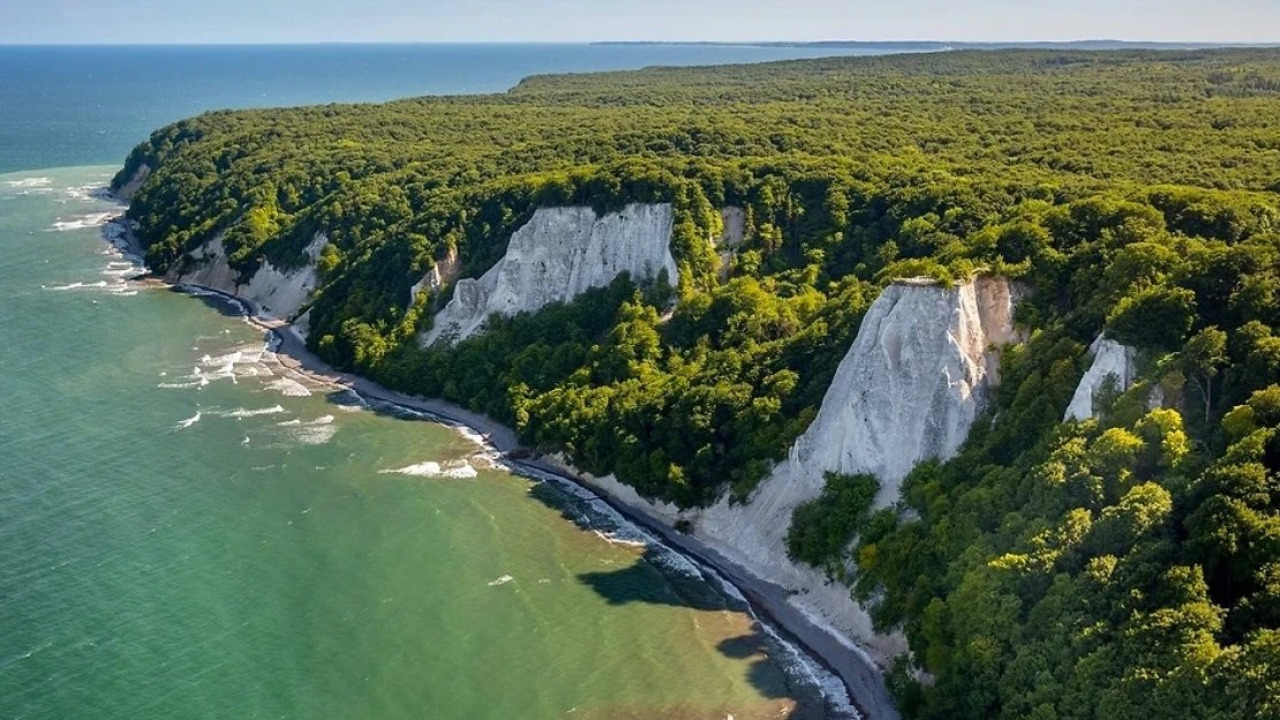
Jasmund National Park stretches across the peninsula between Sassnitz and Lohme, and despite its breathtaking beauty, it's Germany's smallest national park by area. Its backbone is the ancient beech forest on the Stubnitz ridge, with its highest point, Piekberg, reaching 161 meters. The iconic chalk cliffs are formed from calcareous micro-organism remains deposited on the seabed during the Cretaceous period, giving them their distinctive white, fragile surface. A 493-hectare section of the forest was inscribed as part of the multi-country UNESCO World Heritage site "Ancient and Primeval Beech Forests of the Carpathians and Other Regions of Europe" in 2011.
Königsstuhl and the Skywalk Platform
Königsstuhl (King's Chair) is the most famous protrusion of the chalk wall, rising 118 meters above sea level. The old viewing platform on the rock was replaced by the spectacular Skywalk, which opened on April 22, 2023: an elliptical platform hovering approximately 4 meters above Königsstuhl, 122 meters above the sea. Tickets include access to the exhibition at the national park center, a cinema show, and guided tours; the center is open daily except December 24, with hours varying by season (June-August 09:00-19:00, April-May & September-October 09:00-18:00, November-March 10:00-17:00).
Practical tip: Crowds peak around midday; it's more relaxed in the early morning or after 3:00 PM in summer. Buying tickets online can shorten your entry time.
Getting to the Center: Cars Stay Behind
Visitors cannot drive directly to the center. Cars must be left at the large parking lot in Hagen, from where shuttle bus number 19 takes you to Königsstuhl. Those arriving from Sassnitz can use line 23 from the station or the national park parking lot. For walkers, there's an approximately 3-kilometer forest path from Hagen, and about 8 kilometers from Sassnitz. Vehicles with a blue parking permit can drive up to the center.
Hochuferweg: Experiencing the Cliffs on Foot
The best way to grasp the sheer scale of the cliffs is by walking the Hochuferweg, a coastal ridge trail. The approximately 8-kilometer route from Sassnitz to Königsstuhl winds through the beech forest, offering intermittent viewpoints opening up to the sea. The terrain is rooty and muddy in places, so ankle-supporting footwear is essential. The cliff edge is constantly eroding; straying off the marked path violates conservation rules. Visitors wishing to see the white wall in its entirety might consider boat tours departing from Sassnitz harbor or Sellin Pier.
Coastal Resorts: Binz and Sellin
The island's eastern coast was shaped by the seaside bathing trend of the late 19th century. The distinctive Bäderarchitektur (resort architecture), characterized by white facades, wooden balconies, and ornate railings, still defines the appearance of these charming towns.
Binz and its Resort Architecture
Binz is the island's largest seaside resort, nestled where the sandy beach meets the forest. The villas lining the promenade have been beautifully restored and converted into guesthouses and apartments. A walk starting from the pier and extending towards the forest edge offers a comprehensive view of the town's unique character. Infrastructure here is extensive for families; an early morning stroll helps avoid the crowds.
Sellin Pier
Sellin is renowned for its 394-meter-long pier, the longest among the island's piers. The original structure, built in 1906, was 508 meters long and deteriorated over the years. The current pier was faithfully reconstructed to its historic design and opened in April 1998. The white pavilion at the pier's head is the town's symbol and houses a restaurant. Since 2008, a diving gondola at the end of the pier has taken visitors several meters deep into the Baltic Sea. The stairs leading down to the pier are steep; an alternative is to use the cliffside elevator.
Prora, Rasender Roland, and Hiddensee
Prora: A Concrete Legacy Parallel to the Coast
North of Binz, stretching for 4.5 kilometers just behind the beach, lie eight identical blocks, considered the island's most controversial structure. Prora was built between 1936 and 1939 for the National Socialist "Kraft durch Freude" (Strength Through Joy) organization, designed to accommodate approximately 20,000 guests simultaneously. Construction halted with the outbreak of war, and the complex was never used for its intended purpose. After 1945, some blocks were demolished, and the remaining ones were converted into military barracks. Today, the area holds monument status; a documentation center recounts the building's construction and history of use, and other museums are also on-site. It's worth dedicating two to three hours for visitors interested in recent European history.
Rasender Roland: The Raging Roland Narrow-Gauge Steam Train
In the island's southeast, this steam train, running on a 750-millimeter narrow-gauge track, began service on July 21, 1895, with its first 10.8-kilometer section between Putbus and Binz. The line was extended to Sellin, Baabe, and Göhren in subsequent years; daily services still operate on this route, with additional departures from Lauterbach Mole added for approximately 180 days a year. The train is deliberately slow, allowing passengers to soak in the passing forests and charming town entrances at a pace impossible by car. Taking one leg of your journey between two resorts by train is a delightful experience.
Hiddensee: The Car-Free Neighboring Island
Located west of Rügen, Hiddensee is a car-free island; access is by ferry, and bicycles and horse-drawn carriages are the primary modes of transport on the island. Ferries depart from Schaprode; the journey takes about 30 minutes to Neuendorf and approximately 45 minutes to Vitte and Kloster. The coastal marshes and migratory bird activity attract keen birdwatchers.
Practical tip: If you're planning a day trip, note the return ferry times upon departure; evening services become less frequent, and missing the last one means an unplanned overnight stay on the island.
Getting to Rügen from Turkey and Exploring the Island
Flights and Land Connections
Rügen does not have its own commercial airport. For travelers coming from Turkey, the most practical gateways are Berlin and Hamburg airports. From both cities, you can continue to the island by long-distance train or car. Intercity services run via Stralsund and Bergen auf Rügen all the way to Binz. Travel times vary seasonally, so check the current timetable on the official website of the German railways.
Crossing to the Island: Rügendamm and Rügenbrücke
The island is connected to the mainland via Stralsund by two separate structures. The Rügendamm, completed in 1936-1937, carries the old B96 highway, the railway line between Stralsund and Sassnitz, and a shared pedestrian-bicycle path; it features a movable bridge section that opens for large vessels. The Rügenbrücke, opened in 2007, is dedicated to motorized traffic and serves as the main structure of the approximately 4.1-kilometer crossing, with its two pylons reaching nearly 130 meters. Be prepared for queues before the bridge during peak season.
Getting Around the Island
Regional trains connect Bergen auf Rügen to Binz and Sassnitz, while bus lines link the various towns. Cycling is a strong option due to the island's gently undulating topography. Renting a car isn't strictly necessary; in Jasmund, your vehicle will be left in the parking lot anyway, so a combination of public transport and cycling is sufficient for most itineraries.
When to Visit Rügen Island
The island is at its most vibrant between May and September, but the best time to visit depends on what you're looking for.
| Period | What to expect | Best for |
|---|---|---|
| April - May | Cool weather, longer days, lower crowds | Hiking and photography trips |
| June - August | Mild weather, long daylight hours, busy beaches and accommodation | Beach and family holidays |
| September - October | Fewer crowds, changing forest colors, variable winds | Nature walks, relaxed itineraries |
| November - March | Short days, strong winds, many coastal businesses closed | Winter coastal escapes and tranquility |
July and August are the months when accommodation sells out fastest; book months in advance. September is a balanced month for hiking and boat tours.
Baltic Cuisine: What to Eat on the Island
The island's cuisine is a northern German interpretation, with seafood at its heart. The first must-try delicacy is Fischbrötchen: this sandwich, featuring fresh herring or salmon with onions and lettuce in a crispy bun, is the standard on-the-go lunch at pierheads. Smoked fish stalls are common in harbor towns; often, the very hut where the fish is smoked doubles as the sales point.
On the sweet side, the region's signature fruit is sea buckthorn (sanddorn); these orange berries appear in jams, syrups, and pastries. Game meat and seasonal vegetables are frequently seen on evening menus. Restaurants in coastal resorts tend to close early in the evening, so don't delay your dinner plans. For readers considering adding Southern Europe to their itinerary, our Italy travel guide can help with regional planning.
Cliffs in the Morning, Pier in the Evening: A Four-Day Itinerary
The following itinerary is designed for a four-day program based in Binz or Sellin; transfers can be made using public transport.
- Day 1: Settle into your chosen resort, stroll along the beach promenade, and end your evening at the tip of Sellin Pier.
- Day 2: Take the shuttle bus from Hagen parking lot to Königsstuhl, explore the Skywalk and visitor center, and walk a section of the Hochuferweg on your return.
- Day 3: Visit the documentation center and museums in Prora, then take a leg of the Rasender Roland towards Göhren in the afternoon.
- Day 4: Take a ferry from Schaprode to Hiddensee, explore the island by bike, and return on the evening ferry.
If you're compressing the program into three days, omit the Hiddensee day. If you're extending to five days, add a dedicated beach day and a boat tour.
| Stop | Recommended Duration | Timing Note |
|---|---|---|
| Königsstuhl and Skywalk | 2-3 hours | Quieter in the early morning or after 3:00 PM in summer |
| Hochuferweg (towards Sassnitz) | Half-day | Approximately 8 km one way, return by bus |
| Sellin Pier | 1-2 hours | Sunset hours offer the most picturesque views |
| Prora | 2-3 hours | Museums are open midday, morning visit is relaxed |
| Rasender Roland | 1-2 hours | Departures are infrequent, plan according to the timetable |
| Hiddensee | Full day | Note return ferry times upon departure |
Bütçede toplamı belirleyen şey konaklama süresi, ulaşım biçimi ve müze girişlerinin sayısıdır. Kalemleri şu sırayla düşünün: uçuş, Almanya içi tren ya da otomobil, konaklama, günlük kur katkısı, müze biletleri, vapur ile dar hat treni biletleri, yeme-içme. Güncel tutarlar için kurumların resmi sayfalarını kullanın; toplu taşıma ve tatil dairesi tercihi, bütçe dostu program kurmanın iki etkili kararıdır.
Çantada bulunması işe yarayanlar:
- Ankle-supporting, non-slip hiking shoes; forest terrain is rooty and can be wet.
- Windproof, waterproof outer layer; coastal weather can change several times a day.
- Layered clothing for warmth; evenings can feel cool even in summer.
- Water bottle and snacks; sales points within the park are limited.
- Offline map and screenshot of timetables; mobile coverage can be weak in the forest.
- Binoculars; useful for birdwatching along the cliff coast and on Hiddensee.
What truly defines Rügen is the ability to combine a geology lesson, an architectural tour, and a nature hike all in one day. The chalk cliffs are best experienced early in the morning, while the piers shine brightest in the late afternoon. For travelers seeking a similar blend of nature and coastal charm in Turkey, our Turkey nature and adventure tours category offers a great starting point, and for those interested in history-rich itineraries, our Turkey cultural tours category is an excellent resource.
Frequently Asked Questions 5
How do I get to Rügen Island from Turkey?
The island does not have its own commercial airport. The most practical way is to fly to Berlin or Hamburg and continue by train or car. Intercity services go via Stralsund and Bergen auf Rügen to Binz; those arriving by car cross to the island from Stralsund via Rügendamm or Rügenbrücke.
How do I reach Königsstuhl and the chalk cliffs?
Visitors cannot drive directly to the national park center. Cars must be left at the Hagen parking lot, and shuttle bus number 19 takes you to Königsstuhl; line 23 is used from Sassnitz. For walkers, there's an approximately 3-kilometer forest path from Hagen, and about 8 kilometers from Sassnitz.
How many days are enough to visit Rügen Island?
Three days are sufficient to see Jasmund National Park and one or two coastal resorts. For those wishing to include Prora, Rasender Roland, and Hiddensee in their itinerary, four to five days offer a more balanced experience. Island distances are short, but the pace of travel is leisurely.
Is it necessary to rent a car on Rügen?
It is not necessary. Regional trains connect Bergen auf Rügen to Binz and Sassnitz, bus lines link the towns, and bicycle routes are widespread. In Jasmund, cars are left in the parking lot anyway, so a combination of public transport and cycling is sufficient for most itineraries.
What is the best time to visit Rügen Island?
May to September is generally the most favorable period. July and August are suitable for beaches but are busy, and accommodation sells out early. September is when crowds thin out; April and May offer a quiet window for photography and nature excursions.