
Most travelers stepping through the ancient gates feel as if time has stood still. Yet, Rothenburg ob der Tauber's true story isn't about standing still, but about standing strong—twice over. On March 31, 1945, a bombing raid, veering off its primary target, devastated approximately 40% of the old town. City archives record the destruction of 306 houses, 9 towers, and over 610 meters of the town wall, claiming 39 lives. The picturesque perfection you see in postcards today is the result of decades of meticulous reconstruction following that devastation. This guide is designed to help you appreciate the town in its two layers: the enduring medieval fabric and the new structures carefully integrated alongside it. Your journey begins with a walk along the walls, followed by the legend of the town square's clock, and the exquisite wooden altarpiece in the church.
Quick Facts
| Topic | Information |
|---|---|
| Location | Bavaria, Middle Franconia; on a slope above the Tauber Valley |
| Key Attractions | Stadtmauer (Town Wall), Marktplatz (Market Square) & Rathaus (Town Hall), Plönlein, St. Jakob's Church, Burggarten (Castle Garden) |
| Wall Circumference | Approximately 4 kilometers; Turmweg walk takes about 2.5 hours |
| Wall Access | Largely open all day and free of charge |
| Tower Climbs | Rathausturm 220 steps; Röderturm 103 steps |
| Christmas Period | Reiterlesmarkt, November 20 - December 23, 2026 |
| Nearest Airport | Nürnberg, approximately 90 kilometers |
| Recommended Stay | 2 days with 1 overnight stay |
What Makes Rothenburg Stand Out Among Medieval Towns?
Germany boasts many walled towns, but Rothenburg's unique charm lies in its unbroken defensive ring. Unlike others with fragmented fortifications, Rothenburg's nearly four-kilometer wall completely encircles the town, with much of it accessible for walking. The town also sits at the heart of the famous Romantische Straße (Romantic Road) route, stretching between Würzburg and Füssen.
Destruction and Reconstruction: The Rothenburger Way
The scars of the 1945 bombing were most concentrated in the northeastern section. Reconstruction followed principles outlined by the city archives as the "Rothenburger Weg" (Rothenburg Way): neither a direct copy nor unrestrained modernization. New buildings were designed to harmonize with the old fabric in volume, form, and spirit, without concealing their contemporary origins. If you notice familiar facade proportions and understated details in the northeastern streets, you're looking in the right place.
UNESCO Status: Not on the List, Candidacy Continues
A common misconception about the town is that Rothenburg is on the UNESCO World Heritage List. It is not. According to city archive documents, Rothenburg, along with Dinkelsbühl and Nördlingen, was on the tentative list between 1984-1993. An application made via Bavaria in 2011 was unsuccessful, and candidacy efforts continue today under a new heading.
What to Expect Season by Season
Access to towers and museums varies by season.
| Period | Town Status | Planning Note |
|---|---|---|
| April - May | Rathausturm daily, Röderturm weekends & holidays | Days lengthen, moderate crowds |
| June - August | Widest access, Röderturm daily | High density during midday |
| September - October | Rathausturm daily, Röderturm weekends | Softer light, easier accommodation |
| November | Tower hours shift to weekends | Quiet window before Reiterlesmarkt |
| Nov 20 - Dec 23, 2026 | Reiterlesmarkt (Christmas Market) open | Weekdays are less crowded |
| January - March | Reduced hours, Night Watchman tour Saturdays | Wall walk remains open and free |
Reiterlesmarkt and December Crowds
The town's Christmas market is called Reiterlesmarkt, and its opening day begins with a ceremony: a mounted figure first appears in the square, followed by the mayor's greeting and the lighting of the grand Christmas tree. The market spreads across Marktplatz, Grüner Markt, and the church square, featuring 61 stalls according to official information. Dates vary year to year: the 2026 season is planned between November 20 and December 23, and it is closed on Totensonntag (Sunday of the Dead). Those wishing to avoid crowds should aim for weekday mornings.
Above the Walls: Turmweg, Röderturm, and Spitalbastei
A practical way to grasp the town's layout is to view it from above before descending into its streets. The town wall offers this perspective free of charge.
Turmweg: The Wall Walk Encircling the Town
The Turmweg is an approximately four-kilometer wall walk that encircles the old town, taking about 2.5 hours to complete, according to official information. Along the route, information panels across 42 towers narrate the town's history. The majority of the wall walk is open all day and free of charge. The section starting from Rödertor, proceeding towards Wolfgangskirche, and then via Burggarten to the Spital district, is considered the most scenic and fluid part.
Röderturm and Spitalbastei
The Röderturm is the tower on the wall accessible for visitors. A climb of 103 steps leads to the tower chamber, offering panoramic views of the old town, including the Markusturm, known for its stork's nest. Opening hours are seasonal: 11:00-14:00 on weekends and holidays in April, May, September, and October; daily 11:00-14:00 from June to August; and subject to weather conditions from November to March.
At the southern end, the Spitalbastei stands as the latest and most robust link in the town's defensive system. This double bastion, resembling the number eight, was originally designed with seven gates, a gate cage, and a drawbridge. The inscription above the gate, "Pax intrantibus, salus exeuntibus," wishes peace to those entering and well-being to those departing. For those who enjoy exploring walled towns on foot and are seeking similar historical city experiences in Turkey, you might want to check out our historical city tours in Turkey category.
Must-See Sights Within the Town
This itinerary is structured as an inner loop, starting from the main square and concluding at the garden overlooking the valley.
Marktplatz (Market Square), Rathaus (Town Hall), and the Kunstuhr (Art Clock)
The Rathaus in the market square showcases two distinct eras on its facade. The rear section is the original Gothic structure. The front portion, added after a fire in 1501, was built in the Renaissance style during the 16th century, with the Baroque arcade completed in 1681. A climb of 220 steps leads to the tower's observation platform, offering views of the rooftops and the encircling town walls from approximately 60 meters up. Access is daily from 09:30-12:30 and 13:00-17:00 between April and October; weekends from 12:00-15:00 from November through January-March; and daily from 10:30-14:00 and 14:30-18:00 during the Reiterlesmarkt period.
On the facade of the old Ratstrinkstube (Council Drinking Tavern), a mechanical clock has been operating since 1910. Its windows open every hour on the hour between 10:00 and 22:00, reenacting the "Meistertrunk" (Master Draught) scene. According to legend, in 1631, former mayor Georg Nusch saved the town by drinking a nearly 3.25-liter tankard of wine in one go before Commander Tilly. Historical records do not confirm this event; it remains a legend. The play has been performed during the Pfingsten (Pentecost) period since 1881 and is recorded in Germany's inventory of intangible cultural heritage.
Plönlein and the Kobolzeller Tor Line
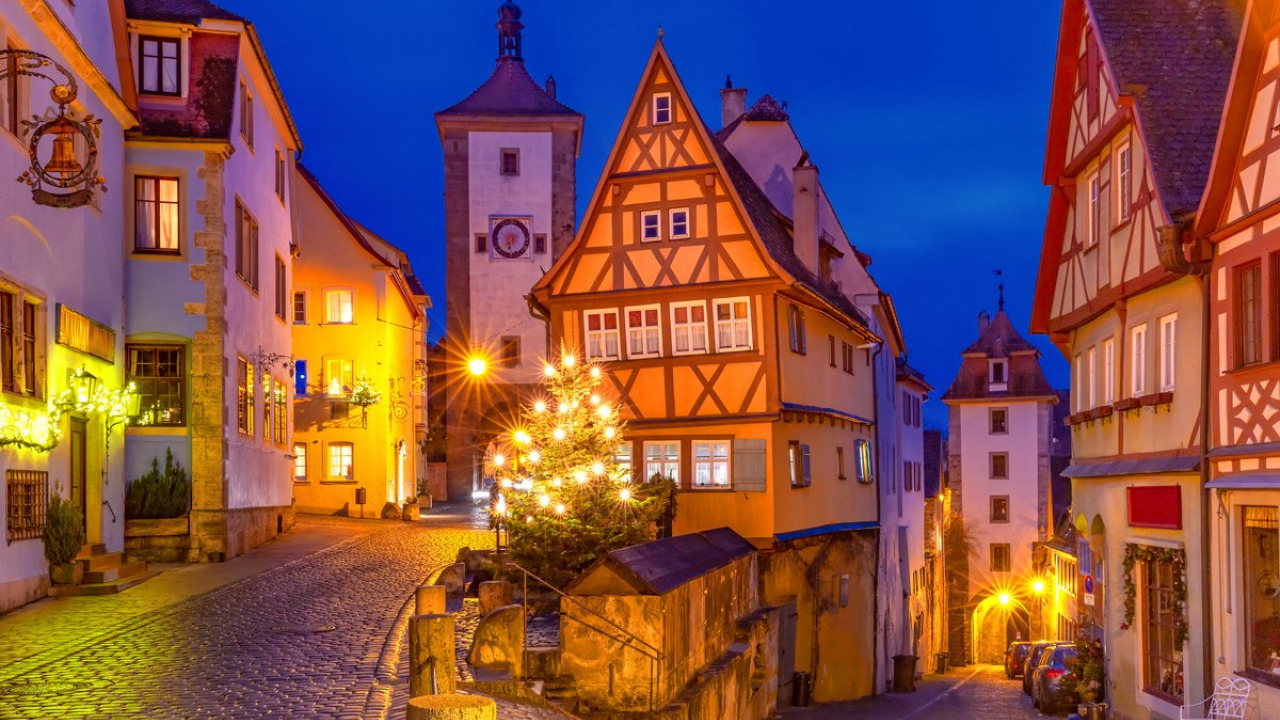
The iconic Plönlein square is the image you'll encounter repeatedly in the town's promotional materials. This picturesque spot stands at the intersection of three old streets: Spitalgasse, Kobolzeller Steige, and Untere Schmiedgasse. The descending path leads to the Kobolzeller Tor, built around 1360, and then opens into the Tauber Valley. The ascending path passes through Siebersturm to reach the Spital district. Crowds fill the square midday, but the street remains empty in the early morning hours. If you venture down into the valley, remember that the return journey is uphill.
St. Jakob's Church and the Heilig-Blut-Altar
The construction of St. Jakob's Church spanned a long period: the east choir was completed between 1311-1322, the main nave from 1373-1436, and the west choir from 1450-1471. The structure was consecrated by the Bishop of Würzburg in 1485 and passed to the Evangelical congregation after 1544. The Heilig-Blut-Altar (Altar of the Holy Blood) in the west choir is a masterpiece by the Würzburg woodcarver Tilman Riemenschneider; the contract was signed on April 15, 1501, and the work continued until 1505. The artist placed the relic of the Holy Blood at the altar's center, carving the Last Supper scene around it. The structure underwent extensive restoration between 2005-2011 and reopened for the church's 700th anniversary. Visits are generally possible from 10:00-18:00, with earlier closing on Wednesdays and Saturdays. Schedules change on days of worship, and an entrance fee applies. For those interested in medieval church architecture and woodcarving art and seeking similar cultural experiences in Turkey, you can explore our cultural tours in Turkey category.
Medieval Crime and Justice Museum
Located in Burggasse, the Medieval Crime and Justice Museum has been housed in a former Johanniter building since 1977, covering a millennium of European legal history. The collection features over two thousand objects, including trial documents, shaming masks, instruments of punishment, and visual materials illustrating the societal response to crime. The subject is presented within the context of legal history, not as a mere tourist spectacle. Visits are generally possible daily from 10:00-18:00, with the last entry shortly before closing; exploring the entire collection can take several hours.
German Christmas Museum and Christmas Shop
The German Christmas Museum is located on the upper floor of the Christmas shop in Herrngasse. The exhibition features historical Christmas trees, evolving decoration trends through different periods, candle arches known as Schwibbögen, a collection of nutcrackers, and antique Advent calendars. The museum is generally open from 10:00-17:00, with reduced hours from mid-January to March. It offers an off-season Christmas experience for visitors arriving outside of December.
Burggarten (Castle Garden) and Tauber Valley View
At the western end, the Burggarten is a garden laid out in the 19th century on the site of the former Stauferburg castle. It is believed that the castle was severely damaged in the 1356 Basel earthquake, though the extent of the destruction remains debated among researchers. The surviving structure is the Blasiuskapelle, which preserves Romanesque fragments of the old palace within. From the western edge of the garden, you can see both the Tauber Valley and the outer wall line. As the late afternoon light illuminates the valley from end to end, this spot serves as an excellent final stop for the day.
Start Your Morning on the Walls, End Your Evening with the Night Watchman
The elevation changes between stops can be tiring; the following sequence makes a two-day itinerary efficient.
- On your first morning, ascend the wall walk from Rödertor and traverse the northern section of the Turmweg; this allows you to see the town from above before the crowds gather.
- Descend from the wall walk to Marktplatz, watch the Kunstuhr open on the hour, then climb the 220 steps of the Rathausturm.
- Dedicate your afternoon to Plönlein and the Kobolzeller Tor line via Untere Schmiedgasse; on your return, explore the inner courtyard of Spitalbastei.
- After dinner, join the Night Watchman's tour, which gathers in front of the Rathaus; the English tour starts at 20:00, the German tour at 21:30, and both last approximately 60 minutes.
- On the morning of your second day, visit St. Jakob's Church and the Heilig-Blut-Altar, then proceed towards Burggasse to the Medieval Crime and Justice Museum.
- In the afternoon, stop by the Christmas Museum in Herrngasse and conclude your day at the Burggarten with its valley views.
Dining and Accommodation in Rothenburg
Dining and accommodation options are closely tied to the town's daily rhythm.
Schneeballen and Franconian Cuisine
The pastry most synonymous with Rothenburg is the Schneeballen (Snowball). Shortcrust pastry is cut into strips, wrapped around a special mold, deep-fried, and then dusted with powdered sugar, taking its name from its spherical shape. This centuries-old Franconian dessert is available year-round in bakeries and patisseries, with chocolate and hazelnut-coated varieties also popular. Portions are generous, so sharing one is often more comfortable. The rest of the local cuisine features baked meat dishes, seasonal vegetables, regional wines, and local beer.
Staying Inside or Outside the Walls?
The primary decision for accommodation is choosing your area. Staying within the historic walled town offers advantages for evening and morning hours: the square empties after day-trippers depart, and the Night Watchman's tour and early morning wall walk are within easy walking distance. However, a night driving restriction is enforced in the old town center between 19:00 and 06:00; while vehicle access to hotels and businesses is possible, inquire about parking arrangements in advance. The peripheral areas outside the walls offer convenient parking and a concentration of budget-friendly options, but evening activities will involve a longer walk. Guesthouses in surrounding villages provide tranquility but require a car for transport.
Getting to Rothenburg from Turkey and Arriving in Town
There are no direct flights to Rothenburg; travel involves transfers.
Airports and Train Transfers
According to official tourism information, distances to the town are as follows: Nürnberg 90 kilometers, Stuttgart 165 kilometers, Frankfurt am Main 175 kilometers, Munich 240 kilometers. Scheduled flights from Turkey are available to these airports, with the shortest land connection typically established via Nürnberg. Those arriving by train should take a main line train to Würzburg or Ansbach, then transfer to a regional train via Steinach to Rothenburg. The short line between Steinach and Rothenburg operates hourly and takes approximately 15 minutes; as transfer windows can be tight, check connections on bahn.de on the day of travel.
| Departure Point | Distance | Connection |
|---|---|---|
| Nürnberg Airport | 90 km | Train via Ansbach or car |
| Stuttgart Airport | 165 km | Train via Ansbach or car |
| Frankfurt am Main Airport | 175 km | Train via Würzburg or car |
| Munich Airport | 240 km | Train via Ansbach or car |
| Steinach Station | Regional line | Hourly, approx. 15 minutes |
Arriving by Car and Parking Information
Those arriving by car should use the A7 autobahn (Würzburg-Ulm route) and take exit 108, "Rothenburg/Tauber." Signposts will lead you to parking areas approximately two kilometers later. There are five large, signposted parking lots outside the town walls, from which the old town is just a few minutes' walk away. Visa requirements vary by nationality and are updated periodically; please confirm with the relevant German official representation's website before traveling.
Practical Notes Before Your Visit
- The streets are cobbled and uneven in places; closed-toe shoes with good grip will make your exploration easier.
- Tower stairs are narrow and steep; carrying your backpack in front can reduce congestion.
- Main attractions are within walking distance, but daily walking can easily exceed eight kilometers.
- Museum and tower hours vary by season; confirm schedules on official websites before finalizing your itinerary.
- Accommodation fills up quickly in December and on summer weekends; book well in advance if you plan to stay within the walls.
- Strollers can be challenging on narrow sidewalks; a foldable pushchair is more practical.
- Those curious about German traveler habits can read our article on German tourist profiles, and those extending their route south can check out our Italy travel guide.
Frequently Asked Questions 6
How many days are needed to visit Rothenburg ob der Tauber?
Main attractions can be covered in one day, but two days with an overnight stay allow for a more relaxed exploration of the town. The square empties when day-trippers leave in the evening; the Night Watchman's tour and an early morning wall walk are available to those staying overnight.
How do I get to Rothenburg?
There are no direct flights. The nearest airport is Nürnberg, approximately 90 kilometers away; Stuttgart is 165 km, Frankfurt am Main 175 km, and Munich 240 km. Those arriving by train should take a main line train to Würzburg or Ansbach, then continue via regional train through Steinach. This line operates hourly and takes about 15 minutes. Those arriving by car should use exit 108 of the A7 autobahn.
Is walking on Rothenburg's walls free?
Most of the wall walk is open all day and free of charge. The approximately four-kilometer Turmweg route takes about 2.5 hours, according to official information, and is supported by information panels across 42 towers. Fees apply for tower climbs and museum entrances; the Rathausturm has 220 steps, and the Röderturm has 103 steps.
When does Rothenburg's Christmas market (Reiterlesmarkt) open?
The opening date for Reiterlesmarkt varies year to year. The 2026 season is planned between November 20 and December 23 and is closed on Totensonntag. Hours are 11:00-19:00 from Sunday to Thursday, and 11:00-20:00 on Friday and Saturday; 61 stalls are spread around Marktplatz.
Is Rothenburg on the UNESCO World Heritage List?
No, the town is not on the list. According to city archive documents, Rothenburg, along with Dinkelsbühl and Nördlingen, was on the tentative list between 1984-1993. An application made via Bavaria in 2011 was unsuccessful, and candidacy efforts continue today under a new heading.
Is Rothenburg suitable for families with children?
Yes, it is suitable. The wall walk, tower climbs, and Christmas museum are engaging for children. However, cobbled streets and narrow wall stairs can be challenging for strollers; a foldable pushchair is more practical. Some parts of the Medieval Crime and Justice Museum might be too intense for younger children.