The proclamation of the Republic wasn't just a change of regime for Turkey; it also signified a profound reimagining of public spaces. The most visible way to convey the new era's ideals to the masses was through monumental sculptures erected in city squares. Istanbul, the former Ottoman capital, became the initial stage for this transformation, soon followed by Ankara and other cities across the country. Today, these works, stretching from Sarayburnu to Taksim, Beşiktaş, and beyond to the capital, stand as open-air chronicles not only of the evolution of sculpture but also of Turkey's modernization journey.
This guide delves into Istanbul's Republican Era monumental sculptures, exploring their history, sculptors, and locations. We'll provide a half-day walking itinerary, transportation options, and insights into the symbolism that brings these powerful monuments to life.
Quick Facts
| Topic | Information |
|---|---|
| City | Istanbul |
| Period | Republican monuments from 1923-1946 |
| First Example | Sarayburnu Atatürk Statue, October 3, 1926 |
| Iconic Monument | Taksim Republic Monument, August 8, 1928 |
| Prominent Sculptors | Heinrich Krippel, Pietro Canonica, Ali Hadi Bara, Zühtü Müridoğlu |
| Materials | Bronze figures; stone, granite, and porphyry-clad pedestals |
| Admission Fee | Monuments are in public spaces, free of charge |
| Recommended Duration | Half-day, approximately 3-4 hours |
| Best Time to Visit | Early morning or sunset |
| Transportation | T1 tram, M2 metro, F1 funicular, ferry |
What is a Monumental Sculpture, Why Did the Republic Turn to Squares?
Definition of a monumental sculpture
A monumental sculpture is a statue placed in public spaces like parks, squares, streets, and avenues to commemorate an event or a person. This definition also explains what distinguishes it from a sculpture inside a museum: a monumental sculpture doesn't choose its audience; it becomes part of the daily routes of city dwellers. Therefore, the height of the pedestal, the direction of the figure's gaze, and the surrounding open space are as much urban decisions as they are artistic ones.
The visual language of the new regime
After 1923, sculpture was considered one of the tangible indicators of the goal of modernization. The scarcity of figurative sculpture in public spaces during the Ottoman era made the decision to erect monuments in squares a bold move. These monuments not only presented a portrait to the public but also demonstrated that art and aesthetics could indeed occupy public spaces. Nearly every city desired an Atatürk monument, and their unveilings transformed into enthusiastic ceremonies with widespread public participation. In a multi-layered city like Istanbul, these monuments served to integrate a modern identity into the historical fabric.
Istanbul's First Step: Sarayburnu Atatürk Statue
From a Vienna workshop to Sarayburnu
The first Atatürk statue erected in Turkey is located in Istanbul. Completed in the Vienna workshop of Austrian sculptor Heinrich Krippel, the work was unveiled on October 3, 1926, after an approximately fourteen-month construction period, with a ceremony led by the then-mayor Emin Erkul. Istanbulites showed immense interest in the monument.
It's particularly significant that the statue depicts Atatürk in civilian clothes, emphasizing his image as a statesman and citizen rather than solely a military leader. Thanks to the persistent initiative of the local government, Istanbul became the first city to have an Atatürk statue.
A revolutionary evening in the same park
Sarayburnu, where the statue stands, witnessed one of the turning points in Turkish history two years later. On the evening of August 9, 1928, during a meeting in Sarayburnu Park, Atatürk introduced the new Turkish alphabet to the public, announcing the Alphabet Revolution. Remembering that this very spot hosted such a pivotal speech while visiting the statue in Sarayburnu Park, now connected by a bridge to Gülhane Park, adds a profound layer to your journey.
Travel Tip: Enter Gülhane Park from the Alemdar Caddesi gate, walk through the park towards the shore, and cross the bridge to Sarayburnu Park. This route allows you to reach the statue with stunning Bosphorus views. Early morning is ideal to avoid both crowds and harsh sunlight.
Taksim Republic Monument: The Centerpiece of the Square
The two faces of the monument
Istanbul's iconic Republican monument stands proudly in Taksim Square. Based on a model prepared by Italian sculptor Pietro Canonica and approved by the Ministry of National Education, a commission chaired by the Mayor of Istanbul decided on December 1, 1926, to commission the monument. It was unveiled on the evening of August 8, 1928, in a ceremony attended by approximately 30,000 people, officiated by the Speaker of the Grand National Assembly, Kâzım Paşa.
Canonica's design is based on the idea of a Turkish gate rising on a pedestal. One face of the gate depicts the National Struggle period, while the other illustrates the proclamation of the Republic. On the southern face, Gazi Mustafa Kemal stands in the center, flanked by Prime Minister İsmet Paşa and Chief of General Staff Marshal Fevzi Çakmak. On the same face, behind İsmet Paşa and Fevzi Çakmak, two Soviet commanders, Mihail Frunze and Kliment Voroshilov, are depicted. This detail, interpreted as a gesture for Soviet support during the National Struggle years, transforms the monument from a mere portrait group into a diplomatic document of its era.
Pedestal, materials, and landscaping
The monument's 7-meter-high pedestal was entirely constructed from concrete, then clad with granite and red porphyry. The design of the pedestal and the surrounding landscaping was entrusted to Italian architect Giulio Mongeri, with Canonica's approval. Two young Turkish artists, Hadi Bara and Sabiha Bengütaş, assisted Canonica in the monument's creation; this collaboration became a direct workshop education for the first generation of Turkish sculptors.
Travel Tip: Walk around the monument first from the Cumhuriyet Caddesi side, then from the square side. Reading the two faces separately reveals the narrative logic of the design. Since the square is illuminated at night, evening hours are excellent for photography.
From Beşiktaş to the Capital: A Monument Map of the Era
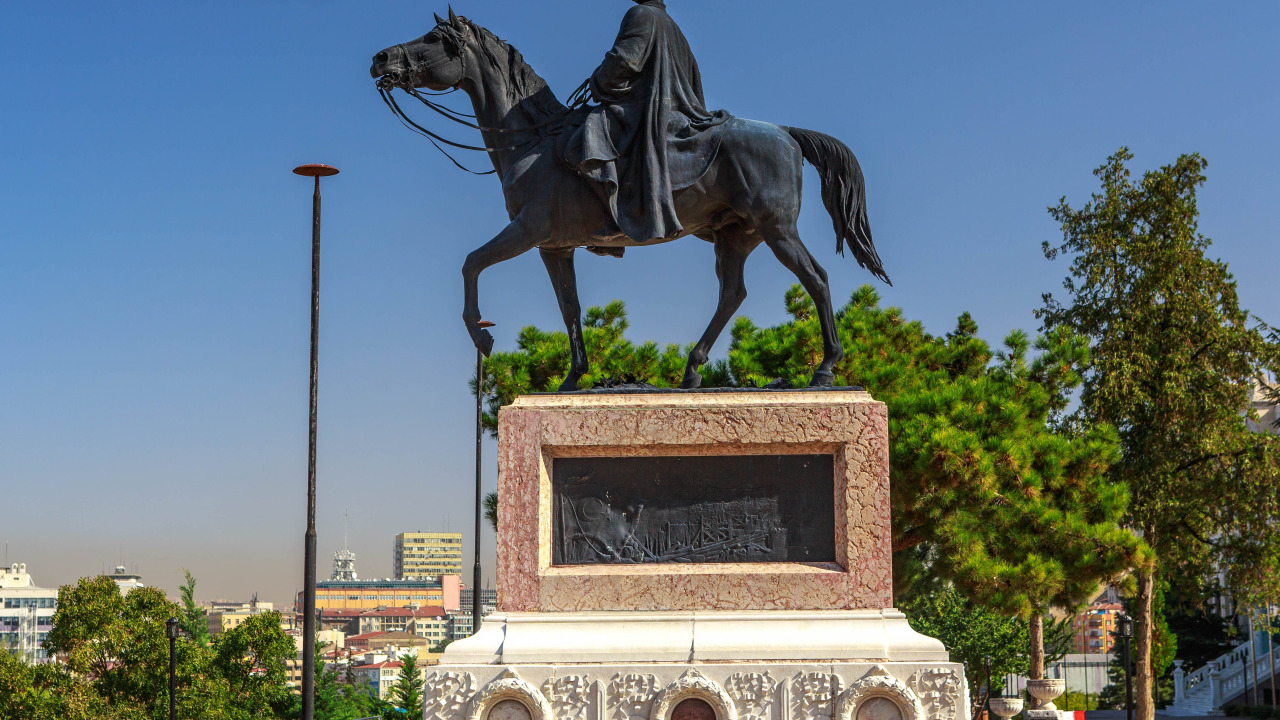
Republican monuments weren't confined to Istanbul. Following the first monumental sculpture erected in Istanbul, monuments rapidly proliferated in Ankara, which was being developed as the modern capital. The first example there was the Equestrian Atatürk Monument in front of the Ethnography Museum. The table below roughly maps the period and offers a chance to compare Istanbul's works with their contemporaries in the capital.
| Monument | Location | Sculptor | Year | Materials |
|---|---|---|---|---|
| Sarayburnu Atatürk Statue | Sarayburnu Park, Fatih | Heinrich Krippel | 1926 | Bronze figure, stone pedestal |
| Taksim Republic Monument | Taksim Square, Beyoğlu | Pietro Canonica | 1928 | Bronze, granite and red porphyry-clad pedestal |
| Barbaros Monument | Barbaros Park, Beşiktaş | Zühtü Müridoğlu and Ali Hadi Bara | 1944 | Bronze figures, stone pedestal |
| Equestrian Atatürk Monument | In front of the Ethnography Museum, Ankara | Pietro Canonica | 1927 | Bronze |
| Güvenlik Anıtı | Güvenpark, Ankara | Anton Hanak and Josef Thorak | 1935 | Bronze and stone |
The Barbaros Monument, the latest dated of Istanbul's entries in the table, is one of the largest works of its period in terms of scale. Prepared by Zühtü Müridoğlu and Ali Hadi Bara between 1941-1943, the monument was erected in 1944; the bronze casting was undertaken by Yusuf Akpınar and Ali Haydar Seymen. The work, with a total height of 11.50 meters, features Barbaros Hayreddin Paşa and two levent (Ottoman marine) figures standing on a pedestal resembling a ship. The pedestal bears lines from a poem by Yahya Kemal Beyatlı. The monument is located in Barbaros Park, right next to the Tomb of Barbaros Hayreddin Paşa; visiting the tomb and the monument together reveals how the Ottoman and Republican narratives converge in the same corner.
The Sculptors Behind the Monuments
European masters
European sculptors played a significant role in the early monuments of the Republic. Heinrich Krippel, in addition to Istanbul's Sarayburnu, also created monuments in Ankara and Samsun. Pietro Canonica, alongside the Taksim Republic Monument, defined the visual language of the era with his works in the capital. German sculptor Rudolf Belling, meanwhile, took charge of the sculpture department at the Academy of Fine Arts in Istanbul in 1937 and restructured the curriculum throughout his tenure until 1954. Belling's 1938 design for an Atatürk monument for Istanbul University, however, remained unimplemented, serving as an example of how some projects of the period stayed on paper.
The first Turkish generation
Local artists largely trained in these workshops. Ali Hadi Bara worked alongside Canonica on the Taksim Republic Monument; years later, he produced the Barbaros Monument with Zühtü Müridoğlu. Sabiha Bengütaş, also involved in the Taksim project, is remembered as one of the first female names in Turkish sculpture. Nusret Suman, on the other hand, created Atatürk monuments in many cities from Tokat to Gaziantep; the bust of Fatih Sultan Mehmet in the garden of Galatasaray High School is an example showcasing his distinctive style in portrait sculpture. This generation formed the bridge between imported mastery and the effort to establish a local school of art.
Symbols and Iconography in the Monuments
Republican monuments are readable works of art. The reliefs on the pedestals and the objects carried by the figures summarize the ideas the era sought to convey. Taking a few minutes in front of a monument to observe these details will transform the quality of your visit:
- Sword and soldier figure: Narrative of the National Struggle and liberation
- Torch: Emphasis on enlightenment, education, and teaching
- Wheat ear and agricultural tool: Emphasis on Anatolia's development and production
- Flag and victory wreath: Assertion of the new state's sovereignty
- Pedestal and architectural framework: The surface supporting the figure was treated as a distinct design challenge in most monuments
The attire of the figures is also a deliberate choice. A leader depicted in civilian clothes versus a uniformed commander conveys two distinct messages from the same period. The difference between the Sarayburnu statue and the Taksim Republic Monument is the most concrete example of this interpretation.
How to Get There? Half-Day Monument Route
It's entirely possible to combine Istanbul's three main stops into a half-day itinerary. The following sequence adheres to both chronological order and logical transportation:
- Enter Gülhane Park from the Alemdar Caddesi gate, descend to the shore, cross the bridge to Sarayburnu Park, and begin with the Atatürk Statue; allocate approximately 45 minutes for this stop.
- From the Gülhane stop, take the T1 tram towards Kabataş.
- From Kabataş, take the F1 funicular up to Taksim and explore both faces of the Republic Monument separately.
- Descend from Taksim to Kabataş, then follow the coastal line to Beşiktaş; the Barbaros Monument is in Barbaros Park, right next to the tomb.
- Conclude your route with a ferry ride departing from Beşiktaş pier; seeing the monuments from the sea helps to grasp their urban scale.
| Stop | Transportation | Note |
|---|---|---|
| Sarayburnu Park, connected to Gülhane | T1 tram, Gülhane stop | Gülhane entrance is on the Alemdar Caddesi side |
| Taksim Square | M2 metro Taksim stop or F1 funicular from Kabataş | The square is illuminated at night |
| Barbaros Monument, Beşiktaş | Beşiktaş ferry pier and bus stops | The monument is in Barbaros Park, right next to the tomb |
Visitors who wish to hear the stories behind the monuments with a guide can choose from Istanbul cultural routes that combine square and museum stops. For those looking to integrate this itinerary with the city's walls, mosques, and palaces, Istanbul historical city tours offer a suitable framework. Travelers with limited time in the city can select a half-day option from Istanbul day trip cultural programs to fit these three stops into a single plan.
Preservation and Current Value of the Monuments
Republican Era monuments are today considered part of urban heritage. Many of these works have lost some of their original impact due to their surroundings being gradually encroached upon over time, demonstrating that preservation is more than just surface cleaning. The open space around a monument, the approach distance, and the viewing angle are as much a part of the design as the artwork itself.
The patina that forms on bronze surfaces requires regular maintenance due to air pollution and salty sea air; for stone pedestals, water ingress and joint issues are prominent. When restoration methods that preserve the original texture are preferred, the artist's handiwork and the craftsmanship of the period become visible once again.
For visitors, the implication is simple. Don't just settle for photographing the monuments from afar; approaching the pedestal reliefs reveals the layers of information embedded within the work. This route, stretching from Taksim to Sarayburnu and then to Beşiktaş, adds the public face of the Republic to the classic Istanbul itinerary of exploring walls, mosques, and palaces.
Frequently Asked Questions 6
Who created the Taksim Republic Monument and when was it unveiled?
The Taksim Republic Monument is the work of Italian sculptor Pietro Canonica. A commission chaired by the Mayor of Istanbul decided on December 1, 1926, to have the monument built according to Canonica's model. It was unveiled on the evening of August 8, 1928, in a ceremony attended by approximately 30,000 people, officiated by the Speaker of the Grand National Assembly, Kâzım Paşa.
Who created Atatürk's first statue?
The first Atatürk statue erected in Turkey is the Sarayburnu Atatürk Statue, completed in the Vienna workshop of Austrian sculptor Heinrich Krippel and unveiled with a ceremony on October 3, 1926.
How many statues of Atatürk were there?
It's not possible to give an exact figure as an official inventory covering all monumental statues erected nationwide during Atatürk's lifetime has not been published. The first known example was unveiled in Sarayburnu, Istanbul, in 1926. Monuments from the period extending to 1946 are collectively examined in Kıvanç Osma's 297-page work "Republican Era Monumental Sculptures (1923-1946)," published by the Atatürk Research Center.
What is a monumental sculpture?
A monumental sculpture is a statue placed in public spaces like parks, squares, streets, and avenues to commemorate an event or a person. During the Republican era, these works were positioned to be the visual focal points of city centers.
What materials were used for the Republican monuments in Istanbul?
The figures in the monuments of that period were predominantly cast in bronze, while the pedestals were constructed from stone materials. The 7-meter pedestal of the Taksim Republic Monument was made of concrete, then clad with granite and red porphyry.
Why is the preservation of Republican Era monuments important?
These monuments serve as historical documents, both from an art history perspective and as part of the public memory of the Republic's founding years. Many monuments have lost their original impact due to their surroundings being encroached upon over time, making maintenance and landscaping crucial for preserving the artwork's authentic perception.