Munich, the capital of Bavaria and Germany's third-largest city by population, offers a captivating blend of history and vibrant city life. Nestled near the foothills of the Alps, its medieval squares, royal palaces, and renowned beer garden tradition make it perfect for anything from a weekend getaway to a week-long adventure. This guide isn't just a scattered list of attractions; it's a cohesive itinerary: how to get from the airport to the city center, understanding the public transport ticket system, which palaces and museums are open (and which are under renovation), the unwritten rules of a beer garden, and how to plan a perfect three-day route. Opening hours and seasonal windows are based on official institutional publications. Visa requirements vary by nationality and are updated periodically; please confirm with the official website of the German Federal Foreign Office before your trip.
Quick Facts
| Topic | Information |
|---|---|
| Location | Germany, Bavaria; North of the Alps foothills, on the Isar river |
| Top Attractions | Marienplatz, Englischer Garten, Residenz, Nymphenburg, Viktualienmarkt |
| Airport Connection | S1 and S8 to main station, approx. 40 minutes |
| City Transport | U-Bahn, S-Bahn, tram, bus; MVV zone system |
| Best Time to Visit | May-September for outdoors, December for Christmas markets |
| Peak Crowds | September 19 - October 4, 2026 Oktoberfest |
| Recommended Duration | 3 days for city center, 4-5 days with day trips |
| Tour Inventory | Travel Tour Shop does not currently offer programs for this destination |
Getting to Munich and Around the City
Your transport plan in Munich involves two main layers: getting from the airport to the city center, and then navigating within the city itself. Both are covered by the same fare system, so deciding on your ticket before you land can save you valuable time.
From the Airport to the City Center
Two S-Bahn lines connect Munich Airport (MUC) to the city center. The S1 travels via the west, while the S8 goes via the east; they operate alternately, meaning a train is available approximately every ten minutes on either line. The airport operator states the journey to the main station takes about 40 minutes. For passengers heading to Marienplatz, there's a slight difference: the S8 reaches the square in about 38 minutes, while the S1 takes approximately 48 minutes. If you have a lot of luggage, the airport bus is a convenient alternative.
| Option | Route | Approx. Time | Note |
|---|---|---|---|
| S8 | Airport, eastern line, Marienplatz | 38 minutes | Shorter route for city center-bound passengers |
| S1 | Airport, western line, Marienplatz | 48 minutes | Convenient for those staying on the west side |
| S1 and S8 | Airport, main station | approx. 40 minutes | Combined service every 10 minutes |
| Airport Bus | Airport, Schwabing, main station | 45 minutes | Service every 20 minutes |
The MVV Zone System and Ticket Logic
Munich's public transport operates under the MVV regional fare system. The city center falls within Zone M, while the airport is in Zone 5. For visitors exploring just the city center, an M-zone ticket is sufficient. However, for round trips to and from the airport, you'll need a day ticket covering Zones M to 5, or a specific airport day ticket. Day tickets are valid until 6 AM the following morning. Fares are subject to change, so always check the current prices on the official MVV website.
Pro tip: There are no turnstiles on the platforms, and inspections are conducted onboard. Make sure to validate your paper ticket before descending to the platform; an unvalidated ticket is invalid and can result in a fine.
Exploring the City on Foot and by Bike
Munich's historic core is perfectly walkable; you can easily explore the stretch from Marienplatz to Viktualienmarkt, Residenz, and Odeonsplatz in half a day. The flat topography also makes cycling a fantastic option; most main streets have dedicated bike lanes, and walking in these lanes is considered a violation of traffic rules.
Marienplatz and the Historic Center
Marienplatz has been Munich's central market and ceremonial square since the Middle Ages, and it remains the heart of the city's municipal administration today. The three prominent structures in the square each tell a complementary part of its history.
Neues Rathaus (New Town Hall) and the Glockenspiel Show
The Neo-Gothic Neues Rathaus (New Town Hall) dominates the northern side of the square. Its central tower houses the famous Glockenspiel, one of Europe's largest clock shows, featuring 43 bells and 32 life-sized figures moving on two levels. These figures re-enact two scenes from Munich's history. Showtimes vary seasonally: daily at 11:00 AM and 12:00 PM from November to February, and daily at 11:00 AM, 12:00 PM, and 5:00 PM from March to October. Every evening at 9:00 PM, the Münchner Kindl figure is put to sleep accompanied by music from Wagner and Brahms.
Pro tip: The 11:00 AM show is the busiest of the day. Instead of jostling for a spot at ground level, consider watching from an upper floor of one of the surrounding cafes for a more comfortable view.
Mariensäule: The True Story of 1638
The Mariensäule, or Marian Column, in the center of the square, was not erected to celebrate the end of the Thirty Years' War, as is often recounted; the war concluded in 1648, while the column was raised in 1638. The true reason was a vow: Elector Maximilian I pledged to erect a monument if Munich and Landshut were spared from the war's devastation. Following the cities' deliverance during the Swedish occupation, the column of Adnet marble was erected, with its surrounding landscaping completed in 1639. The figure atop the column is revered as the patroness of Bavaria (Patrona Bavariae).
Altes Rathaus (Old Town Hall) and its Tower Museum
Closing off the eastern end of the square, the Altes Rathaus (Old Town Hall) now houses a toy museum in its tower. Located at Marienplatz 15, the museum is open seven days a week from 10:00 AM to 5:30 PM, showcasing a collection of European and American toys across four floors. Due to the narrow spiral staircase, access with strollers can be challenging.
Englischer Garten: Munich's Urban Oasis
The Englischer Garten (English Garden) is one of the world's largest urban parks, spanning 376 hectares – making it even bigger than New York's Central Park. The park was opened to the public in 1789 by decree of Elector Karl Theodor, based on an idea by Benjamin Thompson, who later became Count Rumford. Friedrich Ludwig von Sckell, who arrived in Munich in 1804 as the court garden inspector, gave the park its current landscape character. The area is managed by the Bavarian Administration of State Palaces, Gardens and Lakes.
The Monopteros and Chinesischer Turm
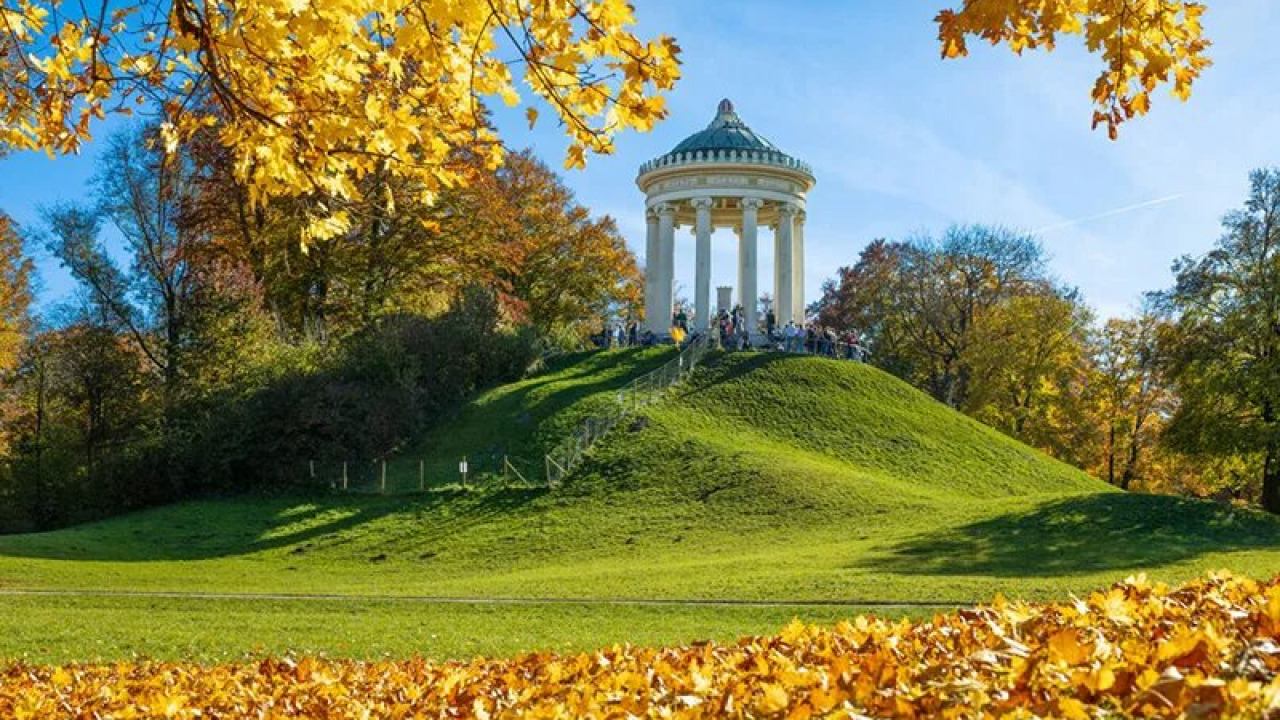
In the southern part of the park, the Monopteros was built by architect Leo von Klenze between 1836 and 1837, atop an artificial hill shaped by Carl August Sckell. From this small, columned temple, you can enjoy views of the city's towers and historic rooftops; the ascent to the top is a gentle, few-minute walk. To the north, the Chinesischer Turm (Chinese Tower), built in 1790, stands 25 meters tall and is surrounded by a beer garden with seating for approximately 7,000 people.
Pro tip: Head up to the Monopteros about half an hour before sunset; the light beautifully highlights the city's silhouette, and the crowds are typically thinner than during midday.
The Eisbach Wave and Recent Rule Changes
At the southern entrance of the park, beneath a bridge in the Eisbach canal, a standing wave has long been a popular spot for river surfers. It's important to note the current situation: the wave was closed following a fatal accident in April 2025 and subsequently deteriorated in the autumn of the same year. With new general regulations from the city administration, the area reopened for surfing on May 8, 2026. Rules are restricted to experienced river surfers and require self-responsible use, a self-releasing leash, and prohibit entering the water after 10:00 PM. For spectators, the bridge railing offers a natural vantage point.
Palaces and Museums: Planning Your Visit
Planning your palace and museum visits requires attention to opening hours, as there can be up to a two-hour difference between summer and winter schedules.
The Residenz and Schatzkammer (Treasury)
The Residenz, located in the city center, is the sprawling palace complex used by Bavarian rulers for centuries. It comprises the Residenzmuseum, the Treasury (Schatzkammer), and the Cuvilliés Theatre, which can be visited as separate sections. Visiting hours are from 9:00 AM to 6:00 PM between late March and mid-October, and from 10:00 AM to 5:00 PM between mid-October and late March. It is closed on January 1st, Shrove Tuesday, and December 24th, 25th, and 31st. Audio guides are free and available in many languages. The ticket price depends on the combination of sections you choose; check the official website for current rates.
Nymphenburg Palace
Nymphenburg Palace, situated in the west of the city, was commissioned in 1664 by Elector Ferdinand Maria and his wife Henriette Adelaide following the birth of their heir to the throne, Max Emanuel. The initial plans were drawn by Italian architect Agostino Barelli. The Baroque core gradually expanded with wings extending on both sides. The palace is open from 9:00 AM to 6:00 PM between April 1st and October 15th, and from 10:00 AM to 4:00 PM between October 16th and March. During the summer season, gondola rides are offered on the central canal when weather permits, and the small pavilions within the park are also open for visitors.
Pro tip: Exploring both the palace and its extensive park can easily fill half a day. In winter, as the pavilions are closed, focus your visit on the main palace building.
The Pinakotheken and Deutsches Museum
In the Maxvorstadt museum district, three Pinakotheken stand side-by-side, but it's crucial to be aware of their current status: the Neue Pinakothek has been closed for renovation since January 2019, with its reopening anticipated towards the end of the decade. During this period, selected masterpieces from its 19th-century collection are exhibited on the ground floor of the Alte Pinakothek and at the Sammlung Schack. The situation is similar at the Deutsches Museum: the first phase of renovation opened in July 2022, featuring 19 new exhibitions across approximately 20,000 square meters, while the remaining half is still closed, with the entire museum expected to be fully operational by 2028.
Bavarian Cuisine and the Beer Garden Tradition
Bavarian cuisine is a highlight of any Munich itinerary. Weißwurst, a traditional white sausage served with sweet mustard and a fresh pretzel, is a local breakfast staple. Schweinshaxe (roasted pork knuckle), Obatzda cheese spread, and Apfelstrudel are other popular classics found throughout the city. For those who love to explore culinary traditions through guided experiences, you can find similar structured gastronomy and event tours in Turkey through Travel Tour Shop.
Viktualienmarkt
Viktualienmarkt is an open-air food market that was moved from Marienplatz to its current location in 1807 by decree of King Max Joseph I. The market features over a hundred stalls, organized by product type: butchers, cheesemongers, fishmongers, greengrocers, bakeries, and florists each have their dedicated sections. It is open from Monday to Saturday and closed on Sundays.
How a Biergarten Works
While the rules of a beer garden aren't always written down, they are quite clear. In the self-service section, you pick up your drinks from the counter, and in true Bavarian tradition, you're welcome to bring your own food. At tables with waiter service, food must be ordered from the establishment. A deposit is taken for glasses and refunded upon return. The long communal tables are shared, and it's customary to ask if a spot is free before sitting down.
Best Time to Visit Munich
| Period | Character | Note |
|---|---|---|
| March-May | Parks open, moderate crowds | 5:00 PM Glockenspiel show starts in March |
| June-August | Beer garden and lake season | Palaces have their longest opening hours |
| September 19 - October 4, 2026 | Oktoberfest | Accommodation demand at its peak |
| November-December | Christmas market season | November 20 - December 24 Christkindlmarkt |
| January-February | Quiet and economical period | Shorter museum hours, pavilions closed |
Oktoberfest Season
Oktoberfest 2026 will take place from September 19th to October 4th, spanning 16 days at the Theresienwiese fairgrounds. Approximately 40 festival tents are erected, offering products from six Munich breweries and traditional Bavarian dishes. Over a hundred amusement rides complete the festive atmosphere. Tuesdays are family days, with discounted rates applied until 7:00 PM. Accommodation demand peaks during this period, so book your stay months in advance.
December and the Christkindlmarkt
The Munich Christkindlmarkt at Marienplatz for the 2026 season will run from November 20th to December 24th. There are around 130 stalls, open from Monday to Saturday from 10:00 AM to 9:00 PM, and on Sundays until 8:00 PM. On December 24th, it operates from 10:00 AM to 2:00 PM.
Accommodation Areas
Choosing an area is often more impactful than selecting a specific hotel brand; the differences between neighborhoods directly affect your walking distances and evening activities.
| Area | Character | Best For |
|---|---|---|
| Altstadt and Lehel | Walking distance to main squares | Those wanting to stay central for a short trip |
| Ludwigsvorstadt (main station) | Transport hub, wide availability | Routes focused on airport access and day trips |
| Maxvorstadt | Museum district, university area | Visitors focusing on the Pinakothek museums |
| Schwabing | Cafes, northern entrance to the park | Those staying near the Englischer Garten |
| Haidhausen | East bank of the Isar, local neighborhood feel | Travelers seeking to avoid tourist crowds |
Sample 3-Day Munich Itinerary
- Day One: Historic Center. Plan your morning around the 11:00 AM Glockenspiel show, then visit the toy museum in the Altes Rathaus tower. Grab lunch from the stalls at Viktualienmarkt. Dedicate your afternoon to the Residenz and its Treasury; avoid visiting too late in winter, as it closes at 5:00 PM.
- Day Two: Park and Palace. Start at the southern entrance of the Englischer Garten, watch the surfers at the Eisbach bridge, ascend to the Monopteros, and take a break around the Chinesischer Turm. In the afternoon, take a tram to Nymphenburg Palace; if it's summer, allow extra time for a canal ride and visiting the pavilions.
- Day Three: Museums or Day Trip. The open sections of the Alte Pinakothek and Deutsches Museum can easily fill a day. If you prefer to venture outside the city, a regional train from the main station reaches Füssen in about two hours; from Füssen station, a bus to the castle area takes approximately ten minutes.
Practical Notes Before You Go
- Store hours in Bavaria are regulated by law: retail outlets are closed on Sundays and public holidays, and typically close by 8:00 PM on other days. Plan your grocery shopping for Saturday.
- Bring comfortable walking shoes; cobblestone streets and extensive park distances will quickly add up your step count.
- A rain jacket or a light outer layer is useful year-round; the weather can change quickly in the afternoon.
- Buying museum and palace tickets online can help you skip the queues; always verify prices on the institution's official website.
- Keep some small change handy for beer gardens; glass deposits are often processed faster with cash.
- Do not walk in bike lanes; they are part of the traffic flow.
Wrapping Up Your Munich Adventure
The key to planning your Munich itinerary revolves around understanding seasonal opening times: the Glockenspiel performs two or three times a day depending on the season, palaces close earlier in winter, Viktualienmarkt is closed on Sundays, and park pavilions open only during the summer. Once these four pieces of information are in place, the rest of your stops will naturally fall into sequence.
For those looking to experience a similar city-and-culture framework in a different region, our Italy travel guide offers a regional breakdown that might be helpful. If you're curious about how this culture translates into holiday habits in Turkey, our article on German tourist profiles provides a comparative perspective. Travelers seeking a similar theme within Turkey, focusing on ancient cities, palaces, and museums, can explore our cultural tours in Turkey category.
Frequently Asked Questions 6
How many days should I allocate for a trip to Munich?
A basic itinerary covering the city center, Englischer Garten, and Nymphenburg can be completed in three days. For those wishing to expand on the museum district or add a day trip towards Füssen, four to five days will allow for a more relaxed pace.
How do I get from Munich Airport to the city center?
The S1 and S8 lines connect the airport to the city center; the journey to the main station takes approximately 40 minutes. For Marienplatz, the S8 takes about 38 minutes, and the S1 takes about 48 minutes. If you have a lot of luggage, the 45-minute airport bus is an alternative.
Which public transport ticket should I buy in Munich?
The ticket choice depends on the zones you plan to travel through. For those staying in the city center, an M-zone day ticket is sufficient. Since the airport is in Zone 5, a ticket covering Zones M to 5 is required for round trips. Always verify current fares on the official MVV website.
What are the Glockenspiel showtimes?
From November to February, it plays daily at 11:00 AM and 12:00 PM. From March to October, it plays daily at 11:00 AM, 12:00 PM, and 5:00 PM. A short closing scene is performed every evening at 9:00 PM.
Is surfing allowed on the Eisbach wave currently?
The area reopened for surfing on May 8, 2026, following new regulations from the city administration. Use is restricted to experienced river surfers and is at one's own risk; a self-releasing leash is mandatory, and entering the water after 10:00 PM is prohibited.
Is it worth visiting Munich outside of Oktoberfest?
Absolutely. The Oktoberfest period drives accommodation demand to its peak and makes attractions very crowded. For a more relaxed itinerary, late May to early June and early September are ideal. For a festive Christmas atmosphere, late November and December are perfect windows.