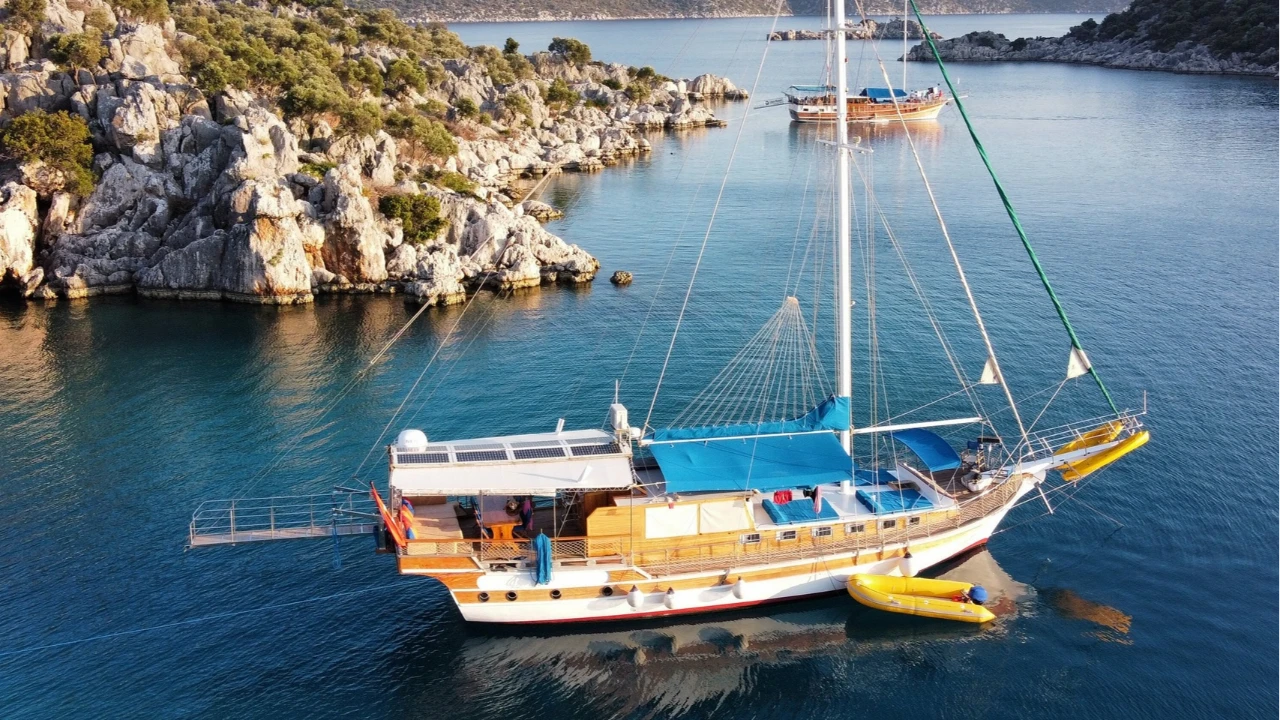
A Kaş boat tour is one of the most delightful ways to spend a day at sea from this charming Lycian town on Antalya's western edge. Boats departing from Kaş Harbor typically head in two distinct directions: east towards the Kekova region and its sunken city, or west towards the Blue Cave and Kaputaş coastline. Both programs fill a full day but offer very different experiences. One emphasizes ancient ruins and leisurely cruising, while the other focuses on shorter distances and more frequent swimming breaks. This guide brings together everything you need to know: the routes, cove-by-cove stops, the day's flow, what influences ticket prices, and key details to clarify before booking.
Which Way Do Kaş Boat Tours Go: East or West?
There are two main directions for boats departing from Kaş Harbor. The eastern route passes Sıçak Peninsula and extends to the Kekova region; as the journey by sea takes nearly two hours, a significant portion of the day is spent cruising, reducing the number of swimming stops. Highlights of this route include Akvaryum Koyu, the sunken city line, Kaleköy, and Üçağız, all within the Kekova area. The western route rounds the tip of Çukurbağ Peninsula, heading towards the Blue Cave coastline and the waters off Kaputaş; since the distance is shorter, two or three extra stops can be fit into the same timeframe.
A third option is the short bay tour, which stays closer to Kaş. This half-day program offers a perfect compromise for those arriving or departing on the same day, or families with small children. It's also possible to explore the same area independently by sea taxi, giving you more flexibility to choose your own timing rather than a fixed itinerary.
Questions to Answer Before Choosing Your Route
A few questions can help simplify your decision. Is anyone in your group a non-swimmer or a small child? If so, prioritize stops with shallow entry points and jetties over coves where you enter deep water directly from the boat's platform. How many times do you want to swim during the day? The number of stops is usually listed on the program page, and the binding information is the reservation text, not the captain's announcement.
Is photography or cooling off your main priority? Midday, when the light is direct, is ideal for capturing the colors of caves and canyons, while early morning is best for seeing underwater ruins without reflections. The final question concerns duration: if you're traveling on the same evening, a distant route might cut your return time short, whereas a short bay tour leaves the rest of your day free.
The Wind Factor Affecting Route Choice
The afternoon breeze (meltem) strengthens in July and August, increasing waves in coves open to the west. The Kekova region, being sheltered behind islands, is significantly calmer on windy days. If you're prone to seasickness, opt for the eastern route on a windy day, choose a morning departure, and sit in the middle section of the boat.
The daily rhythm of the wind is also predictable: mornings are generally calm, the breeze picks up towards noon, and strengthens until late afternoon. Therefore, on morning departures, the first stops are in calmer waters, while the return journey in the late afternoon might be choppier. Checking the weather forecast the day before departure allows you to anticipate potential route changes or cancellations. Some operators offer to transfer canceled trips to another day; this flexibility is valid only if explicitly stated in the program description.
Quick Facts
| Topic | Information |
|---|---|
| Departure Point | Kaş Harbor, the old pier in the town center; some Kekova-focused programs start with a road transfer to Üçağız |
| Main Routes | East: Akvaryum Koyu, Kekova sunken city line, Kaleköy, and Üçağız; West: Blue Cave and Kaputaş waters; Short: Limanağzı, İnceboğaz, and Çukurbağ cape |
| Duration | Full day 7-8 hours, half day 3-4 hours |
| Daily Schedule | Departure late morning, return late afternoon; times vary by operator and route, confirm upon reservation |
| Season | Late April to late October; sea is warmer between June and September |
| Swimming Stops | 3-5 stops depending on the program |
| Pricing | Shared tours are per person, private charters are per boat; confirm current rates with the operator |
| Paid Entry | Only Simena Castle in Kaleköy requires a ticket; as it's under Ministry tariff, a Museum Pass is valid, and a separate list applies for foreign visitors. Antiphellos theater and King's Tomb in the center are free, no ticket booths at sea stops |
| Restricted Area | Swimming and diving are prohibited in the Kekova sunken city line; boats pass slowly |
| Nearest Airport | Dalaman approx. 165 km, Antalya approx. 190 km |
| Suitable For | Families, snorkel enthusiasts, those interested in Lycian ruins |
What Coves and Islands Will You See on a Kaş Boat Tour?
The list of stops for tours departing from Kaş varies depending on the route's direction. The following headings list the most frequently mentioned stops in search results and on program pages. Stops on the eastern route are in the Kekova region, western route stops are along the Kaputaş coast, and short bay tour stops are in the immediate vicinity of the town center. You won't see all of them in one day; the captain will select a subset based on the route's direction and the group's pace, with the stop list in the program text being the binding written source.
Kekova Island and the Sunken City Line
Along the northern coast of Kekova Island lie the submerged ruins of an ancient settlement. Wall foundations, steps, and traces of a pier are visible from the surface in the clear water. The area is administratively part of Demre district, Kaş's eastern neighbor; this same route is therefore also offered on tours departing from Demre and Üçağız.
The area holds a special environmental protection status, meaning swimming and diving are prohibited along this line. Boats pass at a slow speed, the captain makes announcements, and anchoring is not allowed. On glass-bottom boats, the underwater traces are more easily observed during the passage; whether glass-bottom use is included in the ticket varies by operator, with some programs charging extra.
The name's scope can also cause confusion: Kekova refers to both the island and the region comprising the surrounding coves and villages. A program page stating "Kekova tour" describes a day that includes not only the sunken city but also stops like Akvaryum Koyu, Kaleköy, and Üçağız. Therefore, two programs bearing the same name might have different stop lists.
Morning light reduces surface reflection, making the ruins more visible in the early hours. On tours departing from Kaş, this line is the furthest point of the day, so the return journey is spent cruising. For those wishing to extend their time among the ruins, programs with a transfer to Üçağız are an alternative: you travel to Üçağız by road, the boat departs from there, and the shorter cruising time allows for more time at the ruins.
Üçağız and Ancient Teimiussa
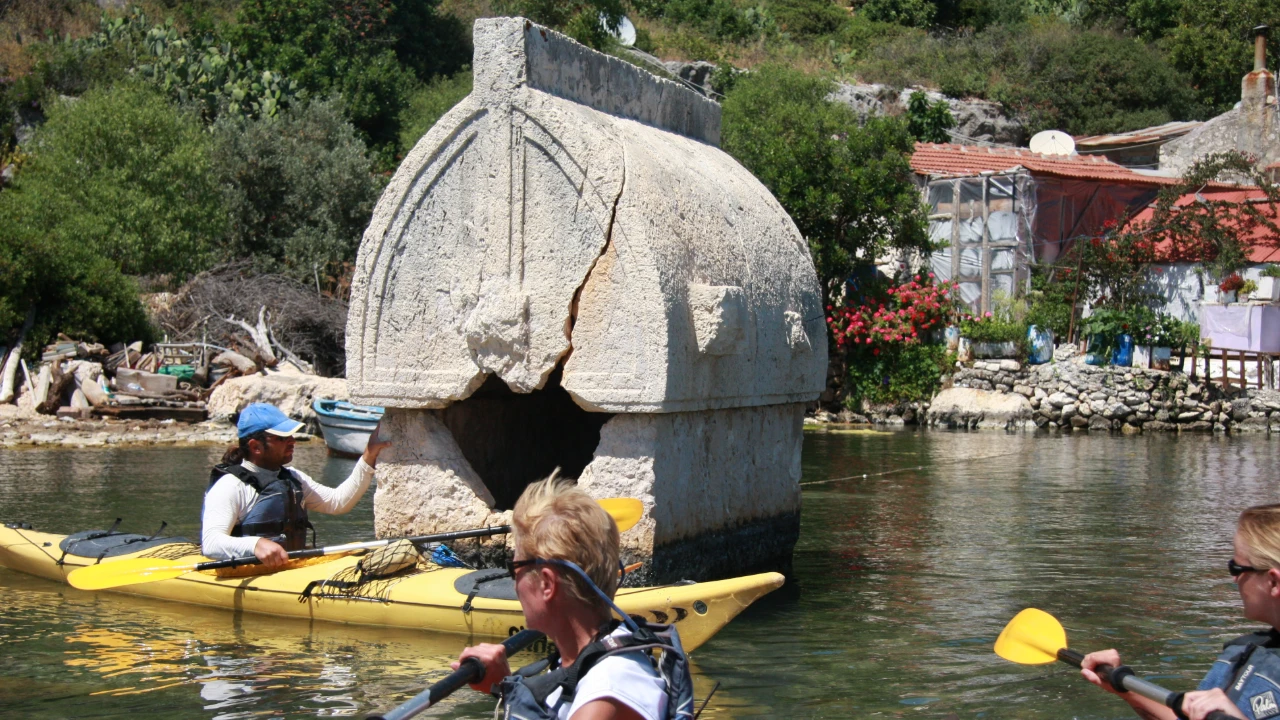
Üçağız is a fishing village at the end of the road, intertwined with the coastal sarcophagi of ancient Teimiussa. Fish restaurants line the pier, and rock tombs and sarcophagi with broken lids can be seen in the stony areas among the village houses. The settlement was part of the same coastal network as Simena during the Lycian period.
Some Kekova-focused programs bring guests here by minibus and depart from the sea; in this case, the meeting point is not Kaş Harbor but in front of your hotel. The road journey from Kaş center to Üçağız is approximately 40 kilometers and 45 minutes, whereas reaching the same area by sea takes nearly two hours; this difference is precisely why transfer programs exist. If lunch is served at restaurants on the Üçağız pier, the bill is usually separate; in this case, the phrase "lunch included" on the program page refers to a restaurant stop, not a meal cooked on deck.
The village becomes quieter in the evenings as boat traffic decreases, allowing those staying overnight to enjoy the early mornings. Tours departing from Üçağız start significantly closer to the sunken city line than those from Kaş, thus allowing more time for the ruins and castle within the same duration.
Kaputaş Beach and Canyon Mouth
Kaputaş is a pebble beach located approximately 20 kilometers along the road between Kaş and Kalkan, where a canyon opens to the sea. Access from land is via a long staircase by the roadside; there are about 187 steps, and it's tiring on the way back, so it's wise not to descend without water.
Due to the fresh water flowing from the canyon, the sea temperature is cooler than in surrounding coves, and the color transition from turquoise to deep blue is striking. From the boat, you can see the beach's cleft extending into the canyon and the rock walls on both sides. Many programs anchor here for a swimming break but do not go ashore; whether going ashore is included in the program depends on anchoring permits and stop duration.
The cove has a municipal facility: sun loungers and umbrellas are charged separately, and basic amenities like showers and toilets are available. Entry policies change seasonally, so the current status is posted at the ticket booth; as it's a municipal beach, a Museum Pass is not valid here. There is no separate parking lot above the beach for those arriving by land; vehicles park along the roadside.
In the morning, a section of the beach remains shaded, while in the afternoon, it's fully sunlit. In mid-summer, the roadside and stair queue for those arriving by land can be long; approaching by sea is therefore a more comfortable option. Since currents can be felt at the canyon mouth, it's safer to stay closer to the shore when swimming with children.
Akvaryum Koyu (Aquarium Bay)
Akvaryum Koyu is in the Kekova region and is one of the stops on the eastern route from Kaş Harbor; it gets its name from the clarity of its water. It often appears early in the sequence of Kaş-departing Kekova programs, making it frequently the first long swimming stop of the day. It is not included in short bay tours because the cove is within the eastern route, not within sea taxi distance of the center.
The bottom is a mix of sand and stone, allowing light to penetrate deep, making it easy to observe small schools of fish with a snorkel. Masks and fins can be rented on the boat, but bringing your own mask eliminates fit issues. Since the cove's bottom doesn't deepen quickly, those new to swimming can also comfortably enjoy this stop.
As swimming is prohibited in the sunken city line, the eastern route's water breaks are concentrated in coves like Akvaryum and Gökkaya. If one of these two names appears on the program page, it means a significant portion of the day's time in the water will be spent there. Water temperatures might still be cool in mid-May but become suitable for long swimming breaks from early June onwards.
Coves with the same name are also found in Göcek bay, off Fethiye, on the Datça peninsula, and along Bozcaada's coast, so the name alone doesn't pinpoint a location. On a program page departing from Kaş, Akvaryum Koyu will be listed alongside the sunken city and Üçağız. If the same name is mentioned with Yassıca Adalar or Ölüdeniz, it refers to a different region.
Kaleköy and Simena Castle
Kaleköy, located on the opposite shore of the sunken city, is built upon the ancient settlement of Simena. Inside the castle on the hill, there's a small rock-cut theater, surrounded by Lycian sarcophagi. Since there's no road access to the village, it can only be reached by boat or by walking a Lycian Way trail; this has preserved the village's tranquil character.
There is a ticket fee at the castle entrance, and this amount is not included in the boat ticket. The site is subject to the Ministry of Culture and Tourism tariff, so a Museum Pass is valid, and a separate tariff applies to foreign visitors; two lists are posted at the ticket booth. As the climb up is via stairs and offers no shade, a hat and water are essential; half an hour is usually sufficient for the climb and time spent at the top.
The time allocated to the castle directly determines the quality of the day: some tours only offer a photo stop in Kaleköy, while others stay in the village for over an hour. There are small terraced restaurants along the stairs, suitable for a break after descending. From the castle walls, the entire coastline where the sunken city lies can be seen, an angle not achievable from the boat.
Blue Cave (Mavi Mağara)
The Blue Cave is located on the steep coast between Kaş and Kalkan, approximately 600 meters from Kaputaş Beach, and has no land access; entry is only by sea. It is about 18 kilometers from Kaş center and approximately 6 kilometers from Kalkan. Since these two points are so close on the same coastline, the cave and the waters off Kaputaş are usually visited in the same section of western route programs, with short intervals. The cave is known to have been documented by geologist Temuçin Aygen in 1972.
As the boat approaches the entrance, the light hitting the water illuminates it, and the cave interior turns a brilliant blue. This play of color is related to the angle of the sun, making it most vivid around midday. The cave is reported to be approximately 50 meters long, 40 meters wide, and 15 meters high; its wide entrance makes it easy for boats to approach. The interior, unlike the outside, is dim and calm, a contrast immediately felt upon entry.
If waves are high, captains may not enter the cave for safety reasons or will show the entrance from a distance; this decision depends on weather conditions and is not considered a program cancellation. Boats that allow swimming inside typically provide life vests. Due to light conditions, flash photography can result in a white reflection, while an angle facing the light preserves the blue tone. If you're planning a dive-focused day, taking the cave into your program with a dive school boat rather than a regular tour boat will give you more underwater time; a guided dive package is priced significantly higher than a shared boat tour of the same duration.
Hidayet Koyu
Hidayet Koyu is a well-known spot on the Çukurbağ Peninsula road, famous for its platforms built on the rocky shore. There is no sand; entry to the water is via ladders or platforms, and the bottom quickly deepens. This characteristic makes the cove appealing to experienced swimmers, snorkelers, and diving enthusiasts, but challenging for families with small children.
The water clarity remains high throughout the day, and the water color deepens in the afternoon as the sun moves west. Boat tours usually anchor offshore for a swimming break, while those arriving by land rent sun loungers from the platform operators. It's a smaller and calmer cove compared to the central beaches, and amenities are limited, so you'll need to bring your own water and shade solutions. Non-slip sandals or sea shoes are helpful for the rocky entrance, as the platform edges can be slippery when wet.
Aperlai and Sıçak Peninsula
Aperlai is an ancient port city located on the coast of Sıçak Peninsula, west of Üçağız, with parts of it submerged underwater. It was one of the settlements known by its own name within the Lycian League; its city walls and structural foundations running parallel to the coast are still visible. The cove is approximately 30 kilometers from Kaş center and has no road access; it can only be reached by boat or via a Lycian Way trail starting from Sıçak village.
Some of the ruins are in shallow water, allowing them to be observed while swimming in clear weather. Aperlai is not always included in standard Kaş boat tour programs; a separate tour itinerary bearing its name, private charters, and canoe programs add this cove to their routes. It's one of the less-visited stops in the region for those seeking a quiet break and is suitable for visits in the spring and autumn afternoons.
Gökkaya Koyu and Aşırlı Island
Gökkaya, located east of the Kekova region, is one of the coves where boat tours take long swimming breaks, thanks to its sheltered structure. The cove's bottom is a mix of sand and pebbles, so the water maintains its clarity throughout the day, making it ideal for snorkeling along the coastline. Shore facilities in the cove are limited, so you'll need to stock up on water and food on the boat for the day. Boats anchoring early in the morning find the cove secluded, while multiple boats anchor in the same area after noon.
The nearby Aşırlı Island's cave is used as a stop in sea canoe and snorkel programs. The cave entrance is shallow and narrow, so large boats anchor offshore, and visitors approach by canoe or swimming. Life vest use is standard around the island, and underwater visibility is clearer in the morning. Aşırlı Island is not a fixed stop on full-day programs departing from Kaş; it's usually included in canoe and snorkel packages sold alongside a Gökkaya stop.
Limanağzı
Limanağzı is a series of three small coves on the eastern side of the Kaş peninsula, about 15-20 minutes by sea taxi from the center. On the shore, you'll find businesses with wooden jetties, backed by pine and olive groves. Since entry to the water is from the jetty, the bottom isn't stony, which is why families with children often prefer this spot.
For hiking enthusiasts, a trail from the center descends to the cove, passing Lycian rock tombs, and takes about an hour; as the trail includes unshaded sections, it's more comfortable in the morning or late afternoon. Sea taxis start mid-morning and make their last trip in the late afternoon, with frequency decreasing outside the main season; return times are posted on a sign at the pier. Shore businesses offer sun loungers and food, but it's advisable to carry cash as card readers don't always work in smaller coves.
İnceboğaz and Çukurbağ Peninsula
İnceboğaz is a narrow isthmus connecting the Çukurbağ Peninsula to the mainland, with sea on both sides. While there are waves on the windy side, the opposite shore remains calm, and since the water on both sides heats differently, it's possible to experience two different temperature sensations at the same stop. There isn't extensive sand on the shore; entry is from platforms and stony areas; the narrowness of the isthmus keeps swimming distances short, so groups with children can easily keep the shore in sight. Most half-day bay tours stop here, and it's often the first stop sacrificed if the program needs to be shortened.
Beyond the isthmus, the Çukurbağ Peninsula extends into the sea and is the first cape rounded on the western route; if there are waves around the cape, movement will be felt in this section, after which the coastline becomes sheltered again. Along the ridge road, you'll find boutique hotels with sea views, and on the shore, platform entry points and businesses renting sea canoes. Setur Kaş Marina is located on the inner side of this line, in the sheltered waters between the mainland and the peninsula, and is about one kilometer from the center; the marina primarily serves yacht traffic, while daily excursion boats depart from the old pier.
How Long Do Kaş Boat Tours Last and How Does the Day Unfold?
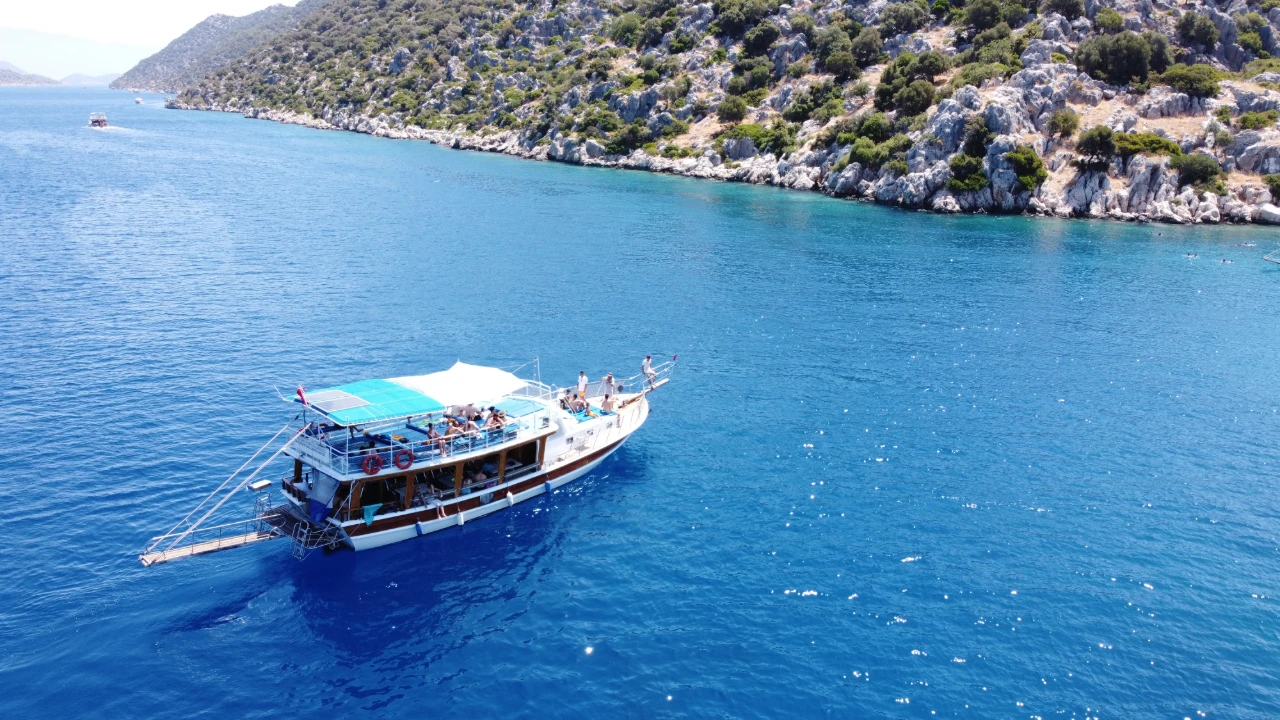
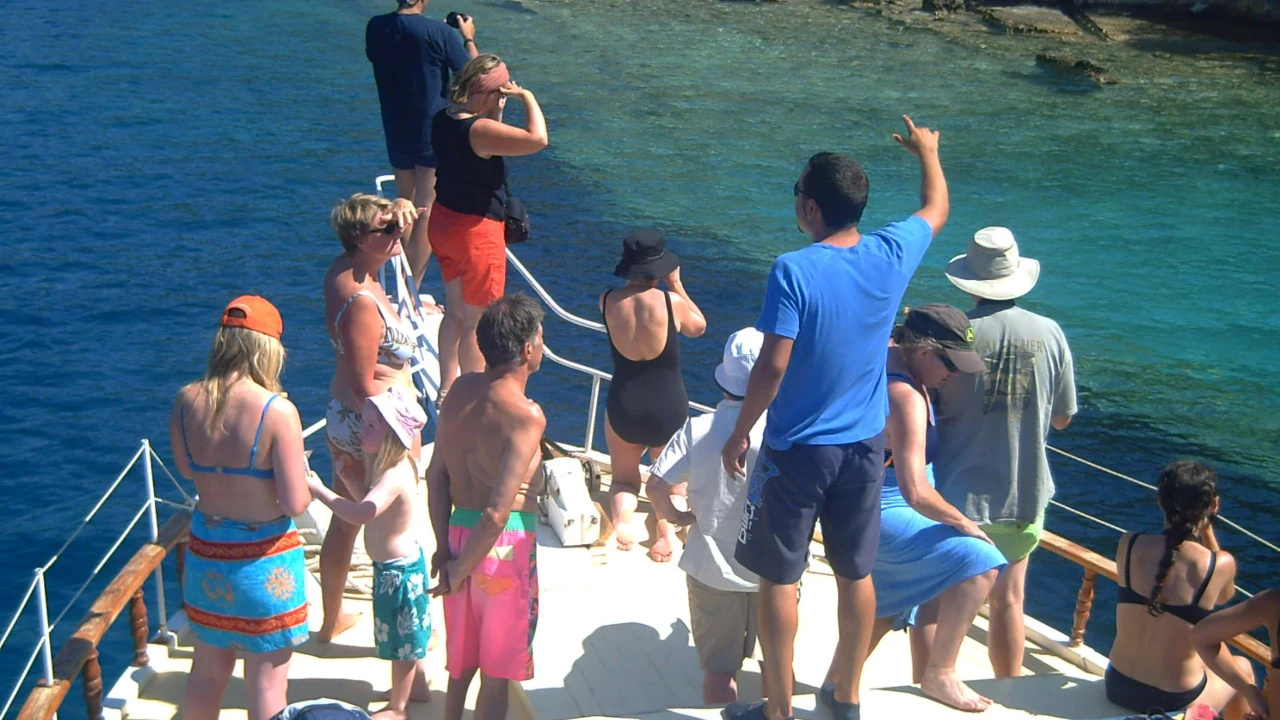
The structure of shared full-day programs is largely similar across operators: late morning departure, late afternoon return, and three to five stops in between. The following sequence describes the flow rather than exact times; even if the order of stops changes, the progression of sections remains consistent.
- Head to the pier at Kaş Harbor half an hour before departure, and check the boat's name and departure time. For programs with hotel pick-up, collection starts about an hour before departure, so factor in transfer time.
- After casting off, the captain will make a safety and route announcement. This announcement will cover the number of swimming stops, meal arrangements, and return time; if there's any inconsistency with your written program, ask immediately.
- The first swimming stop is usually given approximately 45 minutes after departure and lasts about half an hour. On the western route, this stop might be in one of the coves around Çukurbağ cape, while on the eastern route, it will be in a clear spot like Akvaryum Koyu after entering the Kekova region.
- Towards noon, the boat proceeds to the furthest point of the route; on the eastern route, this is the Kekova line, and on the western route, it's the Blue Cave and Kaputaş waters. Use the shaded areas on deck to protect yourself from the sun during the cruise.
- Lunch is served between noon and late afternoon. On most boats, it's cooked on deck, but on some Kekova route tours, it's served at a restaurant on the Üçağız pier, in which case the bill is separate.
- After lunch, the second and third swimming stops follow. The longest stop of the day is usually in this section, so set aside this time for snorkeling.
- As the afternoon progresses, the return journey begins. The captain may choose a different return route than the outward journey to find calmer waters.
- The boat returns to the harbor in the late afternoon. If you're traveling on the same evening, it's safer to schedule your bus or transfer at least an hour after the estimated return time.
Which Route and Boat Type is Right for You?
The differences between two boats on the same day usually boil down to three things. The number of stops determines the program's fullness, the cruising time dictates how much time is spent on the water, and the boat type defines the comfort on deck. The first table below compares routes, and the second compares boat types; by reading both, a visitor can see if their expectations align with the program before reaching the reservation screen.
Route Comparison
| Route | Approx. Duration | Key Stops | Swimming Stops | Best For |
|---|---|---|---|---|
| East: Kekova Line | Full day, 7-8 hours | Akvaryum Koyu, sunken city line, Kaleköy & Simena Castle, Üçağız, Gökkaya | 2-3 stops | Those interested in ancient ruins, seeking calm seas on a windy day |
| West: Blue Cave & Kaputaş | Full day, 6-7 hours | Blue Cave, Kaputaş waters, Hidayet Koyu area | 3-5 stops | Those wanting to spend more time in the water, planning a snorkel & photo-focused day |
| Short Bay Tour | Half day, 3-4 hours | Limanağzı coves, İnceboğaz, Çukurbağ cape | 2-3 stops | Families with small children, those with arrival or departure day constraints |
| Sea Taxi for a Free Day | Flexible timing | Limanağzı coves | Shore-based, duration up to you | Those who prefer their own pace over a fixed itinerary |
| Private Charter | Customizable | Route determined by group | Customizable | Large families, those planning special occasions |
Experience by Boat Type
| Boat Type | Capacity Tendency | Strong Point | Point to Note |
|---|---|---|---|
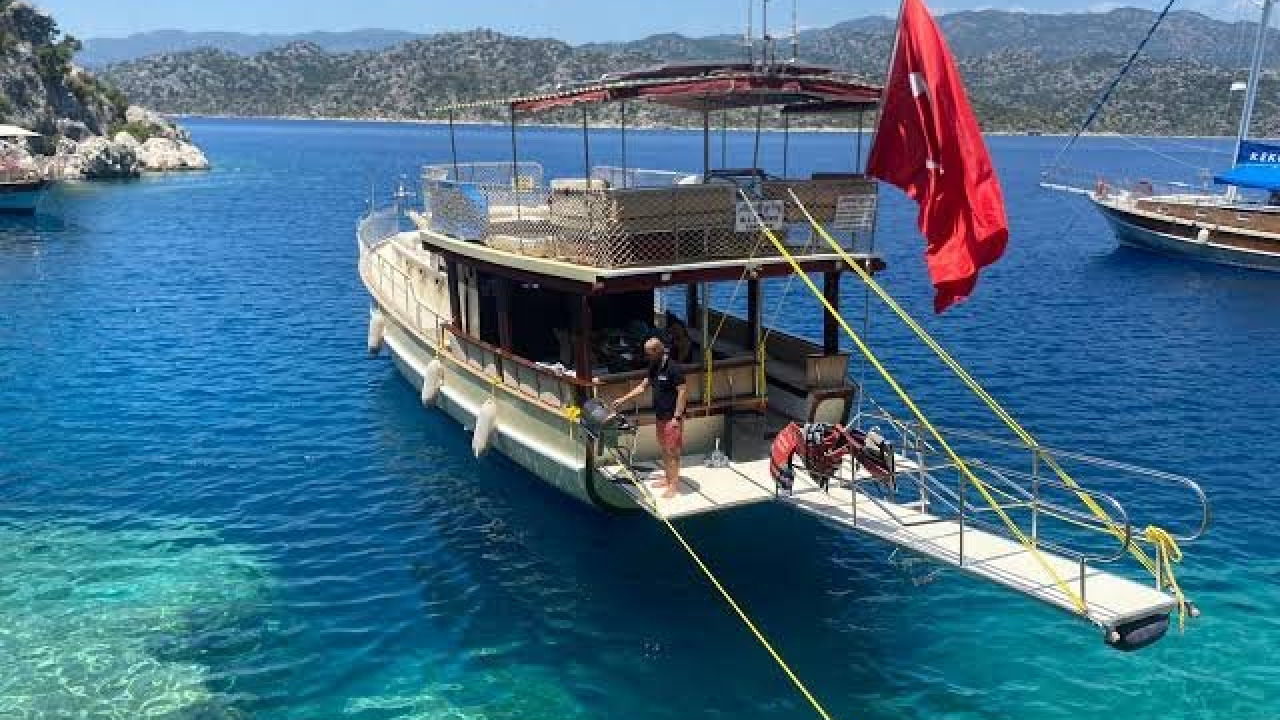
| Gulet | Larger groups | Spacious deck, shaded areas, on-deck dining | Anchoring might be further from shore |
| Small Wooden Boat | Fewer people | Tranquil atmosphere, anchoring closer to coves | Limited shade and toilet facilities |
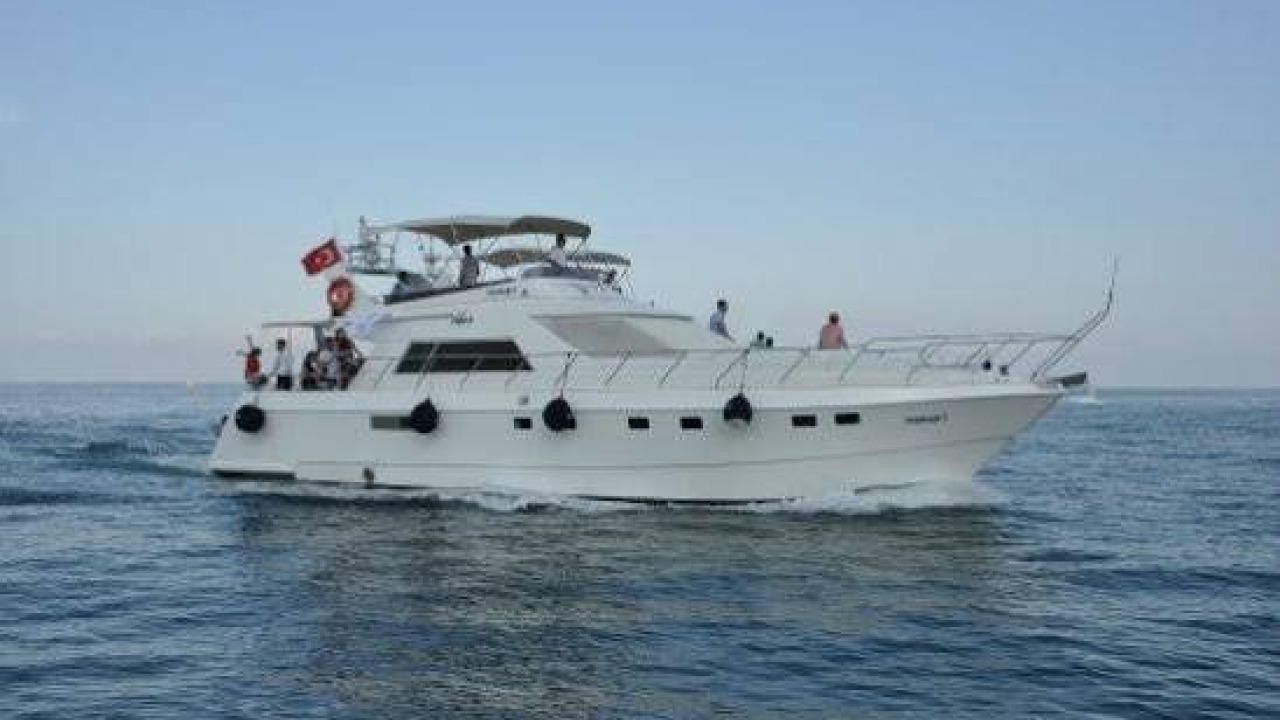
| Glass-Bottom Boat | Medium | Underwater viewing on sunken city line | Glass-bottom use may be extra with some operators |
| Speedboat | Fewer people | Many stops in a short time | Comfort decreases in choppy weather |
| Sea Canoe Program | Small group | Access to caves and shallow areas | Paddling strength and wind determine the route |
Boat and Sea Activity Options in Kaş
Multiple program types operate side-by-side along the same coastline. Shared excursion boats, private charters, diving and snorkeling trips, sea canoeing, and combined days with land stops are all sold separately; thus, it's possible to see the same cove with three different programs. The headings in this section distinguish which program suits which expectation.
Shared Daily Boat Tours
Shared tours are pre-determined itineraries sold per person. On these tours departing from Kaş Harbor, lunch is often included in the ticket, while drinks are charged separately. Group size varies by boat type; visitors seeking a quieter day should inquire about capacity when booking. To compare route, departure, and return time differences, you can compare programs side-by-side on the Kaş boat and sea tours list.
Diving, Snorkeling, and Sea Canoeing
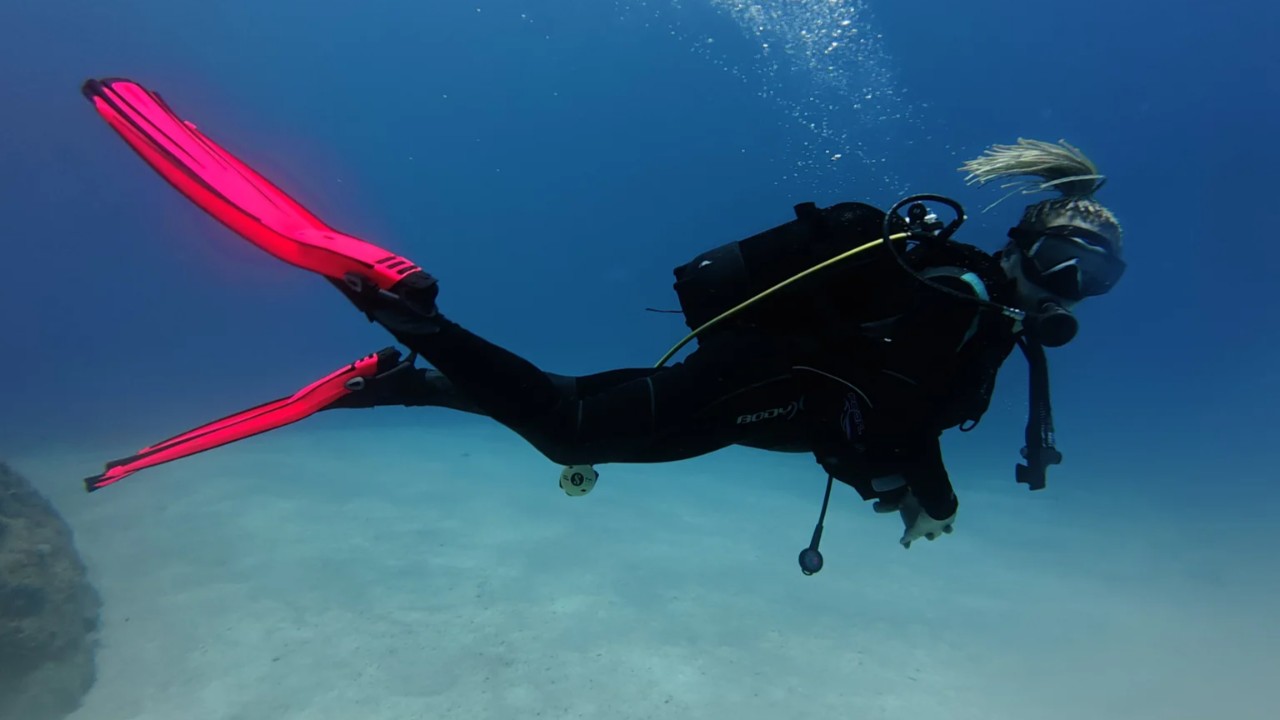
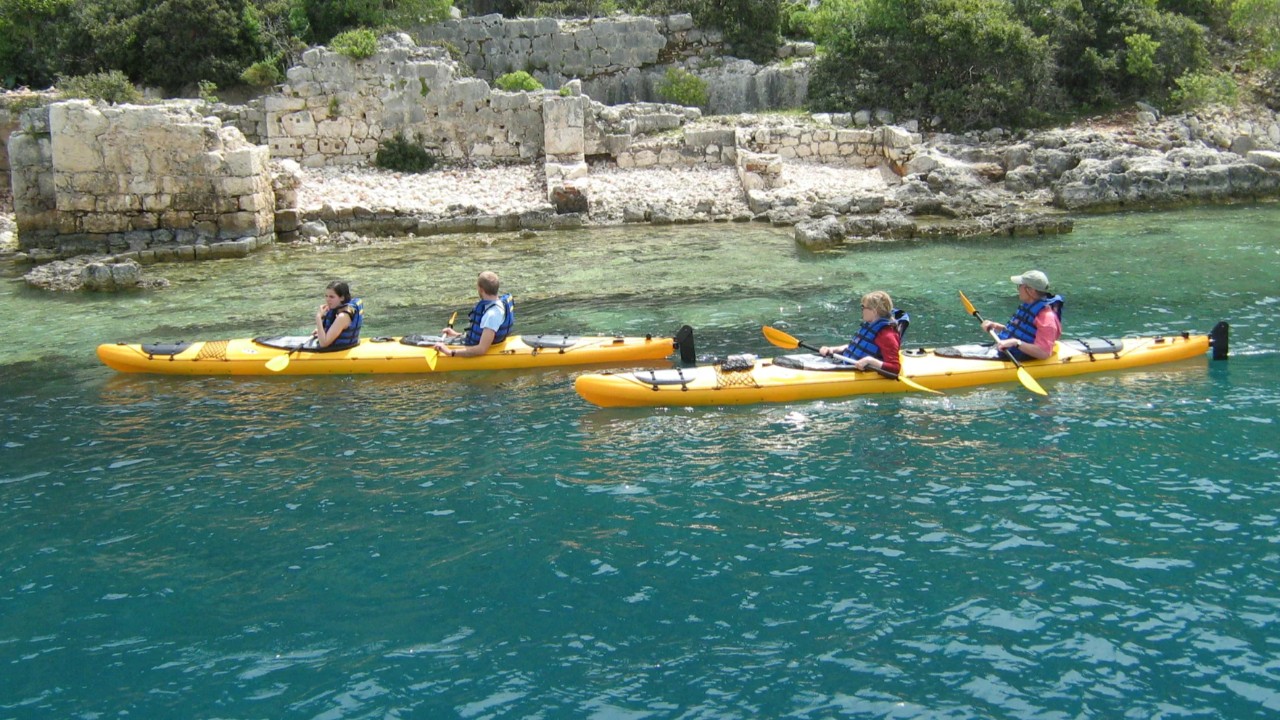
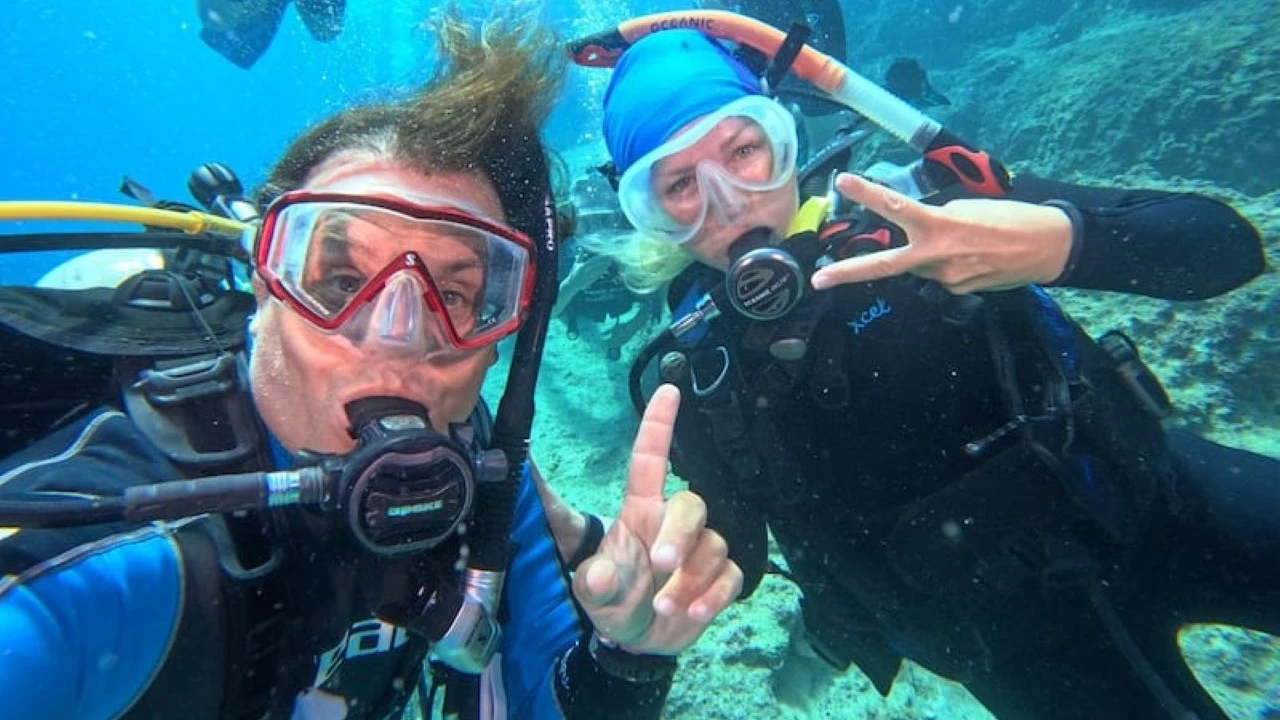
The Kaş coast is a popular area for dive centers due to its clarity and steep underwater topography. Introductory dives for first-timers and wall and cave dives for certified divers are offered in separate packages. For snorkel enthusiasts, Akvaryum Koyu and Gökkaya on the eastern route, and the area around Hidayet Koyu on the western route, offer clear lines; if walking from the center, Küçük Çakıl and Büyük Çakıl beaches serve the same purpose. Sea canoe tours in the Kekova region follow the coastline slowly and enter shallow spots inaccessible by boat, such as the Aperlai coast. You can explore the scope of underwater options on the Kaş sea adventure tours page.
What to See in Kaş Town and Within Walking Distance?
A boat program fills one day, but visitors usually stay in Kaş for several days. The attractions in the town center are within walking distance and are sufficient to fill the two or three hours remaining after a boat trip. The following four headings are useful when planning your arrival or departure day; none require a vehicle.
Antiphellos Ancient Theater
Kaş's ancient name is Antiphellos, and the town is built upon this city. The theater stands on the western slope of the center, a walk up from the bazaar. The structure is dated to the Hellenistic period, mostly the 1st century BC; approximately 26 rows of seating are preserved today.
Since the stage building is not standing, looking from the rows offers a direct view of the sea and the Meis Island line. The main attraction here is not the ruin itself, but the view framed by the ruin. The area is completely open and has no shade, so the seating stones get hot towards midday in mid-summer; a visit takes 20 to 30 minutes.
Entry is free, and the area is open all day; no ticket booth means no Museum Pass is needed here. Sunset light finds an open horizon on this slope, making it an ideal stop for the late afternoon after a boat trip. On busy days, those wanting a spot on the seating stones should arrive early.
King's Tomb and Uzun Çarşı
The King's Tomb (Lion Tomb) stands on a high pedestal within the bazaar, and a visit takes only a few minutes. The reliefs on its lid and the Lycian inscription on its side face hint at the same tomb tradition you'll see along the Kekova and Üçağız coastlines. There is no entry fee.
The monument's true value lies in its surroundings: the stair-lined streets leading up from it open to upper neighborhoods, and exploring this stepped area for 20 to 30 minutes offers views of the harbor over the rooftops. The bougainvillea-covered Uzun Çarşı and its surrounding side streets are the main route for an evening stroll; small galleries like Tuğra Art Gallery and shops like Minelli Butik are scattered along these streets.
For those wanting to buy water, nuts, and fruit before a tour, central markets like Rabia Ucuzluk Pazarı are close to the pier. In mid-summer, the hours between noon and late afternoon are best spent in the shaded courtyard cafes along this line, as all surrounding open-air stops lack shade.
Küçük Çakıl and Kaş Municipality Public Beach
Küçük Çakıl is a ten-minute walk from the center, and this proximity is both the cove's advantage and its challenge; the area around the pier gets crowded by midday. The ground is pebbly, the bottom deepens quickly over a short distance, and sea shoes make entry, and especially exit, easier. Since the water is clear, snorkeling along the coastline is also possible here.
Kaş Municipality Public Beach is one of the publicly accessible entry points around the center; basic amenities like showers and toilets are available, and sun lounger rental is charged separately. Both spots are within walking distance for a quick cool-down after a boat trip. Leaving your swim until after late afternoon will help you find more space in the same cove.
Büyük Çakıl Beach
Büyük Çakıl is located east of the center, 1.5 to 2 kilometers away, and as its name suggests, it's a beach with coarser pebbles and a more spacious feel. It can be reached on foot, or by dolmuş during hot hours. Platform-equipped businesses operate throughout the season, and the sea here also deepens quickly.
There is no natural shade along this stretch; without a hat and high-factor sunscreen, you can get sunburned even in the late afternoon. As the westerly breeze can create waves in the afternoon, families with small children might find the morning and early afternoon more comfortable. This is the preferred stretch for those wanting to spend the whole day at the central beaches.
Combining Your Boat Day with Land Routes
If you're staying in the region for several days, adding a land route to your day at sea balances your itinerary. The following stops are not accessible by boat tour; they require a car, dolmuş, or a guided day trip, and each demands a separate day. Entry fees for archaeological sites are subject to the Ministry of Culture and Tourism tariff: tickets are per person, a Museum Pass is valid, and a separate tariff applies to foreign visitors; current rates and last entry times are posted at the ticket booth. For such combined plans, the day trips on the Kaş nature adventure tours page can simplify your arrangements.
Patara Ancient City and Patara Beach
Patara is located in Gelemiş, part of the Kaş district, and is approximately 40 kilometers from the center. Known as the capital of the Lycian League, the city offers a monumental entrance arch, the assembly building where the league voted, a theater, a colonnaded street, and a harbor basin filled with sand. The city is also known as the birthplace of Saint Nicholas.
Patara Beach, which begins at the end of the archaeological site, is a wide sandy strip and a nesting ground for caretta caretta sea turtles. For this reason, the beach is closed at night; climbing the sand dunes and entering marked nesting areas is prohibited. The archaeological site ticket also covers beach entry, meaning history and sea are combined with a single payment, and a Museum Pass is valid here.
Within the area, shade and buffet options are limited, so water and a hat are essential. Planning the ancient city for the morning and the beach for the afternoon light helps to avoid fatigue. As evening closure is enforced for turtle protection, the day's closing time is announced at the ticket booth.
Xanthos Ancient City
Xanthos in Kınık village is about 20 kilometers west of Kalkan and was inscribed on the UNESCO World Heritage List in 1988 along with Letoon. The city was one of Lycia's political centers; siege narratives recounted by Herodotus highlight its importance in ancient sources.
The core of the visit includes the Roman-era theater, the Harpy Monument and pillar tomb next to the theater, the agora, and the obelisk known for its long Lycian inscription; the inscription is considered one of the most comprehensive surviving examples of the Lycian language. Some of the original reliefs from the monumental tombs were taken abroad in the 19th century, with copies now in their place, and information panels indicate this distinction.
The site is spread across two sides, with a stony path connecting them, requiring closed-toe shoes; the visit takes 1 to 1.5 hours. Finding shade at midday is difficult, so early morning hours are more productive. Since you pass through Kalkan when coming from Kaş, Xanthos can be combined with Kaputaş on the same day.
Saklıkent Canyon
Saklıkent is a deep canyon located in the direction of Fethiye and is one of the few cool spots to escape the summer heat. The distance from Kaş varies between approximately 60 and 85 kilometers depending on the route taken, so planning based on the upper end of this range will make your return time more comfortable. The canyon is approximately 45 kilometers from Fethiye town center; for visitors staying in the Fethiye area, the journey is significantly shorter.
The water inside the canyon is cold even in mid-summer. After the wooden platform ends, the walk continues in the water, and the ground is slippery, so non-slip shoes are useful in this section. Saklıkent has national park status and is not an archaeological site under the Ministry of Culture and Tourism, so a Museum Pass is not valid here; entry is charged separately. Additional activities like tubing and mud bathing are also priced separately by various operators.
Since the canyon is a shaded valley, midday hours become an advantage here. A day dedicated to archaeological sites in the morning can leave the canyon for the afternoon; unlike archaeological sites, there is no early morning requirement here.
Demre, Myra, and St. Nicholas Church
Demre district, to which Kekova and Üçağız belong, is 45 kilometers from Kaş and approximately a 45-minute drive; the ancient name of the district is Myra. Approximately 2 kilometers north of the center, Lycian tomb facades carved into the rocky slope stand alongside a Roman-era theater.
The St. Nicholas Church in the district bears the name of the saint who is the source of the Santa Claus narrative and is a comfortable stop on hot days as it is indoors. Andriake at Çayağzı was Myra's port settlement; the Roman-era granary here is now organized as the Museum of Lycian Civilizations.
All three stops are subject to the Ministry tariff and are covered by the Museum Pass. Since distances within the region are short, all three can fit into the same half-day; those taking the Kekova boat tour with an Üçağız transfer can dedicate the morning of the same day to these stops.
Kalkan, Kaputaş Road, and Phellos
Kalkan is a coastal town 27 kilometers west of Kaş, known for its stone streets and terraced restaurants. The coastal road from Kaş to Kalkan passes above Kaputaş Beach, so if you're traveling by land, the two can be combined on the same half-day. Since dolmuş lines operate between the two settlements, those without a car can also use this route.
Access to Kaputaş from land is via a long staircase by the roadside; there is no separate parking lot above the beach, so vehicles park along the roadside, and finding a spot becomes difficult in mid-summer. Going early in the morning makes a difference for both parking and shade. Due to the steepness of the stairs, the return climb is more tiring than the descent, so you'll need to bring water.
Phellos, located on the slopes in the interior of Kaş, is a mountain settlement sharing the same name root as Antiphellos in the center. The area is accessible only by land, via village roads and trails; it is outside the scope of sea routes and requires a shaded climb, so it's more comfortable to visit in cooler months.
What Determines the Price of a Kaş Boat Tour?
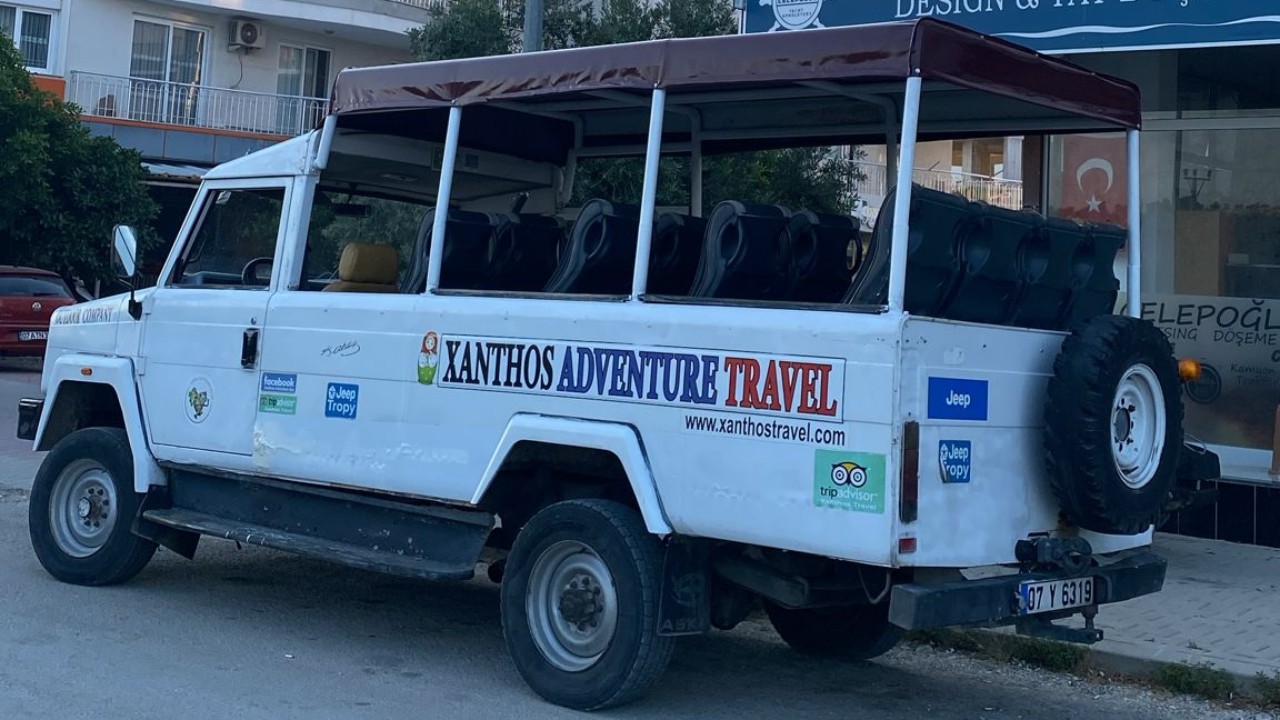
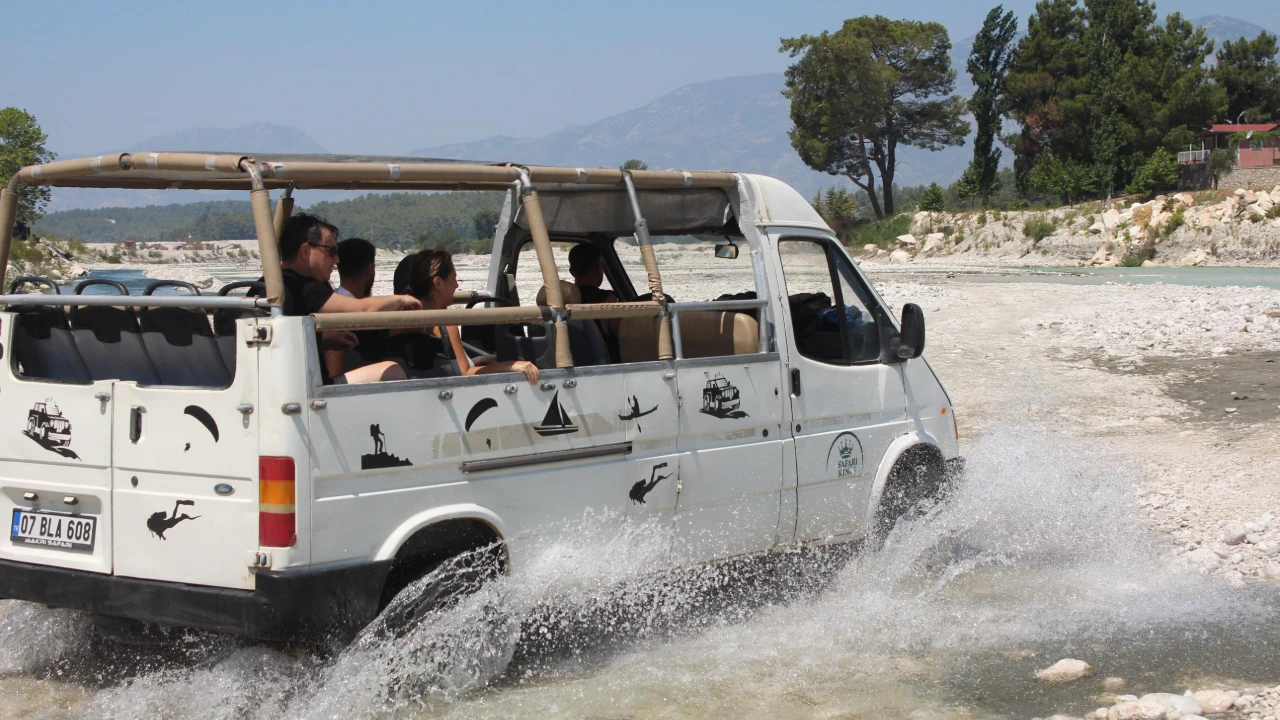
The total cost of a boat day is determined by four main items. The ticket comes first, followed by drinks and equipment rental on board, any archaeological site entry fees, and hotel transfers if applicable. Since tariffs fluctuate with fuel costs and demand intensity throughout the season, this guide does not provide specific figures; instead, it explains how each item is priced and what factors determine the amount. Current program-specific rates are live on the cards in the Kaş boat and sea tours list linked in the section above; archaeological site tickets are posted on lists at the ticket booths.
| Item | How Priced | Usually Included | Factors Determining Price |
|---|---|---|---|
| Shared Full-Day Tour | Per person | Boat trip, route announcement, lunch in most programs | Route length, boat type, inclusion of meal, season intensity |
| Half-Day Bay Tour | Per person | Boat trip, swimming stops | Significantly lower than full-day ticket due to shorter duration; lunch usually excluded |
| Private Charter | Per boat | Route flexibility, exclusive use of boat for group | Boat size, duration, catering scope; per-person cost decreases with larger groups |
| Sea Canoe Tour | Per person | Equipment, guidance, transfer in some cases | Group size, program duration, inclusion of transfer |
| Sea Taxi, Limanağzı | Per person round trip | Transportation only | Distance; significantly lower than a daily tour ticket |
| Simena Castle Entry | Per person ticket | Archaeological site and castle area | Ministry tariff period, discounted tickets & Museum Pass coverage, separate list for local and foreign visitors |
| Guided Dive Package | Per person | Equipment, instructor, boat transport to site | Whether it's a discovery or certified dive, number of dives; significantly higher than a shared boat tour of the same duration |
| Equipment & Extras | Per item | Mask, fins, sun lounger, drinks | On-deck drink prices may be higher than on shore |
Factors That Drive Prices Up or Down
The following seven items can push the ticket price of two boats selling the same route to the higher or lower end. The order is based on the decision-making sequence, not the magnitude of the effect.
- Program length: A significant difference exists between half-day and 7-8 hour full-day tours.
- Route distance: The Kekova line is more expensive than the Kaputaş line due to fuel and duration.
- Boat type and capacity: A crowded gulet and a small wooden boat calculate per-person costs differently.
- Meals and refreshments: Packages including meals are at the higher end, while those without are at the lower end.
- Season intensity: July and August drive demand up, while April-May and October push it down.
- Hotel service: Programs including transfers incorporate transportation costs into the price.
- Shared vs. private charter: Private charters are priced per boat, shared tours per person.
Paid Entries and Museum Pass
On a Kaş boat day, the number of paid entries is low. There are no ticket booths at stops seen from the sea: no separate tickets are needed for the sunken city line, Blue Cave, Akvaryum Koyu, Gökkaya, or the Aperlai coast. However, for visitors who go ashore on the eastern route and climb to Kaleköy, there is a ticket fee at the Simena Castle entrance, and this amount is not included in the boat ticket.
The situation changes for programs combined with land routes. Patara, Xanthos, and the sites in Demre are managed by the Ministry of Culture and Tourism, so a Museum Pass is valid there; Saklıkent, being a national park, does not accept the same card, and the municipal facility at Kaputaş cove is also outside the card's scope. In areas where separate tariffs apply to local and foreign visitors, two lists are posted at the ticket booth, allowing you to see which list applies to you when purchasing a ticket. For a program visiting two or three Ministry sites, a Museum Pass is more economical than buying individual tickets; if only one site is visited, a regular ticket is more suitable. Carrying cash can prevent delays, as card readers don't always work at small ticket booths.
What to Know Before Setting Sail?
The comfort of a day at sea depends on your bag's contents, departure time, and your accommodation area. The headings in this section address practical questions often asked after booking: what to bring, what each month offers, what to eat on board, and how to get to the harbor.
What to Pack in Your Bag
- High-factor, water-resistant sunscreen, as shaded areas on deck may be limited.
- Hat, sunglasses, and a light windbreaker; the afternoon breeze can be noticeably cooling.
- Your own mask and snorkel, to avoid fit issues with rented equipment.
- Non-slip sandals or sea shoes, necessary for rocky entry coves.
- Waterproof phone case and a portable charger.
- Cash, as card payments may not be accepted at small businesses in some coves.
- Light towel and a change of dry clothes, as the return journey might be windy.
Sea, Wind, and Crowds by Month
| Period | Sea & Weather | Crowds | Note |
|---|---|---|---|
| Late April & May | Mild weather, cool sea | Low | Programs start, limited number of boats |
| June | Sea suitable for swimming | Medium | Long daylight hours, light afternoon breeze |
| July & August | Hot and dry, strong afternoon breeze | High | Morning departures and advance booking recommended |
| September | Sea warmed up all summer | Medium | Favorable balance of water temperature and crowd levels |
| October | Weather cools, sea still warm | Low | Fewer programs, monitor weather forecast |
What to Eat on Board and Shore
On shared programs, chicken or meatballs with pasta, salad, and seasonal meze are typically served on deck; drinks are charged separately. On the Kekova route, meals may be served at fish restaurants on the Üçağız pier, where grilled sea bream and sea bass are popular. In the regional cuisine, tahini piyaz, hibeş, wild fennel sauté, stuffed zucchini flowers, and shish köfte are commonly found dishes.
For those wanting to buy fruit and local products, Kaş's weekly Friday market offers stalls with vegetables, fruits, and cheeses; it's possible to stock up on snacks for the deck before a boat program departing on Friday morning. If you have a vegetarian or allergic diet, it's essential to inform the operator during booking, as the same menu is cooked for everyone on deck, and finding alternatives during the day can be difficult.
Where to Stay for Accommodation
If you want to walk to the boat in the morning, Kaş center, specifically around Uzun Çarşı and the harbor, makes things easy; dinner and shopping are also concentrated in this area. If sea views and tranquility are your priority, boutique hotels on the Çukurbağ Peninsula are close to the center but away from the noise, though you'll need a car or taxi to get to the center in the evening.
The Küçük Çakıl and Büyük Çakıl area offers a middle ground for those seeking walking distance to the sea. For a trip focused on the Kekova route, small guesthouses in Üçağız and Kaleköy offer the advantage of proximity to the boat's departure point; since there's no road to Kaleköy, luggage must be carried from the pier. Those staying in the Kalkan direction will be 27 kilometers from Kaş, adding transfer time to their program.
Getting to Kaş and the Harbor
- Plan your flight to Dalaman or Antalya airport; Dalaman is approximately 165 kilometers from Kaş, Antalya approximately 190 kilometers.
- Search for tickets covering both airports. Demand is lower outside the season and mid-week, and planning your arrival at one airport and departure from the other can also change the picture. When comparing, factor in airport transfer costs, as the difference in travel time between the two airports is over half an hour.
- Continue by road from the airport. Calculate approximately 2.5 hours from Dalaman and over 3 hours from Antalya.
- If coming by bus, use the 3.5-4 hour routes from Antalya bus station to Kaş; services coming from the Fethiye direction also stop at Kaş bus station.
- From Kaş bus station, you can walk down to the center and harbor, but a short taxi ride is more comfortable if you have luggage. Since the center and harbor are within walking distance, you don't need to rent a car for your boat day; if you want to visit land stops like Kaputaş, Patara, and Saklıkent at your own pace, a car or transfer with hotel pick-up options comes into play.
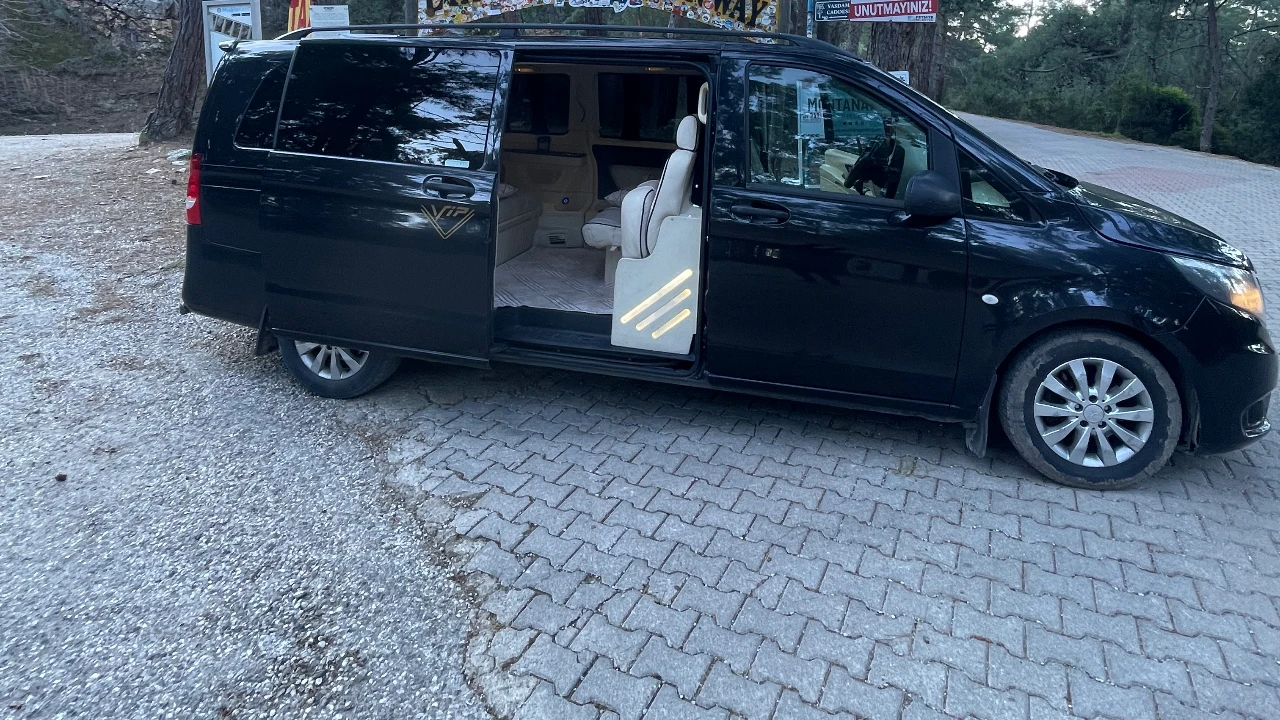
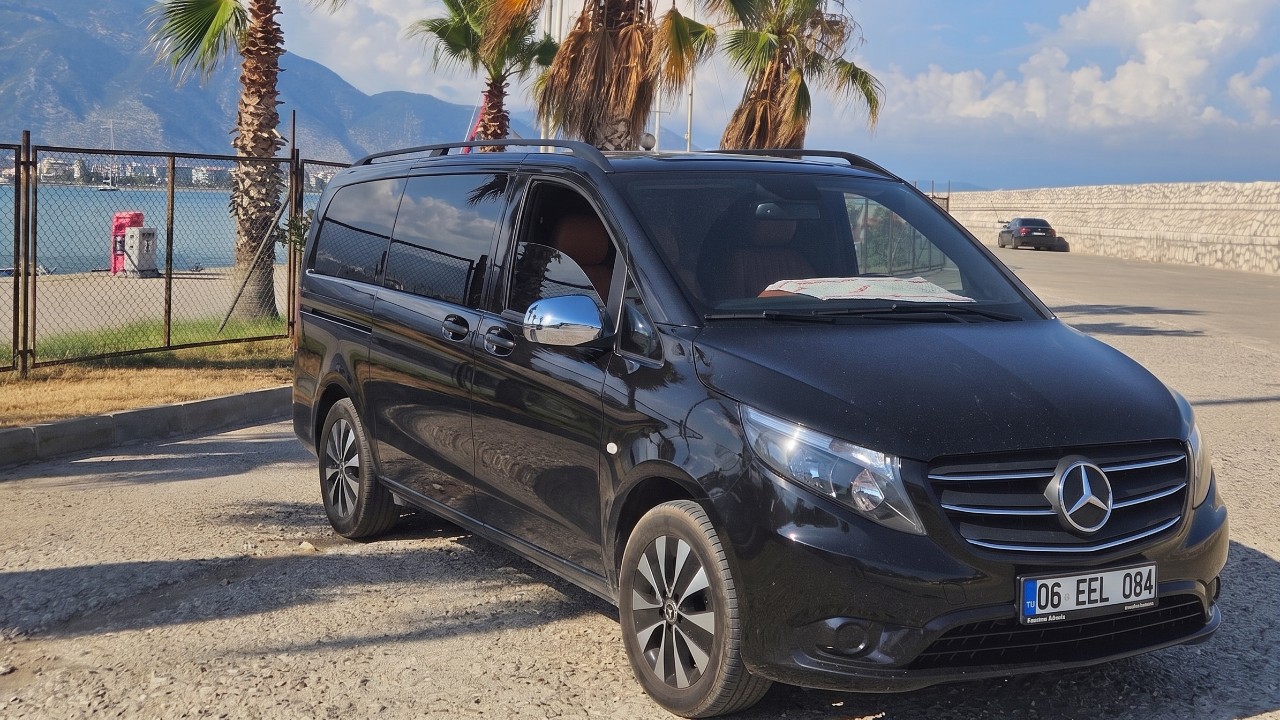
- If you want a shuttle service from your hotel to the harbor or starting point, choose programs with hotel pick-up options; services on the Kaş hotel transfer tours page cater to this need.

Brief Summary and Next Steps
For a day at sea in Kaş, the first decision is the direction: the Kekova line offers ruins and longer cruising, while the Kaputaş line provides shorter distances and more swimming stops. Once the direction is set, the duration and boat type naturally narrow down the options. The key lines to check on the program page are also clear: the list of stops, departure and return times, whether lunch is included, castle entry and ticket arrangements, and the conditions applied for weather-related cancellations. When these details are in writing, there will be no difference in expectations at the end of the day.
If you wish to read more detailed information about two of the stops on the route, the articles Kekova sunken city guide and Kaputaş Beach and Kaş Blue Cave diving guide can assist you in planning your day.
Frequently Asked Questions 11
Where do Kaş boat tours depart from?
Daily excursion boats depart from the Kaş Harbor pier, which is the old pier in the town center. Setur Kaş Marina is located west of the center, in the sheltered waters between the mainland and the Çukurbağ Peninsula, and primarily serves yacht traffic; a visitor looking for a daily boat trip does not need to go to the marina. Some Kekova-focused programs take guests to Üçağız by minibus and depart from there by sea, in which case the meeting point is in front of the hotel, not the harbor, and the boat never calls at Kaş Harbor.
How long do Kaş boat tours last?
Shared full-day programs last 7-8 hours, while half-day bay tours last 3-4 hours. Departures are in the late morning, and returns are in the late afternoon; times vary by operator and route, so they should be confirmed during reservation. For programs with hotel pick-up, collection starts approximately an hour before departure, so the day effectively begins earlier. If you are traveling on the same evening, it is safer to schedule your transportation at least one hour after the return time.
What determines Kaş boat tour prices?
Shared tours are priced per person, while private charters are priced per boat; therefore, for a large group, the per-person cost of a private charter might approach that of a shared ticket. The factors determining the price include program duration, route distance, boat type and capacity, whether lunch is included, hotel transfers, and season intensity. Longer routes like Kekova are more expensive than short bay tours due to fuel and duration. It's more helpful to remember the pricing hierarchy than exact figures: half-day bay tours are at the lower end, shared full-day tours in the middle, and guided dive packages and private charters at the higher end. Current program-specific rates are live on the cards in the Kaş boat and sea tours list linked above.
Can someone without a car join a Kaş boat tour?
Yes. Kaş bus station is within walking distance of the center, and the harbor is in the center, so reaching the boat without a car is not an issue. If you wish to visit land stops like Kaputaş, dolmuş lines operating between Kaş and Kalkan or programs with optional hotel pick-up transfers can solve the problem. The Limanağzı coves are reached by sea taxi, not by road, meaning a visitor without a car would use that route under the same conditions anyway.
Are there any areas where swimming is prohibited on a boat tour?
The sunken city line along the northern coast of Kekova Island is a protected area; swimming and diving are not permitted in this section, and boats pass slowly without anchoring. Glass-bottom boats or morning hours when reflections are minimal are ideal for viewing the ruins. The main swimming breaks of the day are given in coves outside this line, typically in Gökkaya on the eastern route.
Which program is more suitable for someone prone to seasickness?
The Kekova region, being sheltered behind islands, is calmer on windy days. Sitting in the middle section of the boat and in the open air, avoiding enclosed cabins, and fixing your gaze on the horizon can reduce the effect. It also helps not to embark on an empty or overly full stomach. If you plan to take medication, its effect should begin before departure, so consult a pharmacist for timing. On July and August days when the breeze strengthens in the afternoon, routes open to the west might be choppier.
Which stops are suitable for families with small children?
Stops where entry to the water is from a jetty or a shallow shore are comfortable for groups with children: Limanağzı coves, Akvaryum Koyu, and İnceboğaz fall into this group. Spots like Hidayet Koyu, where entry is from a platform into deep water, can be challenging. The half-day short bay tour is less tiring than the Kekova route, which requires longer cruising. It is essential to ask during reservation whether child-sized life vests are available on the boat.
What else can be done for a day trip in Kaş besides a boat tour?
In the center, Antiphellos ancient theater and the Lycian sarcophagus King's Tomb are within walking distance. On the coast, Küçük Çakıl and Büyük Çakıl beaches, and in the bazaar, Uzun Çarşı and its surrounding shops fill the rest of the day. For those preferring land stops, Kaputaş Beach, Patara ancient city and beach to the west, and Saklıkent Canyon in the direction of Fethiye are day trip options. The weekly market held on Fridays is considered a separate stop for those wishing to buy local products.
What is Kaş famous for?
Kaş is known as a coast heavily used by dive centers due to its clarity and steep underwater topography. The second highlight is its Lycian heritage: the town is built upon ancient Antiphellos, the King's Tomb in the bazaar is considered a symbol of the town with its night lighting, and the Kekova sunken city to the east continues the same civilization's coastal network. Third are the views from the sea: the Blue Cave and Kaputaş's turquoise cove are the town's photo-worthy face. Some of these highlights are within walking distance, while others are only visible from a boat; this is why Kaş is known as both a town and a sea base.
Where is the best place to start exploring Kaş?
Starting from the center makes the flow easier. The harbor, bazaar, and marina are within walking distance, creating a car-free loop for your arrival day; Antiphellos theater and the King's Tomb are within this loop. Taking the boat trip on your second day allows you to see the weather forecast a day in advance, and you'll start your departure rested. Land routes are best left for last, as Patara, Xanthos, and Saklıkent each require a separate day and none can fit into the same day as a boat program.
What can be done in Kaş in the evening after a boat tour?
After returning, the area around Uzun Çarşı and Cumhuriyet Square is lively for walking, shopping, and dining. Antiphellos theater, being an open-air site, can be visited at sunset. For those wishing to watch the sunset from the sea, short evening programs are available; these programs are sold separately from full-day tours and last between two and three hours.