
Germany's Romantic Road, officially known as Romantische Straße, is a picturesque 460-kilometer themed route connecting 29 enchanting towns between Würzburg in the north and Füssen in the south. This iconic route winds through the states of Bavaria and Baden-Württemberg, descending from the scenic Tauber Valley to the majestic foothills of the Alps, boasting four distinct UNESCO World Heritage sites along its path. This comprehensive guide divides the journey into five manageable stages, detailing distances and driving times. We'll highlight what to see at each stop, note any current closures, and cover essential topics like transportation, local regulations, best seasons to visit, and accommodation options.
Quick Facts: Your Romantic Road Cheat Sheet
| Topic | Information |
|---|---|
| Route | Würzburg-Füssen, north to south |
| Official Length | Approx. 460 km, 29 member towns |
| Established | 1950 |
| States | Baden-Württemberg (Tauber Valley) and Bavaria |
| Northern Gateway | Würzburg; approx. 1.5 hrs by train from Frankfurt Airport |
| Southern Gateway | Füssen; approx. 15 mins by bus from station to Hohenschwangau |
| UNESCO Sites | Würzburger Residenz (1981), Wieskirche (1983), Augsburg water management system (2019), King Ludwig II's palaces (2025) |
| Recommended Duration | 5-7 days |
| Best Time to Visit | May-September; Advent season for Christmas markets |
| Total Net Driving Time | Approx. 7.5 hours between main stops |
Visa requirements vary by nationality and are subject to change. Always confirm the latest regulations on Germany's official diplomatic mission website before your trip.
What is Germany's Romantic Road and Why Was It Created?
The Romantische Straße isn't a naturally formed historic trade route. Instead, it's a carefully planned scenic drive, conceived after World War II to revitalize tourism in the region.
A Post-War Tourism Initiative, Established in 1950
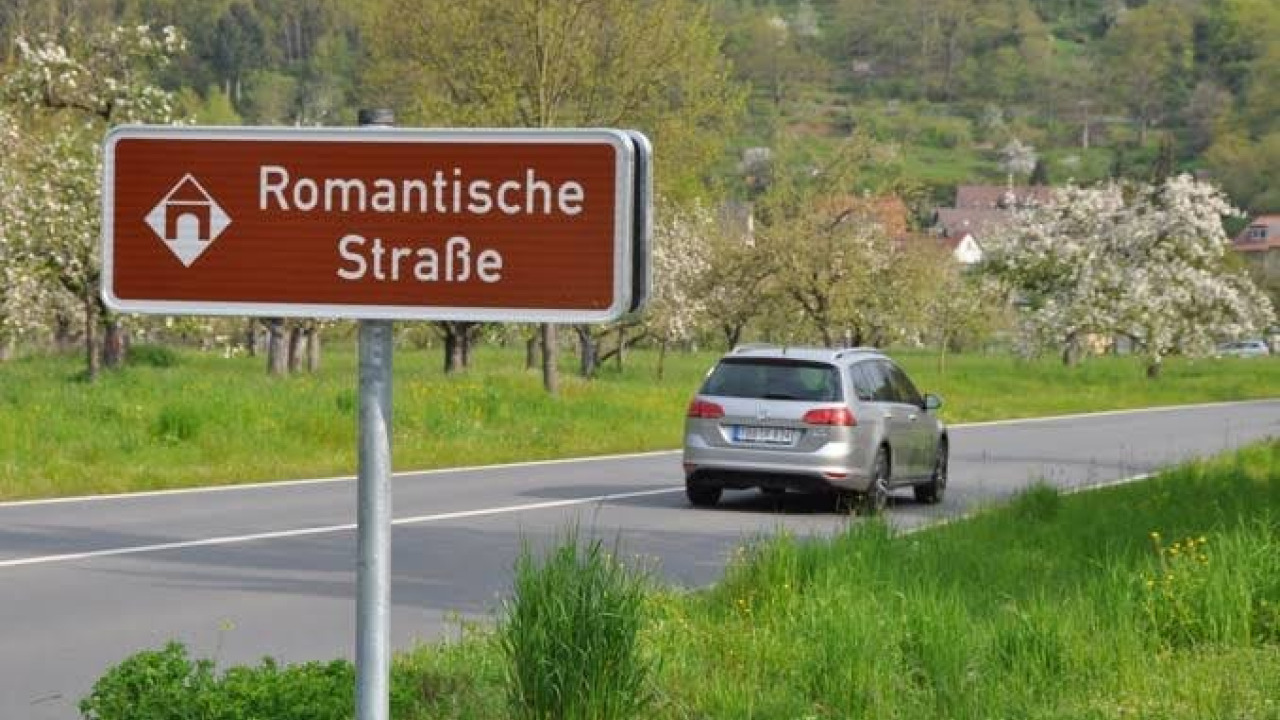
Established in 1950, the route is considered Germany's first thematic road. Today, 29 towns are officially listed as members, benefiting from shared signage and maps. Keep an eye out for the brown "Romantische Straße" signs along the way – they'll assure you're on the right track!
The Route's Geographical Charm
The route gracefully traverses three distinct landscape layers: the Main and Tauber valleys in the north, fertile agricultural plains in the center, and the majestic Alpine foothills to the south. Driving from north to south culminates in the breathtaking Neuschwanstein Castle, while starting from the south often begins with flights into Munich.
Romantische Straße Stages and Distances: Your Itinerary at a Glance
The table below outlines the sections between the main stops. Distances are approximate; the official 460-kilometer length of the route includes detours to smaller towns, making it longer than the sum of these main segments.
| Stage | Approx. Distance | Net Driving Time | Difficulty / Driving Character | Recommended Duration |
|---|---|---|---|---|
| 1. Würzburg > Rothenburg ob der Tauber | 120 km | 2 hours | Easy; winding valley and vineyard roads | 1 day |
| 2. Rothenburg ob der Tauber > Dinkelsbühl | 50 km | 1 hour | Easy; flat countryside roads | Half day |
| 3. Dinkelsbühl > Augsburg | 120 km | 2 hours | Easy; open plains, long stretches | 1 day |
| 4. Augsburg > Wieskirche (Steingaden) | 105 km | 1 hour 45 minutes | Moderate; elevation increases in Lech Valley | Half day |
| 5. Wieskirche > Füssen | 30 km | 40 minutes | Moderate; mountain foothills, narrow curves, seasonal traffic | 1 day |
When planning your stages, keep these three points in mind:
- The times in the table represent net driving durations; breaks and searching for parking will extend your daily schedule.
- During peak season, the final stage around Füssen can take longer than its distance suggests due to crowded parking lots.
- If you plan the stages in reverse, Neuschwanstein will be on your first day, and Würzburg on your last.
Must-See Sights Along the Romantic Road
Würzburg: The Northern Gateway to the Romantic Road
Würzburg, a historic episcopal city nestled on the banks of the Main River, marks the northern starting point of the Romantic Road. At its heart lies the magnificent Würzburger Residenz, commissioned by Prince-Bishop Johann Philipp Franz von Schönborn and designed by architect Balthasar Neumann. Construction of the shell was completed between 1720-1744, with interior decoration continuing until 1780. The breathtaking frescoes on the staircase and Kaisersaal ceilings are the work of Giovanni Battista Tiepolo (1751-1753). This architectural marvel was inscribed on the UNESCO World Heritage list in 1981.
Perched atop a hill overlooking the city, Festung Marienberg presents a different situation: its inner core and courtyard are currently closed to individual visitors due to ongoing construction. However, the second courtyard, Echterhof, and surrounding viewpoints remain open, and guided tours often include access to the restricted areas. The Museum für Franken within the fortress is also open to visitors.
Practical tip: Check guided tour times for the Residenz in advance. If you're heading up to the fortress, take the scenic route across the Alte Mainbrücke; the bridge comes alive in the evening with the tradition of enjoying Franconian white wine. Half a day is usually sufficient for exploring Würzburg.
Rothenburg ob der Tauber: A Fairytale Medieval Town
Rothenburg ob der Tauber is one of Germany's most perfectly preserved medieval towns, with its complete city wall still standing. Much of the wall is accessible throughout the day; the 'Turmweg' (Tower Path) offers a roughly 4-kilometer walk around the old town, taking about 2.5 hours. The iconic Plönlein intersection, where two streets diverge, is one of the town's most famous photo opportunities. From the second half of November until December 23rd, the enchanting Reiterlesmarkt (Christmas Market) fills the squares during the Advent season. Don't miss the local pastry, Schneeball (Snowball), a delicious ball of fried dough. Practical tip: Take your wall walk early in the morning; the route gets crowded midday.
Dinkelsbühl: Untouched Imperial Charm
Dinkelsbühl is a rare gem among imperial towns, having emerged from the Thirty Years' War unscathed, thus preserving its authentic medieval character. The city walls and towers encircling the town are a highlight of guided walks, while the central Münster St. Georg stands as a powerful example of a late Gothic hall church in the region. In mid-July, around the third Monday, the Kinderzeche festival transforms the town into a vibrant historical parade; the 2026 program is scheduled for July 17-26.
Practical tip: For those looking to escape the crowds of Rothenburg, spending a night here offers a peaceful alternative. Accommodation during festival week tends to book up quickly.
Augsburg: A City of Roman Roots and Renaissance Riches
Augsburg was founded during the Roman era, named after Emperor Augustus, and later flourished during the Renaissance, becoming one of Europe's financial powerhouses thanks to the extensive trade network of the Fugger family.
The Fuggerei, established by Jakob Fugger in 1521 for himself and his brothers, is the world's oldest surviving social housing complex. It functions like a self-contained neighborhood, comprising 67 buildings, 142 residences, and its own church. Residency is based not on wealth, but on belonging: applicants must be needy, Catholic citizens of Augsburg, pay a symbolic annual rent, and offer three daily prayers. Visitors can explore the museum, a model apartment, and the bunker exhibition.
The city's second UNESCO designation, inscribed in 2019, is its remarkable water management system. This encompasses 22 objects, including a network of canals, 15th-17th century water towers, monumental fountains, and even hydroelectric power plants that still generate electricity today. Approximately 200 kilometers of streams and canals flow through the city. Practical tip: Before driving into the city center, check the environmental zone regulations.
Wieskirche: A Rococo Masterpiece Amidst Meadows
Near Steingaden, the Wieskirche is a stunning pilgrimage church rising majestically amidst lush meadows, considered a prime example of Rococo architecture. The church was constructed between 1745-1754 by Dominikus Zimmermann, with the exquisite ceiling frescoes created by his brother, Johann Baptist Zimmermann. It was added to the UNESCO World Heritage list in 1983.
Admission is free. Visiting hours vary by season: May-August 08:00-20:00, March, April, September, and October 08:00-19:00, November-February 08:00-17:00. Practical tip: As this is an active pilgrimage church, visits may be restricted during services. Aim for early morning to avoid crowds and ensure full access.
Füssen, Schloss Hohenschwangau & Schloss Neuschwanstein: Fairytale Castles of Bavaria
The southern terminus of the Romantic Road is Füssen, with the iconic castles located in neighboring Schwangau, right on the shores of Alpsee. Schloss Neuschwanstein, famously commissioned by King Ludwig II, began construction in 1869 but was never fully completed during his lifetime. On July 12, 2025, the castle, along with Linderhof, Schachen, and Herrenchiemsee, was officially inscribed on the UNESCO World Heritage List. Perched on the opposite hillside, Schloss Hohenschwangau is where Ludwig spent his childhood.
Entry to both castles is only possible via a guided tour with a fixed entry time. Tickets can be purchased through the official online channel or at the official Ticket Center in Hohenschwangau. Same-day tickets often sell out early. In 2026, the Ticket Center will be open from 08:00-16:00 during summer (March 28-October 15) and 08:00-15:30 during winter. Neuschwanstein tours run from 09:00-18:00 in summer and 10:00-16:00 in winter; Hohenschwangau tours are from 09:00-16:30 in summer and 10:00-16:00 in winter. Both are closed on December 24, 25, 31, and January 1.
Practical tip: Arrive in the valley at least an hour before your scheduled entry time; the uphill walk from the ticket office to the castle takes time, and any delay could cause you to miss your tour. For those seeking programs centered around medieval walls and palace architecture in Turkey, explore our cultural tours in Turkey category.
Getting There from Turkey & Navigating the Route
Entry Points from Turkey & Driving the Route
The route can be started from either end. For those starting in the north, Frankfurt is a natural gateway: a direct train connection from the airport to Würzburg takes approximately 1.5 hours, with numerous services throughout the day. Travelers starting in the south typically choose Munich; from the airport, take the S1 or S8 to the main station, then a regional train to Füssen.
The most convenient way to explore the route is by rental car, as public transport connections between the smaller towns can be infrequent. In Germany, passenger cars are not charged highway tolls, so you won't need to budget for a vignette. Clarify in advance where you'll pick up and drop off your rental car; returning it in a different city may incur an additional fee.
Exploring the Route by Train & Bus
Currently, it's not possible to cover the entire Romantic Road using a single, dedicated bus line. The Romantic Road Coach service for the 2026 season operates only on Sundays, between April 26th and September 27th, covering the northern section of the route, specifically from Frankfurt and Würzburg to Rothenburg ob der Tauber. For the southern section, you'll need to rely on regional trains and local bus services.
The Bayern-Ticket is a valid day ticket for regional trains and urban transport within Bavaria; it cannot be used on ICE or IC services. It's valid from 09:00 on weekdays until 03:00 the following day, and from midnight on weekends and public holidays. From Füssen station, you can reach Hohenschwangau in approximately 15 minutes via RVA bus lines 73 and 78.
Driving Rules, Regulations & Essential Packing Tips
Environmental Zones & Winter Tire Regulations
Many cities in Germany enforce environmental zones (Umweltzone), and only vehicles with a green sticker are permitted to enter these areas. This rule also applies to foreign-registered vehicles: while a sticker isn't required upon entry into the country, you must have a valid one displayed if you plan to drive into an environmental zone. Check the official environmental agency's list to see which cities are included.
Winter tire obligations are dependent on weather conditions, not a fixed calendar date. According to traffic regulations, vehicles can only be driven with winter-appropriate tires (marked with a mountain and snowflake symbol) in conditions involving snow, slush, or ice. This condition can arise at any time between November and March, especially on the stages descending into the Alpine foothills.
What to Pack for Your Romantic Road Adventure
- When picking up your rental car, confirm that a warning vest, warning triangle, and first-aid kit are present.
- Carry a parking disc in your car for time-limited parking zones.
- Bring comfortable, sturdy shoes for wall walks and the uphill climbs to the castles.
- Some small town vendors may not accept cards; keep some cash handy.
- Weather can change quickly around valleys and lakes; a light rain jacket is useful even in summer.
- Download offline maps; mobile network coverage can be spotty in forested areas.
When to Visit: Best Seasons for the Romantic Road
| Period | Route Character | Note |
|---|---|---|
| April-May | Vineyard valleys green up, fewer crowds | Castle tours switch to summer hours on March 28th |
| June-August | Long daylight hours, all facilities open | Kinderzeche week and parking congestion peak |
| September-October | Mild weather, autumn colors | Sunday coach services end Sept 27th, winter hours begin Oct 16th |
| November-December | Advent markets take center stage | Reiterlesmarkt runs until Dec 23rd; winter tire conditions may arise |
| January-March | Quiet and economical period, shorter days | Castle tours reduced to 10:00-16:00 |
Where to Eat & Stay Along the Romantic Road
Gastronomically, the route divides into two distinct regions. In the north, the Franconian region is renowned for its white wines and diverse sausage specialties. To the south, Bavarian cuisine takes center stage: hearty roasted pork knuckle (Schweinshaxe), savory pretzels (Brezel), and local beers are staples on every town restaurant menu.
Choosing your accommodation based on the region rather than specific hotel brands can simplify your trip planning:
- Würzburg city center is practical for your first night, especially for train connections.
- Staying within Rothenburg's city walls allows you to experience the town without the daytime crowds, both in the evening and morning.
- Dinkelsbühl offers a peaceful overnight stay in the middle of your journey, away from the day-tripper rush.
- Augsburg provides city comforts and public transport options between longer stages.
- Staying around Füssen and Schwangau is key for catching the first castle tours in the morning.
For those curious about how German travelers' habits translate to Turkey, our article on German tourist profiles offers a unique perspective.
A Sample Five-Day Romantic Road Itinerary
- Day One: Würzburg – Morning exploring the Residenz and its gardens, afternoon stroll across the Alte Mainbrücke towards Festung Marienberg.
- Day Two: Tauber Valley & Rothenburg ob der Tauber – Early morning wall walk, afternoon exploring the town center, overnight stay in Rothenburg.
- Day Three: Dinkelsbühl – Explore the city walls and Münster St. Georg, then travel to Augsburg for an evening walk around the Fuggerei.
- Day Four: Augsburg & Lech Valley – Morning visiting the water management system sites, afternoon at Wieskirche, overnight accommodation near Füssen.
- Day Five: Schwangau – Morning guided tour of Schloss Neuschwanstein (pre-booked tickets essential), afternoon visiting Schloss Hohenschwangau and the shores of Alpsee.
Those looking to condense the program into three days can combine the second and third days. For a more leisurely seven-day trip, add an extra day to the Tauber Valley and around Augsburg.
Concluding Your Romantic Road Journey
Planning your Romantische Straße adventure essentially boils down to two key decisions: which direction to drive and where to spend your nights. Your budget will primarily be shaped by three factors: accommodation type, rental car and fuel costs, and the number of paid castle and museum tours you choose. Always refer to official sales pages for the most current prices. For those seeking a similar medieval charm closer to home, our historical city tours in Turkey category offers a fantastic starting point. And if your travels continue south of the Alps, our Italy travel guide article can kickstart your planning.
Frequently Asked Questions 6
How long is the Romantic Road and how many days does it take?
The official route spans approximately 460 kilometers between Würzburg and Füssen, encompassing 29 towns. The net driving time between main stops is about 7.5 hours; a comfortable itinerary, including time for exploring, typically requires 5-7 days.
Is it possible to explore the Romantic Road by public transport?
Currently, it's not possible to cover the entire Romantic Road using a single, dedicated bus line. The Romantic Road Coach service for the 2026 season operates only on Sundays, between April 26th and September 27th, and covers only the northern section of the route. For the southern part, you'll need to combine regional trains and local bus services.
Should I book Neuschwanstein Castle tickets in advance?
Entry to the castle is only possible via a guided tour with a fixed entry time. Tickets can be purchased through the official online channel or at the official Ticket Center in Hohenschwangau; same-day tickets often sell out early.
What is the best time to visit the Romantic Road?
For walking and outdoor activities, the May-September period is ideal. Those seeking an Advent atmosphere should opt for the Christmas market season, from the second half of November until December 23rd. Between January and March, castle tours are reduced to 10:00-16:00.
Which UNESCO World Heritage sites are located on the Romantic Road?
There are four UNESCO World Heritage sites along the route: Würzburger Residenz and its gardens (1981), Wieskirche (1983), Augsburg's water management system (2019), and King Ludwig II's palaces (2025). The latter includes Neuschwanstein, along with Linderhof, Schachen, and Herrenchiemsee.
What driving rules should I be aware of when renting a car in Germany?
Passenger cars are not charged highway tolls. However, a green environmental sticker is required for entry into environmental zones, and this rule applies to foreign-registered vehicles as well. Winter tire obligations are based on weather conditions, not a specific date.