The Çankırı Salt Cave is a truly unique destination in northern Central Anatolia, an underground world that has carved out its own distinct climate beneath the surface. Locally known as the "Underground Salt City," this fascinating site emerged from a section of ancient rock salt mining galleries, now thoughtfully opened to visitors. What sets this apart from a typical museum visit is the entirely enclosed environment, where the temperature remains constant from start to finish. This guide focuses less on the city's streets and more on the cave itself: detailing what you'll encounter inside, the recommended flow of your visit, how to plan your day, and what essentials to bring along.
Timing Your Visit: Consider the World Above Ground
Since the underground environment maintains a steady temperature of approximately 13 degrees Celsius (55°F) and low humidity year-round, the season doesn't significantly impact the cave experience itself. What changes is your journey to get there and your plans for the surface: Central Anatolia experiences cold, sometimes snowy winters, and hot summer days. Therefore, the answer to "when to visit" applies not to the galleries, but to the hours you'll spend traveling and exploring above ground.
Timing your visit within the day is just as crucial as the season. Weekends, public holidays, and school group visits can lead to crowded galleries. Setting out early in the morning allows for a more tranquil exploration and leaves ample time for activities in the city center in the afternoon. If you're visiting in winter, starting your program before noon is advisable to avoid driving back in the dark.
| Period | Road and Surface Conditions | Note |
|---|---|---|
| Spring (April-June) | Mild weather, lush green surroundings | Easy to fit the cave and city center into one day |
| Summer (July-August) | High daytime temperatures | The cool underground offers a welcome respite |
| Autumn (September-October) | Calm weather, fewer visitors | Ideal for photography and leisurely walks |
| Winter (December-March) | Cold, sometimes snowy roads | Inside the gallery remains constant; check road conditions before traveling |
Quick Facts
| Topic | Information |
|---|---|
| Location | Approximately 18-19 km east of Çankırı city center, within Balıbağı village limits |
| Known as | Underground Salt City (visitor-accessible galleries of a rock salt operation) |
| Operated by | Çankırı Municipality |
| Depth | Galleries extend approximately 150 meters deep, with ceiling heights of 6-8 meters |
| Accessible area | Approximately 18,000 square meters |
| Internal environment | Around 13°C (55°F) year-round, low humidity |
| Visiting hours | Seven days a week, 09:30-17:00 (may vary on public holidays) |
| Visit duration | Half a day for the cave, a full day including the city center |
| Transportation | Private car or taxi; Tourist Salt Express from Ankara on Saturdays |
| Admission | Ticketed; Museum Card is not valid, rates updated periodically |
| Best time to visit | Year-round; spring and autumn for surface exploration |
| What to bring | A light jacket or sweater, comfortable shoes, a camera with adjustable light settings |
What Awaits You in Çankırı Salt Cave? Galleries, Sculptures, and Scale
The name "cave" might suggest a natural formation, but the vast majority of these underground spaces were created by human hands. Rock salt production has left behind an extensive network of galleries and chambers, a section of which is now open for exploration. It's said that salt extraction in this region has a very long history, with the deposits being worked since the Hittite period.
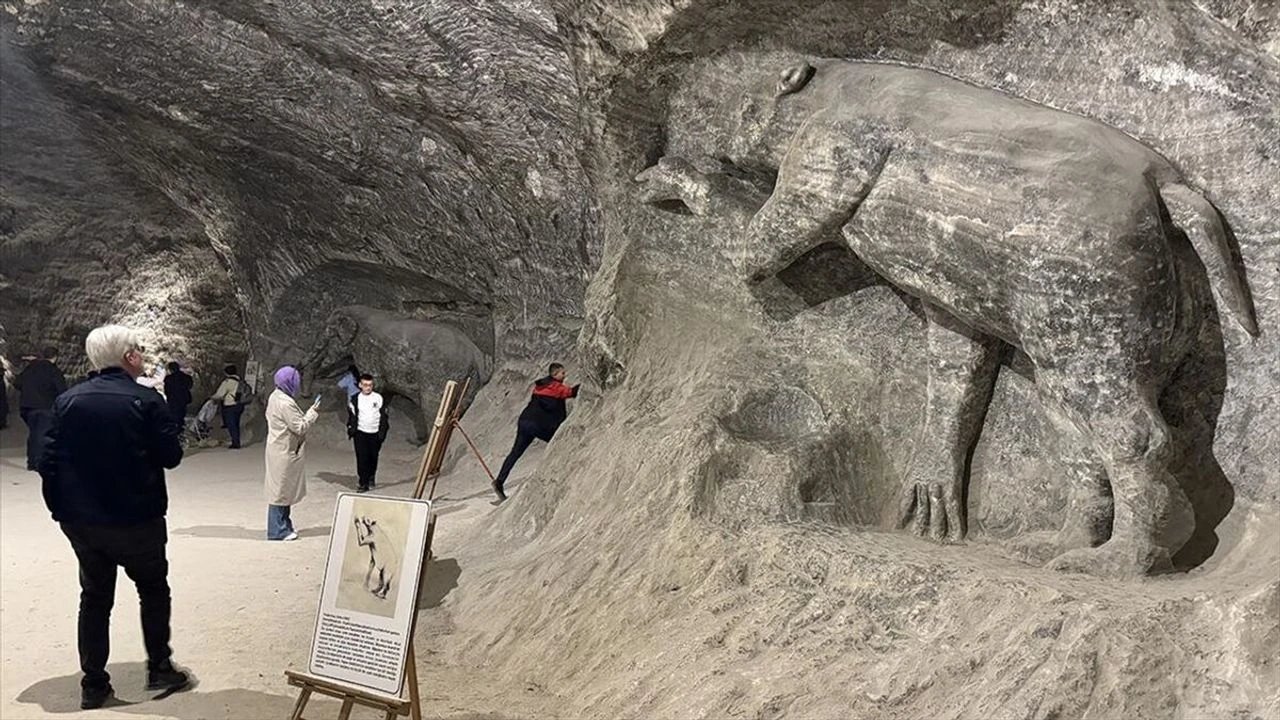
The sheer scale also explains why this visit differs from a classic cave tour. The galleries extend approximately 150 meters (nearly 500 feet) deep, with ceiling heights reaching 6 to 8 meters (20-26 feet) in places, and the accessible section covers about 18,000 square meters (nearly 200,000 square feet). This means there are no sections where you'll need to crawl or stoop; you'll walk beneath ceilings several stories high throughout your journey.
Expansive Galleries Carved from Rock Salt
Because the galleries were created during production, they don't feel like narrow paths. You'll move through wide, high-ceilinged corridors, observing the veined texture of the salt layers along the walls. Under the lighting, these surfaces shift between grey, honey, and white tones, presenting a distinct appearance from the classic dripstone caves known for stalactites and stalagmites.
The walking surface is generally flat and compacted salt, making it easy for extended strolls. Still, it's wise to avoid brushing against the walls, as salt dust can leave marks on clothing. A practical tip: opt for light-colored clothing over dark, as any potential salt residue will be less noticeable.
Sculptures and Exhibition Areas Carved from Salt
Within the accessible section of the galleries, you'll find sculptures, reliefs, and arrangements crafted from rock salt blocks. These aren't displayed behind glass like in an art museum but are positioned directly along the walking path, allowing you to pass right by them.
The lighting in these sections is deliberately designed: when light passes through a salt block, it becomes partially translucent and changes color. This creates one of the most memorable visual moments of the visit. If you're coming with a group, the time spent here might extend, so planning your overall schedule without rushing is a good idea.
The Tale of the Preserved Donkey
One of the most frequently asked-about stops for visitors is the remains of an animal said to have died in the salt deposit and remained preserved due to the salt's protective properties. Local lore dates the event back approximately two centuries, with some sources suggesting three. Since it's based on a story passed down through generations rather than a definitive record, the details vary from source to source. A small rabbit skeleton is also displayed in the same section.
An intriguing detail of the story is that the donkey was reportedly brought to the surface for examination at one point, but upon showing signs of deterioration in external conditions, it was returned to the cave. This concretely demonstrates that the protective effect comes from the environment itself, not the animal.
The reason the story captures so much interest is that salt's moisture-repelling nature prevents decay. This same principle explains why salt has been used for centuries in food preservation. This stop often sparks the most questions from families with children; a brief explanation beforehand can help smooth the flow of the visit for younger explorers.
Resting Area with Talk of Salty Air Benefits
A section of the galleries features seating and resting areas. It's widely believed that the fine salt particles suspended in the air can soothe respiratory passages, and some visitors come specifically for this purpose. The municipality's promotional materials suggest it can be beneficial for conditions like asthma and bronchitis; it's also stated that applications for COPD patients are conducted under medical supervision in groups of approximately 15 people. It's important to note that this is not a substitute for medical treatment; if you're considering a visit for health purposes, consulting your doctor beforehand is the correct approach.
These resting areas also help balance the pace of the tour. Since the time spent underground can often be longer than expected, a break in the middle of the walk is particularly helpful for elderly visitors and young children.
Your Visit Flow: From Entry to Exit
The visit unfolds differently from a conventional museum tour. The following sequence will help you visualize your day:
- At the entrance, ticket and welcome procedures are completed; visiting conditions and current hours are confirmed here.
- Descent into the underground is made via a tunnel path leading from the gallery mouth; this section is often the most anticipated part of the visit.
- Along the walking route, galleries, chambers, and salt surfaces are seen in sequence; guided groups listen to explanations here.
- A stop is made at the sculpture and exhibition section, followed by a short break in the resting areas.
- Upon exit, visitors can browse a sales point featuring rock salt, salt lamps, and salt soaps, before returning to the surface.
Where is Çankırı Salt Cave and How to Get There?
The cave is located approximately 18-19 km east of Çankırı city center, within the boundaries of Balıbağı village, which is part of the central district. The city itself is northeast of Ankara, about a two-hour drive by road. This proximity makes it easy to center a day trip from Ankara around the cave. Once you arrive in Çankırı, your main goal is to reach the galleries outside the city.
| Transportation Option | How it Works | Who it's Suitable For |
|---|---|---|
| Private car | Approximately 20 minutes from the city center via the village road and tourism road towards Balıbağı | Visitors planning their own itinerary, also stopping at nearby attractions |
| Bus plus taxi | To the city center by intercity bus, then by taxi to the galleries | Visitors without a car, seeking flexible visiting hours |
| Tourist Salt Express | A day-trip train service from Ankara to Çankırı and back on Saturdays, with a capacity of approximately 250 people | Those coming from Ankara who wish to return the same day, preferring a pre-arranged plan |
| Guided tour | Transportation and entry organized within the same package | Groups or visitors who prefer not to drive |
For Those Arriving by Private Car
From Çankırı city center, follow the road towards Balıbağı, and you'll reach the galleries in about 20 minutes. The route consists of a village road and a tourism road specifically built for the cave connection; the road is marked with directional signs, and searching for "Yer Altı Tuz Şehri" (Underground Salt City) on navigation apps will simplify the route. If you plan to visit the city center on your way back, choosing a parking spot close to the center will allow you to spend the afternoon exploring on foot.
For Those Using Public Transport
For visitors without a car, reaching Çankırı city center by intercity bus is a practical starting point. Since there's no regular urban bus service to the village road, you'll need to complete the final leg by taxi; discussing your return time with the taxi driver beforehand will prevent waiting in a rural area.
Those coming from Ankara have an additional option: the Tourist Salt Express, which operates a day-trip service between Ankara and Çankırı on Saturdays. With a capacity of approximately 250 people, the train departs from Ankara in the morning and returns in the evening, with the Underground Salt City as its first stop. As the service schedule is determined seasonally, it's essential to confirm dates and times from official sources. For those who prefer to have transportation and entry organized in one package, Travel Tour Shop offers guided tours covering Central Anatolia programs or Ankara tours departing from the capital.
Planning Your Trip Budget Item by Item
The budget for this trip is shaped more by transportation and your daily plan than by the entrance fee itself. The expenditure table for a day-tripper will differ from that of an overnight visitor. The table below indicates which items influence the budget without providing specific amounts; it's always a good practice to confirm current rates from official sources before your visit.
| Item | Budget Determining Factor | Planning Tip |
|---|---|---|
| Entrance ticket | Visitor type and periodically updated rates | Confirm payment methods and current rates before you set off |
| Transportation | Private car fuel or bus plus local connection | A day trip from Ankara shares the distance cost |
| Food | Restaurants in the city center or roadside stops | Timing your lunch break for the city center increases options |
| Souvenirs | Rock salt, salt lamp, salt soap | Salt products can be heavy; plan your luggage accordingly |
| Accommodation | Day trip or overnight stay | Staying in the city center allows for an early start the next morning |
Who is This Trip Suitable For? Children, Seniors, and Photographers
An underground visit here differs from a cave tour requiring climbing or narrow passages, which broadens the profile of participants. Still, there are specific preparation points for each type of visitor.
Notes for Families with Children
The wide galleries and flat terrain provide a comfortable environment for children to walk. Since descending underground can spark curiosity in some children and apprehension in others, a brief explanation during the journey can be helpful. A baby carrier or backpack carrier is a more convenient solution than a stroller for some sections of the route.
For Those with Mobility Limitations and Respiratory Concerns
While the ground is generally flat, the total length of the route can be tiring for elderly visitors; incorporating resting areas into the itinerary helps alleviate the strain. Those with respiratory complaints should seek medical advice before visiting, keeping in mind that this environment is not a substitute for medical treatment.
For Photographers
Light is limited underground, and salt surfaces reflect incoming light. A camera capable of high ISO values or a phone with a strong night mode will make your job easier. Directing the flash straight at a salt wall will cause glare; taking the light from the side will better showcase the texture. For those looking to combine nature and underground themed routes, Travel Tour Shop offers nature and adventure tours options.
Tips Before You Go
- Even in summer, bring a light jacket or sweater; the internal temperature remains constant regardless of outside weather.
- The site is open seven days a week from 09:30 to 17:00; to enjoy your time in the galleries comfortably, aim to enter before 15:30 and confirm hours during public holidays.
- Since the Museum Card is not valid here, plan for the entrance fee separately.
- Salt dust can leave marks on clothing, so light-colored and relaxed-fit garments are more comfortable.
- Phone signal may be weak underground; establish a meeting point at the entrance.
- Bring water and small snacks, as options may be limited until you exit.
- Purchasing souvenir salt products on your way out, rather than at the beginning of your visit, will reduce the burden of carrying them.
Completing Your Itinerary After the Cave
After emerging from the galleries, you can dedicate the rest of your day to attractions in the city center. The Glass Observation Terrace, built at the highest point of Çankırı Castle, offers a brief stop with its glass-floored platform overlooking the city. In the center, you'll also find walkable attractions such as Taş Mescit (Cemaleddin Ferruh Darüşşifası), dating back to the 13th-century Seljuk period, the Çankırı Museum, and the Ferit Akalın Radio and Communication Museum. The stone houses and narrow streets of the city center also offer enough charm to fill an afternoon.
It's worth noting a common planning mistake: Çankırı's Balıklı Göl (Fish Lake) is not in the city center but in Ilıpınar village, part of the Atkaracalar district, and is approximately 70 kilometers away. While this lake, known for its "soldier fish," is a beautiful stop, it cannot be squeezed into the same afternoon as the cave visit; it requires a separate day or a different itinerary.
In summary, the cave visit typically takes half a day, or a full day when combined with city center attractions. If you're planning a two-day trip, dedicating the second day to nature spots towards Ilgaz or the Balıklı Göl route mentioned above makes for a balanced program. If you're coming from Ankara and plan to spend another day in the capital, our Anıtkabir travel guide will complement your itinerary. Those wishing to extend their route to other cities in Central Anatolia can explore cultural tours and historic city tours offered by Travel Tour Shop to prolong their journey.
Frequently Asked Questions 8
How old is the donkey in Çankırı Salt Cave?
Local lore suggests the animal, said to have died in the mine, dates back approximately two centuries. Since it's based on a story passed down through generations rather than a definitive historical record, details vary from source to source.
How much is the entrance fee for Çankırı Salt Cave?
Admission is ticketed, and the rates are determined by the Çankırı Municipality and updated periodically; therefore, instead of sharing a specific amount, we recommend confirming the current price from the municipality's official announcements before your trip. As it is not a museum affiliated with the Ministry of Culture and Tourism, the Museum Card is not valid here.
What is the story of the donkey in the salt cave?
According to the narrative, the animal, which died while working in the mine, remained preserved thanks to salt's moisture-retaining properties. The story has become one of the most talked-about stops of the visit, as it concretely demonstrates salt's tissue-preserving quality.
What can you see in Çankırı Salt Cave?
The Çankırı Salt Cave features expansive galleries carved out by rock salt production, sculptures and reliefs carved directly into the salt, illuminated salt blocks highlighted by special lighting, resting areas, and a sales point at the exit offering rock salt products.
What are the health benefits of Çankırı Salt Cave?
It is widely believed that the fine salt particles suspended in the air can soothe respiratory passages, and some visitors use the resting areas for this purpose. This belief is not a substitute for medical treatment; if you're considering a visit for health purposes, you should consult your doctor beforehand.
How long does the visit take, and how should one dress inside?
The gallery tour is typically planned as a half-day program. Since the internal environment remains around 13 degrees Celsius (55°F) year-round, a light jacket or sweater is recommended even in summer, along with comfortable, non-slip shoes in all seasons.
What are the visiting hours for Çankırı Salt Cave?
The Underground Salt City is open seven days a week from 09:30 to 17:00. As hours may change on public holidays and the site is operated by the Çankırı Municipality, a practical way to check the current status is through the municipality's official website or social media accounts.
Is Çankırı Salt Cave the largest salt cave in the world, or is it the same as Tuz Gölü (Salt Lake)?
Neither. Çankırı Salt Cave is an accessible network of galleries created from rock salt production; the title of "largest" on a global scale is usually attributed to Poland's Wieliczka Salt Mine, a UNESCO World Heritage site. Tuz Gölü, or Salt Lake, is not in Çankırı but is a separate, shallow lake spanning the borders of Konya, Aksaray, and Ankara in southern Central Anatolia.