
Aizanoi Ancient City, nestled in the Çavdarhisar district of Kütahya, is a sprawling Roman-era settlement spread across both banks of the Kocaçay River. This ancient waterway, known in antiquity as Penkalas, bisects the ruins, carving the site into two distinct halves. While many visitors are drawn here to witness one of Anatolia's best-preserved temples dedicated to Zeus, the archaeological site offers far more than just this iconic structure. The unique stadium-theater complex, a circular market building (Macellum) bearing an ancient price edict, two bath complexes, a colonnaded street, and Roman bridges still in use today all line this historic valley. This guide compiles all the practical information you'll need for your visit, from transport options and the best time to go, to a suggested itinerary within the site and an extended route connecting to Kütahya city center.
The Best Time to Visit Aizanoi Ancient City
Aizanoi is an entirely open-air site, with very few shaded structures. Most of your visit will involve walking on stony, uneven terrain, making the comfort of your trip directly dependent on the season. Kütahya is situated in a high transition zone between the Inner Aegean and Central Anatolia regions; summer daytime temperatures can rise significantly, while winters can be cold and snowy. Spring and autumn offer a balanced window, ideal for both comfortable exploration and optimal photographic light.
Timing your visit during the day also makes a difference. The columns of the Temple of Zeus can appear flattened under the harsh overhead light of midday. The early morning and late afternoon hours, however, reveal the intricate fluting and texture of the carvings with beautiful shadows. For winter visits, a blanket of snow visually enriches the site, though ice can make ascending the temple platform challenging.
| Period | Advantage | Things to Note |
|---|---|---|
| Spring (April-May) | Mild weather, lush valley, longer visiting hours | Ground can be muddy after rain |
| Summer (June-August) | Extended daylight, outdoor activities | Hot and exposed at midday |
| Autumn (September-October) | Soft light, fewer crowds | Evening temperatures drop quickly |
| Winter (November-March) | Unique visual texture with snow | Icy conditions, shorter daylight, potential transport delays |
Quick Facts
| Topic | Information |
|---|---|
| Location | Kütahya Province, Çavdarhisar District, on the banks of the Kocaçay River (ancient Penkalas) |
| Key Structures | Temple of Zeus, Macellum, Stadium-Theater Complex, Baths, Colonnaded Street |
| Period | Predominantly Roman era; with a Phrygian regional past |
| Ideal Season | Spring and Autumn |
| Visit Duration | Half a day for the site, two days including Kütahya city center |
| Status | Archaeological site under the Ministry of Culture and Tourism; inscribed on UNESCO World Heritage Tentative List in 2012 |
The Story of Aizanoi Ancient City
Aizanoi was established as a settlement in the eastern part of the Phrygian region. During the Roman Imperial Period, the city flourished, fueled by income from grain, wine, and wool trade. Most of the monumental structures standing today were built during this prosperous era, primarily in the 2nd century AD. The Greek and Latin inscriptions on the walls of the Temple of Zeus offer a direct glimpse into the administrative life of the time, detailing debates over the rental fees for agricultural lands belonging to the temple and copies of correspondence from the reign of Emperor Hadrianus. Being able to read the land and tax regulations of an ancient city directly from stone is a rare find in Anatolia.
The city's rediscovery began in the 19th century with the arrival of European travelers to the region. Systematic excavations, however, commenced in the 20th century, progressing through a long chain of different teams. Understanding when the current layout of the site emerged also helps explain why structures are preserved to varying degrees during your visit.
| Period | Excavation Team | Area of Focus |
|---|---|---|
| 1926-1928 | German Archaeological Institute (D. Krencker, M. Schede) | Temple of Zeus |
| 1970-1982 | R. Naumann | Bath Structures |
| 1982-1990 | A. Hoffmann | Theater and Stadium Complex |
| 1990-2007 | K. Rheidt | Temple, Stadium, Roman Bridges |
| Post-2011 | Turkish University Teams (led by Kütahya Dumlupınar University) | General City Area, Colonnaded Street, and Surrounding Structures |
Must-See Structures in Aizanoi Ancient City
What sets Aizanoi apart is that its structures aren't confined to a museum courtyard but are instead integrated into the village fabric and spread across both banks of the valley. Your visit will therefore involve short walks between various points of interest.
The Temple of Zeus and its Vaulted Undercroft
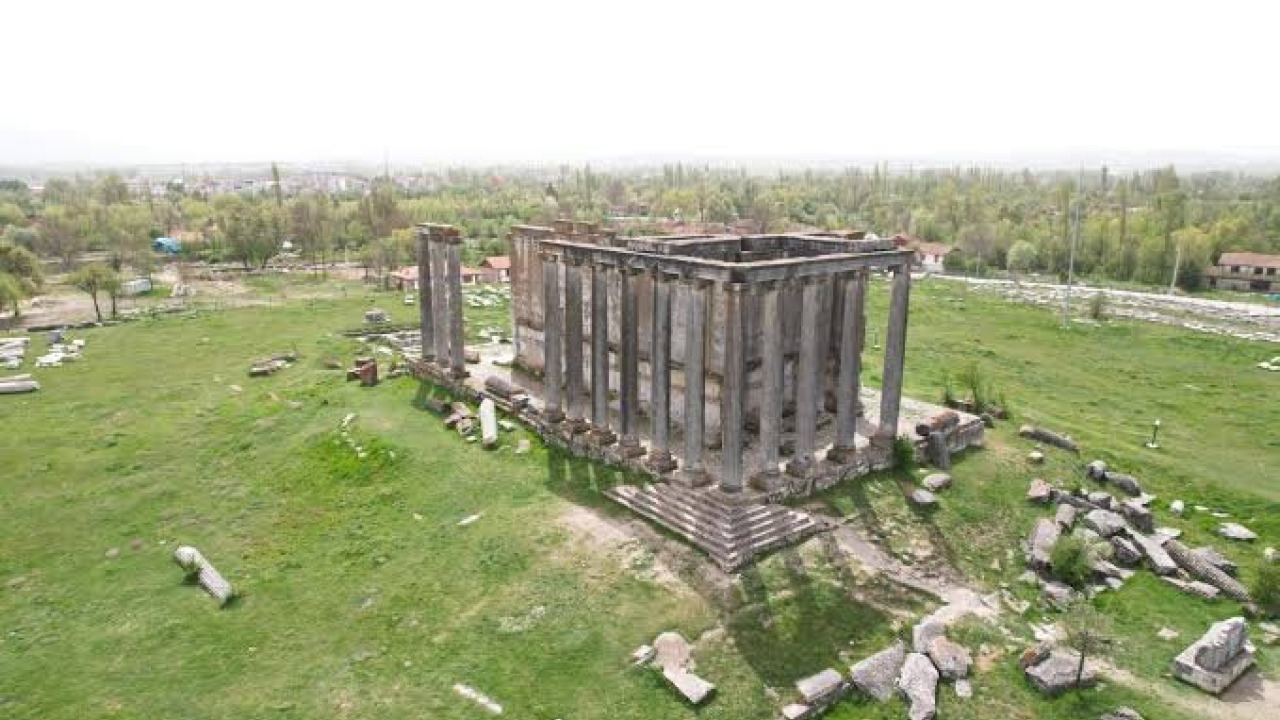
Construction of the Temple of Zeus, the city's iconic symbol, began in 92 AD during the reign of Emperor Domitianus, according to data published by excavation teams, and continued through the Hadrianic period (117-138 AD). For this reason, the structure is often referred to as a "2nd-century AD" building in most sources; it's not merely the work of one emperor but the result of a construction site that spanned generations. Rising on a high platform, the temple boasts a plan featuring fifteen Ionic columns along its long sides and eight on its short sides. Its largely intact facade makes it one of the best-preserved Roman temples in Anatolia. The Greek and Latin inscriptions on the inner and outer walls of the pronaos document debates over the rental fees for agricultural lands belonging to the temple, as well as correspondence from the Hadrianic era.
What truly distinguishes this temple from others is the vaulted gallery beneath its main chamber. Two interpretations are debated regarding the function of this lower level: one suggests it served as a storage area for valuable votive offerings, while the other proposes it was dedicated to the cult of the Mother Goddess Kybele. Terracotta figurines found in the vaulted section support the latter theory, though the matter remains inconclusive. This area, accessed by stairs, is cool and dimly lit, so a stable camera support might be necessary for photography.
Practical Tip: The steps leading up to the temple are worn, so non-slip footwear will make your ascent easier. The late afternoon, when column shadows lengthen, offers ideal lighting for framing the facade.
The Macellum: An Ancient Market Etched with Price Edicts
The circular-plan Macellum is Aizanoi's example of the covered market type found in Roman cities, typically used for food trade; the structure dates to the second half of the 2nd century AD. What truly makes it famous, however, is the ceiling price list carved into its walls two centuries later. A copy of the edict issued at the beginning of the 4th century AD, which imposed price caps on goods and services across the empire, is inscribed here in stone. The list covers a wide range of items, from food and textiles to paid labor and transportation. For this reason, the structure is often referred to in many sources as "the world's first known stock exchange building."
Today, the remains are visible at foundation level, with inscribed blocks displayed around the site. For visitors interested in ancient economics, this is a particularly rewarding stop. If you're looking to combine Aizanoi with similar layered archaeological sites, explore the itineraries on our culture tours page.
Practical Tip: The inscribed surfaces become most legible with side lighting. Early morning or late afternoon hours enhance the shadow contrast of the letters.
The Unique Stadium-Theater Complex
Aizanoi's architecturally rare feature is the design of its theater and stadium not as separate entities, but as a combined, back-to-back complex. While these two structures were typically located at different points within ancient cities, here they converge on a common axis – a layout unparalleled in documented history. The scale is also remarkable: the stadium is estimated to have held around 13,500 spectators, and the theater approximately 20,000. Construction is believed to have begun in the 2nd century AD and continued over a long period.
The seating rows of the theater and blocks belonging to the stage building can be seen alongside the long-side seating arrangement of the stadium. The complex was thoroughly documented during excavations conducted between 1982 and 1990. As the area is extensive, exploring it on foot requires ample time.
Practical Tip: To fully grasp the scale of the complex, start by walking from the stadium end towards the theater. On windy days, a light windbreaker will be useful.
The Baths and Mosaic Floors
Two bathhouse structures have been documented in the city. Among these, the one dating to the second half of the 3rd century AD, known as the "Mosaic Bath," features striking figural mosaic panels on its floor. Depictions of Satyrs and Maenads reveal traces of Dionysian iconography at Aizanoi. Within the bath ruins, you can observe the brick supports and hot air channels of the underfloor heating system (hypocaust); this section was meticulously uncovered during the excavation period between 1970 and 1982.
The mosaic section is covered for protection; as lighting inside may be limited, flash-free photography is recommended. The baths offer a fascinating glimpse into daily life alongside the monumental structures.
Practical Tip: The walking path in the mosaic area is clearly marked; staying on the designated route helps preserve these delicate artworks.
The Colonnaded Street, Agora, and Necropolis Areas
The colonnaded street, forming the city's main axis, served as a route for commerce and ceremonial processions. Along the street, fallen column shafts, capitals, and architrave fragments are scattered. Around the agora, the foundations of public buildings can be traced. In the necropolis areas spread around the settlement, sarcophagi and tombstones are visible, some of which are exhibited in the Kütahya museum.
This section truly conveys the scale of the site: Aizanoi is not just a collection of structures, but an entire city with its streets and cemeteries. The way the ruins are intertwined with today's village houses only enhances this impression.
Practical Tip: The street path can be dusty; keep a lens cleaning cloth and a water bottle handy.
Kocaçay Bridges and the Ancient Dam
Roman-era bridges span the Kocaçay River, which flows through the heart of the city. Two of these bridges are still in use today: one is a five-arched stone bridge, and the other is a wooden pedestrian bridge. The fact that a nearly two-thousand-year-old engineering marvel is still in daily use vividly illustrates how Aizanoi seamlessly blends its ancient ruins with the living village. Further upstream in the valley, a dam wall built in two phases stands on the Penkalas; it is believed the structure was constructed for flood control.
The area around the bridges is ideal for framing shots with the temple in the background. During spring, when water levels rise, the shoreline may change, so it's best not to get too close to the edge. Paths extending along the valley are perfect for a peaceful stroll after your site visit.
Practical Tip: To capture both the bridge and the temple in the same frame, you'll need to cross to the opposite bank of the river.
Where is Aizanoi Ancient City and How to Get There?
Aizanoi Ancient City is located right within the Çavdarhisar district of Kütahya; the archaeological site and the settlement share the same fabric, with clear directional signs along the roads. Access is typically planned via Kütahya city center.
- From Kütahya city center, take the highway towards Emet and Gediz; Çavdarhisar is on this route, approximately 50 kilometers from the center.
- If using public transport, opt for the district buses departing from Kütahya bus terminal towards Gediz and Emet; these routes generally pass through Çavdarhisar, so inform the driver of your stop in advance.
- For those arriving by plane, regional flights land at Zafer Airport, serving Kütahya, Afyonkarahisar, and Uşak provinces; from the airport, continue your journey by rental car or transfer.
- Travelers preferring rail can reach Kütahya Garı (Kütahya Train Station) and then proceed by road connection from the city center; for connecting services, aligning your arrival time with daylight hours will make your travel plan smoother.
Day Trip from Kütahya City Center
Staying in Kütahya and visiting Aizanoi as a day trip is a popular choice. An early morning departure allows you to explore the site before midday, returning to the city center in the afternoon to complete a museum and bazaar tour. Parking is available around the archaeological site; as village streets are narrow, it's practical to leave your vehicle in the designated area off the main road.
Connections from Uşak, Afyonkarahisar, and Eskişehir
Aizanoi is also an accessible point for visitors coming from Uşak to the west, Afyonkarahisar to the south, and Eskişehir to the north; connections are made via Gediz or Altıntaş. Those planning a multi-stop Inner Aegean itinerary can easily integrate Aizanoi with other archaeological sites in these provinces. If you're continuing north, our Eskişehir Odunpazarı travel guide will help you plan your second stop along the same route.
| Mode of Transport | Ideal for Visitors | Note |
|---|---|---|
| Private Car | Those seeking flexible schedules, photography-focused travelers | Facilitates easy movement between stops within the site |
| District Bus | Independent travelers on a budget | Note return journey times in advance |
| Rental Car & Transfer | Those connecting from the airport, families | Practical to arrange upon arrival at Zafer Airport |
| Guided Group Tour | Those interested in the stories behind the structures | Provides valuable insights into inscriptions and architectural details |
Extending Your Itinerary in Kütahya City Center
For those who wish to extend their Aizanoi trip beyond a single day, Kütahya city center is a natural complement. The Kütahya Archaeology Museum, housed within the Vacidiye Madrasa, displays a significant portion of the artifacts unearthed from Aizanoi. Seeing the museum's counterparts to the architectural fragments observed at the archaeological site truly rounds out the experience.
The Kütahya Tile Museum, established in the II. Yakup Çelebi Imaret from the Germiyanid period, showcases the city's centuries-old tradition of tile and ceramic art. Germiyan Street, with its restored mansions, the Ulu Cami (Grand Mosque), and Kütahya Castle perched on the hill overlooking the city, form a central walking route. The house where Hungarian statesman Lajos Kossuth lived in exile from 1850-1851, converted into a museum in 1982, is also open to visitors. If you'd like to explore similar city center routes with a pre-planned program, compare options on our historic city tours page.
Dining and Accommodation Options
Çavdarhisar is a small district center, and the number of establishments around the archaeological site is limited. If you plan to spend half a day at the site, carrying water and light snacks will make your visit more comfortable. You'll find modest establishments in the district offering village breakfast and gözleme (Turkish savory flatbread).
For a more substantial meal break, Kütahya city center offers a wider array of choices. The region's tarhana soup is among its most famous flavors, while pastries and meat dishes frequently appear on the menus of central restaurants. For souvenirs, tile and ceramic products stand out, with workshop visits offering a chance to see the production process firsthand. If you wish to make dining a central part of your itinerary, explore our cuisine-focused programs on the gastronomy tours page.
Accommodation options are primarily concentrated in Kütahya city center, where hotels are within walking distance of the museum and bazaar routes. For those seeking thermal facilities, the Yoncalı area offers an alternative. During summer months and public holidays, booking your stay in advance will help prevent itinerary disruptions.
Is Aizanoi Ancient City Paid Entry? Museum Pass and Budget Planning
Aizanoi is an archaeological site managed by the Ministry of Culture and Tourism; entry requires a ticket, and the Museum Pass (Müzekart), valid at other Ministry-affiliated sites, can also be used here. Visiting hours for Ministry-affiliated sites are set separately for summer and winter periods; summer hours typically extend later, while winter closing times are adjusted earlier due to daylight. As ticket prices and Museum Pass coverage are re-evaluated annually, specific figures are not provided in this guide; please check the Ministry's official archaeological site page for current rates and hours before your trip.
If you plan to include the Archaeology and Tile museums in Kütahya city center in your itinerary, the Museum Pass typically becomes worthwhile after two visits; the card also streamlines ticket counter procedures. Four main categories stand out in budget planning: transportation, entry fees, food, and accommodation. Those arriving by private car should factor in fuel and parking, while public transport users need to consider bus schedules. A guided tour offers both information and time savings; independent travelers should allocate time for the on-site information panels.
Tips Before You Go
- Wear non-slip walking shoes; the terrain at the site is stony, uneven, and worn in places.
- Carry a hat, sunglasses, and water; shaded spots are few, and the need for hydration increases rapidly in summer.
- For photography, choose early morning or late afternoon hours; side lighting enhances the texture of columns and inscriptions.
- Do not touch inscribed blocks or mosaic floors, and stay within the designated walking paths.
- If arriving by public transport, note the return journey times upon arrival; district bus frequencies can be sparse throughout the day.
- For winter visits, to avoid icy conditions, prefer the warmer middle hours of the day rather than early morning.
- On-site cafe and market options are limited; planning with snacks and a thermos will be beneficial.
How Many Days to Allocate: Suggested Itinerary
The main highlights of Aizanoi Ancient City can be comfortably explored in half a day. However, a program combined with Kütahya city center extends to two days. The following itinerary offers a balanced distribution for first-time visitors.
- On the first day, head to Çavdarhisar in the morning; start with the Temple of Zeus, its vaulted undercroft, and the Macellum, then walk to the stadium-theater complex.
- In the afternoon, complete your visit to the baths, the mosaic section, the colonnaded street, and the Kocaçay bridges, then return to Kütahya city center.
- On the second day, explore the Kütahya Archaeology Museum and the Tile Museum, concluding your day with a route through Germiyan Street and the castle.
Those wishing to expand their itinerary can add archaeological sites in the direction of Uşak and Afyonkarahisar to the same route. If you can spare an extra day heading south, our Pamukkale Hierapolis travel guide offers a practical starting point for planning a second ancient city stop along the same route.
Frequently Asked Questions 6
Is there an entrance fee for Aizanoi Ancient City?
Aizanoi is an archaeological site managed by the Ministry of Culture and Tourism, and it requires a ticket for entry. As current admission policies and visiting hours can vary by season, it is recommended to confirm with official sources before your trip.
What is the history of Aizanoi Ancient City?
The city developed as a settlement within the Phrygian region and prospered during the Roman period through agricultural and trade revenues. Monumental structures such as the Temple of Zeus, whose construction began in 92 AD, the 2nd-century AD Macellum, and the stadium-theater complex are products of this era. Systematic excavations began in 1926 with the German Archaeological Institute and have continued to the present day with various teams.
Is the Museum Pass (Müzekart) valid at Aizanoi Ancient City?
The Museum Pass (Müzekart) is valid at archaeological sites and museums affiliated with the Ministry of Culture and Tourism, and Aizanoi is among these sites. As the current scope of the card is periodically updated, it is practical to check before your visit.
Where is Aizanoi Ancient City located?
Aizanoi Ancient City is located in the Çavdarhisar district of Kütahya, on the banks of the Kocaçay River. It is approximately 50 kilometers from Kütahya city center and situated on the highway leading towards Emet and Gediz.
How long does it take to visit Aizanoi Ancient City?
A comprehensive tour covering all the main highlights typically takes half a day. For those who wish to examine inscriptions in detail, take photographs, and walk around the bridges in the valley, a full-day plan allows for a more relaxed pace.
How do I get to Aizanoi Ancient City from Kütahya?
From Kütahya city center, follow the highway towards Emet and Gediz to reach Çavdarhisar. Those arriving by private car can use the parking areas around the archaeological site; for public transport, district buses departing from the bus terminal travel along this route.