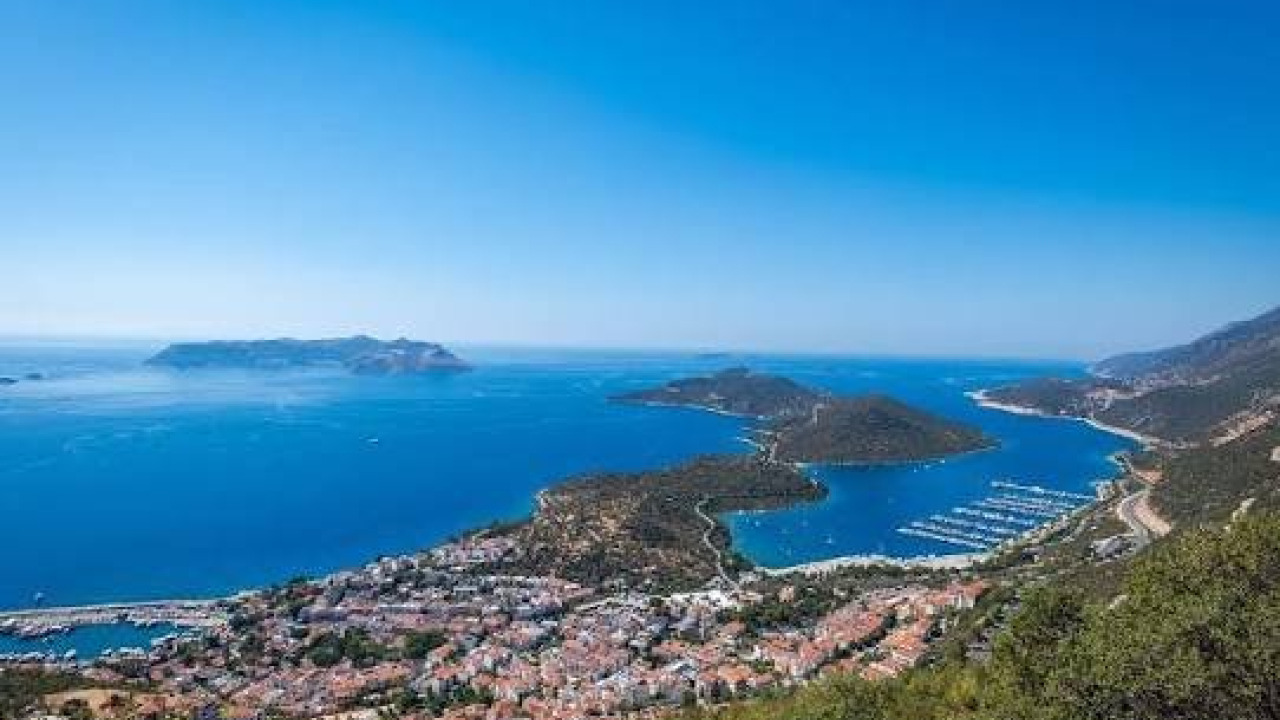

The secret to planning a successful 2-day Kaş itinerary is simple: don't try to cram the town and its surroundings into a single day. Kaş town itself is wonderfully walkable, with its ancient theater, charming bazaar, and pebble beaches all within easy reach, easily filling a full day. However, nearby gems like Kaputaş, Patara, Kekova, and Saklıkent demand a separate day. The winding coastal roads between them mean travel times are longer than they appear on a map. In this guide, we'll break down your two days hour by hour, compare alternatives for your second day, and cover transport options, costs, budget considerations, and practical tips that truly work on the ground. Our focus is on fitting each stop into your schedule; for detailed historical information on each site, our comprehensive Kaş travel guide, linked at the end of this article, offers a more in-depth starting point.
Is a 2-Day Kaş Trip Enough for You?
A two-day itinerary has clear limits: the town center, one beach area, and one major surrounding attraction can comfortably fit. Adding a second major attraction means a significant portion of your day will be spent in transit, as even 40 kilometers on the coastal road can take over half an hour. Here's how different trip lengths break down:
The Difference Between 2, 3, and 4 Days in Kaş
- 2 days: Day one covers Kaş town center, the Antiphellos theater, the King's Tomb, the bazaar, and walkable beaches. Day two is dedicated to either the Kaputaş and Patara route or a Kekova boat trip. This split means day one is car-free, while day two requires transport.
- 3 days: You can dedicate day two to the land route (Kaputaş, Patara) and day three to a boat trip. This is an efficient split for those who want to separate swimming and historical exploration.
- 4 days and beyond: More distant attractions like Saklıkent Canyon, Xanthos, Demre, and even highland villages can be added to your itinerary. You'll also have the luxury of leaving a half-day free for relaxation.
- Weekend getaway: Typically structured with arrival on Friday evening, exploring the town center on Saturday, and the land route on Sunday. Be sure to allocate Sunday afternoon for the journey back, as it can be long.
Which Month is Best for a 2-Day Kaş Itinerary?
The same two-day plan can feel completely different in May versus August. During the peak summer, sun-exposed attractions must be visited in the morning. In spring and autumn, midday visits are also pleasant.
| Period | Sea & Weather | Impact on a 2-Day Plan |
|---|---|---|
| April, early May | Mild weather, cool sea | Ancient sites and canyons are enjoyable, swimming is limited |
| Late May, June | Sea warms up, moderate crowds | Easy to balance history and beach time |
| July, August | Hot and crowded | Open-air stops are best in the morning, midday heat spent in a cool break |
| September | Warm sea, crowds lessen | Ideal for boat trips and beach days |
| October | Mild weather, swimmable sea | Days shorten, evening activities start earlier |
| November to March | Increased rainfall, fewer boat trips | Itinerary focuses on the bazaar, museums, and ancient sites |
Quick Facts for Your Kaş Trip
| Topic | Information |
|---|---|
| Location | Westernmost tip of Antalya, Lycian coast; approx. 185 km from city center |
| Itinerary duration | 2 days, 1 night; can extend to a third day with Kekova or Xanthos |
| Day one | Kaş town center, Antiphellos theater, King's Tomb, Küçük Çakıl and Büyük Çakıl beaches, public beach, İnceboğaz |
| Day two | Kaputaş, Patara ancient city and beach; alternatively, Kekova, Üçağız, and Kaleköy boat trip |
| Best time to visit | May, June, September, October |
| Airports | Dalaman approx. 160 km; Antalya approx. 200 km |
| Car needed? | Town center is walkable; for Kaputaş and Patara, use a dolmuş, tour, or rental car |
| Visiting hours | Patara's announced hours are 08:00 to 20:00; winter schedule closes earlier |
| Museum Pass valid | Patara, Xanthos, Myra, and St. Nicholas Church |
| Museum Pass not valid | Saklıkent National Park entrance and Kaputaş Beach facilities |
| Boat trips | Daily programs typically run from 10:00 to 17:00 |
| Walking distance | Bus station, bazaar, theater, and Küçük Çakıl are 10 to 20 minutes apart |
Getting to Kaş and Transport Decisions for Your 2-Day Plan
Kaş doesn't have its own airport, and on a two-day itinerary, travel time directly cuts into your sightseeing. Therefore, your airport choice, arrival time, and transport decisions are crucial. The coastal road offers stunning views but is winding, so allow more time than maps suggest.
Antalya or Dalaman: Choosing Your Airport
Dalaman is closer to Kaş, while Antalya offers a wider variety of flights. If you arrive at Dalaman on an early morning flight, you'll save a significant portion of your first day. An evening arrival, however, effectively turns your first day into a travel day.
| Option | Approx. Distance & Time | Notes |
|---|---|---|
| Dalaman Airport | 160 km, 2.5 hours | Coastal road via Fethiye; transfer options increase in season |
| Antalya Airport | 200 km, 3 to 3.5 hours | Airport is east of the city center, Kemer and Demre route is winding |
| Bus (Antalya direction) | Around 3.5 hours | Kaş bus station is within walking distance of the center |
| Bus (Fethiye direction) | Around 2.5 hours | Passes Kalkan and Kaputaş turn-offs |
| Dolmuş (Kaputaş, Kalkan) | Kaputaş 20 km, Kalkan 27 km | Services are frequent in summer, less so in winter |
| Rental car | Patara 40 km, Saklıkent 65 to 85 km | Comfortable for the second day's land route |
Ways to Reduce Your Flight and Transfer Budget
- Scan both airports. Dalaman and Antalya prices can differ for the same dates; the approximately 40-kilometer distance difference might offset a higher ticket price.
- Plan different arrival and departure airports. Landing in Dalaman and departing from Antalya allows you to see the entire coastal road once. If renting a car, factor in the extra cost for dropping it off at a different location.
- Look for mid-week flights. Friday evening and Sunday evening departures are peak times. Tuesday to Thursday generally offer more relaxed rates.
- Plan your transfer when booking tickets. The journey between the airport and Kaş is 2.5 to 3.5 hours. Public transport is less frequent for late-night arrivals, so pre-arranged transfers eliminate waiting time.
- Don't add luggage or car class later. During peak summer, car rental upgrades can become very expensive last minute.
If you prefer to arrange your airport-to-hotel transfer according to your own schedule, you can explore Kaş hotel transfer options based on your arrival time.
Is it Possible to Travel Without a Car? Do I Need to Rent One?
You don't need a car for Kaş town center. The bus station, bazaar, theater, marina, and Küçük Çakıl are all within walking distance of each other; the longest stretch is just over fifteen minutes, and finding parking in summer is already a challenge.
For the second day, the question changes. Dolmuş services to Kaputaş and Kalkan are frequent in summer but less so in winter. It's wise to check the departure intervals and last service times when you arrive to avoid any evening surprises. Just tell the driver where you want to get off, and you can flag one down from the roadside for your return. Those taking a dolmuş to Patara will get off at the Gelemiş turn-off and walk the remaining inland road to the ancient site entrance, which can be tiring in hot weather.
Destinations like Saklıkent, Xanthos, or Üçağız will extend your day significantly if relying on public transport. In short: the town center is for walking, a single-stop day can be done by dolmuş, and a multi-stop land route is best with a rental car or a guided tour.
Day One: Kaş Town Center, Ancient Sites, and Walkable Coves
Day one is designed for exploring the town without a car, moving between the cooler morning hours and beach time. The times provided are for the summer season; in spring and autumn, you can shift each stop forward by about half an hour. This section offers an hour-by-hour flow; for detailed historical information on each stop and a full list of coves outside the center, the guide linked at the end of this article is more comprehensive.
09:00 Long Bazaar, Cumhuriyet Square, and Breakfast
Starting your first day in the bazaar makes sense for timing. Breakfast spots are open early, while souvenir and boutique shops open at varying times. Dedicating the early morning to eating and wandering the narrow streets, then saving shopping for the cooler evening, allows you to experience the same streets twice with different activities.
Cumhuriyet Square and its surroundings are a practical starting point for breakfast: the shade of the bougainvillea-lined streets is still cool at this hour, and tables aren't yet full. The streets leading down to the sea from the square are parallel, so you won't get lost. The stepped paths leading uphill connect to your second stop, the theater.
Within the bazaar, you'll find small galleries like Tuğra Art Gallery and artisan workshops, reflecting the town's long history of attracting artists. Opening hours vary, so you might find them closed early in the morning. It's safer to combine a gallery and workshop tour with your evening shopping.
The town also hosts a weekly local market. Ask your accommodation for its day and location to avoid a wasted walk. Stalls are liveliest in the morning and thin out towards midday.
10:30 Antiphellos Ancient Theater
The theater is located on the western slope of the town, a short walk uphill from the bazaar. Visiting here in the morning on a two-day plan has a tangible benefit: the area is completely open, the stone seating rows heat up by midday, and after 11:00, the light becomes challenging for photography.
The structure is dated to the Hellenistic period, mostly cited as the 1st century BC, with approximately 26 seating rows preserved to this day. Since the stage building is no longer standing, looking out from the rows offers an unobstructed view of the sea and Meis Island. The real "frame" here is the view framed by the ruins. Knowing that the town's ancient name was Antiphellos and that the settlement was built upon this city also explains why you'll see a sarcophagus standing in the middle of the bazaar.
The area is open, and there's no entrance fee, making it one of the stops that keeps your first day's entrance budget at zero. Catching the sunset light here is also an option, but for a two-day itinerary, dedicating the evening to the peninsula side is more efficient: the theater can be explored in 20 to 30 minutes in the morning, while sunset requires you to secure your spot in advance.
12:00 King's Tomb, Upper Streets, and Lunch Break
The King's Tomb (Lion Sarcophagus) stands on a high pedestal within the bazaar, and a visit takes only a few minutes. It's an monument you glance at as you pass by, so no separate hour needs to be allocated. Its real value lies in the surrounding stepped streets that open up to the upper neighborhoods. Wandering this stepped area for 20 to 30 minutes offers views of the harbor over the rooftops and a glimpse into the town's daily life. There is no entrance fee.
The reliefs on the sarcophagus lid and the Lycian inscription on its side foreshadow similar tomb traditions you'll encounter in nearby ancient cities. Seeing similar types in Patara on day two and Xanthos on day three thus creates a sense of continuity.
The 12:00 to 15:00 slot is the most challenging part of a two-day itinerary. Spending these three hours in open areas in mid-summer is exhausting and can spoil your afternoon beach enjoyment. Shady, courtyard cafes in the upper streets are perfect for this. Extending your lunch break here allows you to head to the beach in the afternoon and the peninsula in the evening feeling refreshed.
15:00 Küçük Çakıl Beach: A Walkable Gem from the Center
Küçük Çakıl is a ten-minute walk from the center, and this proximity is both the cove's advantage and its challenge: the area around the jetty fills up by midday, and between 13:00 and 15:00, the areas close to the shore become crowded. Leaving your swim for after 15:00 will allow you to find more space in the same cove. This is the second benefit of extending your cool lunch break.
The ground is pebbly, and the depth increases quickly, so water shoes make entering and, especially, exiting the water easier. The water is clear, and visibility is high, making snorkeling along the shoreline enjoyable for families with children too. There are businesses in the cove that rent sun loungers and umbrellas; fees are calculated daily and vary by season.
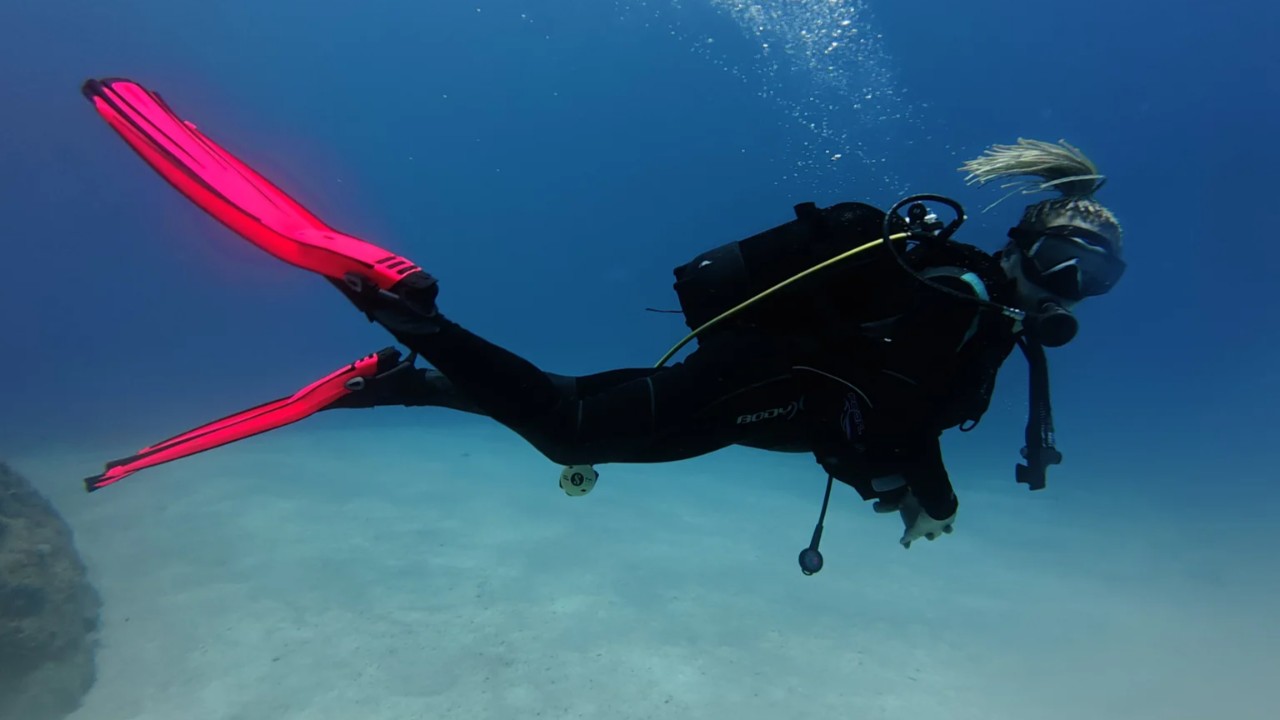
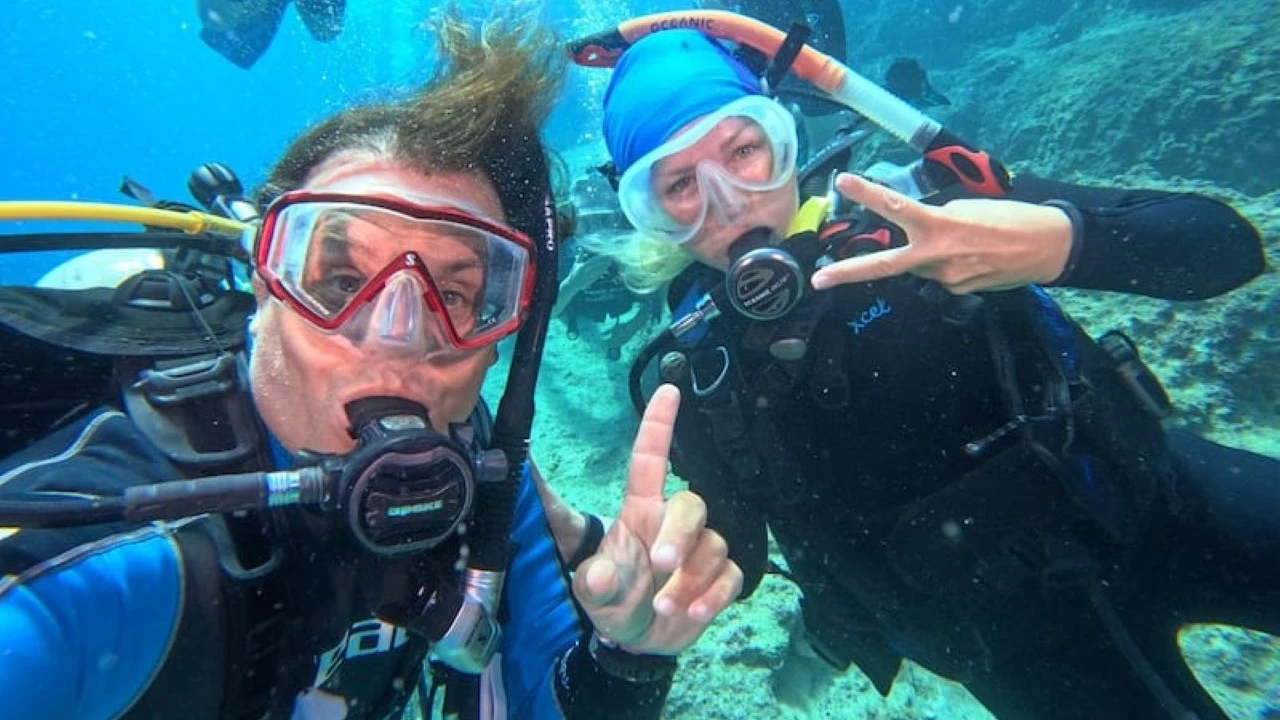
If you want to try snorkeling or diving in Kaş's high-visibility coves, you can fit Kaş sea adventure tours into half-day slots. The afternoon of your first day offers a suitable window for such an excursion.
16:30 Büyük Çakıl Beach: A More Spacious Shore East of the Center
Büyük Çakıl is located east of the center, 1.5 to 2 kilometers away, and as its name suggests (Büyük means "large"), it's a more spacious beach with coarser pebbles. It's walkable, but a dolmuş can be used during hot hours. The shoreline is wide, making it easier to find a spot to lay your towel compared to the central coves, and even in the late afternoon, the crowd remains dispersed.
Since the ground is made of large pebbles, water shoes are useful here too; large stones can become slippery when wet. Sun loungers and umbrella services from businesses are charged per item, so a visitor bringing their own towel can spend the day without extra payment.
Two details are crucial for timing. There is no natural shade along this stretch; even at 16:30, the sun can be intense without a hat and high-factor sunscreen. The afternoon breeze from the west can create waves, making the morning and early afternoon more comfortable for families with small children.
17:15 Kaş Municipality Public Beach: The Closest Budget-Friendly Option
Kaş Municipality Public Beach is within walking distance of the center and is the most budget-friendly option for your two-day beach plan. It operates as a public beach: basic amenities like showers and toilets are available, and sun lounger and umbrella rentals are charged separately. A visitor with their own towel can stay on the shore all day, while those wanting a sun lounger will add a daily cost.
Its proximity to the center is both the beach's strength and its limitation. The shoreline fills up by midday, and space opens up after the afternoon. Therefore, visiting the public beach after Büyük Çakıl allows you to experience two different beach characteristics on the same walk. The ground is pebbly, and the depth increases quickly, so life vests and water shoes enhance comfort for families with children.
This stop also serves as a reference point for budget comparison: a beach day at Kaputaş where sun loungers and umbrellas are rented will cost more than a day here. Those looking to plan a budget-friendly two days might allocate their beach spending to the second day rather than the first.
Hidayet Cove: A Short Detour Away from the Crowds
Hidayet Cove is smaller and quieter compared to the central beaches; even on a busy Saturday afternoon, your chances of finding a spot on the shore are higher than at Küçük Çakıl. The water is clear, and the shore is rocky, making it more efficient for a short snorkeling exploration than Büyük Çakıl.
Amenities are limited. You'll need to bring your own water, towel, and shade solution. Since the path down to the cove and the operational status of any businesses there can change seasonally, it's best to ask your accommodation for directions before heading out to avoid a wasted walk.
In terms of timing, this detour fits well into the late afternoon of day one. Adding it to day two would increase your travel burden, as day two is already packed with either Kaputaş and Patara or the Kekova route.
18:30 Sunset at İnceboğaz and on the Çukurbağ Peninsula Road
İnceboğaz, the narrow neck connecting the peninsula to the mainland, is about 1.5 kilometers from the center and a natural starting point for an evening stroll. With water on both sides of the road, the wind direction determines the comfort of your walk; on breezy days, one side might be wavy while the other remains calm.
Along the road, you'll find boutique hotels and stairs leading down to rocky coves. The sidewalk isn't continuous, so a phone light is useful when returning after dark. The west-facing direction is ideal for sunset, with Meis Island remaining a constant part of the Kaş panorama. Crossing to the island requires a passport, and ferry schedules vary by season, so it's not advisable to squeeze it into a two-day itinerary.
Sunset time shifts with the season: it's later in mid-summer and earlier in September and October. Check the exact time for your day and arrive 45 minutes beforehand to comfortably secure a spot at popular viewpoints.
20:30 Evening: Marina Area and Cumhuriyet Square
Evenings in Kaş follow a relaxed rhythm. A stroll along the promenade around Setur Kaş Marina offers an illuminated path among the yachts, perfect for a 20-minute pre-dinner walk. Around Cumhuriyet Square, you'll find small venues with live music. Ice cream parlors and dessert shops in the bazaar remain open until after dinner.
An effective way to structure your evening is to start with a marina walk, then head to dinner, and save your bazaar exploration and dessert break for after your meal. This way, shops you found closed in the morning will be open. During the summer season, making dinner reservations at popular spots, especially on Saturday nights, can significantly reduce waiting times.
Day Two: Kaputaş, Patara, and Saklıkent Route Step-by-Step
Day two's land route heads west, featuring a cove at a canyon mouth, a Lycian city unearthed from sand, and, for those interested, a cool-water canyon. The rule for sequencing is simple: two sun-exposed stops are scheduled for the cool morning, the peak heat is spent on a long lunch break, and a stone-paved town is left for the late afternoon.
- 07:15 Breakfast and departure. Head west from Kaş center, towards Kalkan. Bring water, a hat, water shoes, and non-slip footwear.
- 08:00 Kaputaş Beach. This cove, about 20 kilometers from Kaş center, is reached by a long staircase from the roadside. At this hour, the water is calm, roadside parking is plentiful; since there's no natural shade in the cove, arriving early directly translates to comfort.
- 10:00 Patara Ancient City. From Kaputaş, it's about a 20-kilometer drive via Kalkan to Gelemiş. Enter through the ancient site's ticket office and walk the route covering the monumental arch, assembly building, theater, and harbor basin. This section takes 1.5 to 2 hours, and as the area is open, it becomes challenging after 12:00.
- 12:15 Long lunch break in Gelemiş. Spend the hottest part of the day in the cool establishments within the village. A two-hour break is not wasted time; it allows you to visit the ancient site in the morning and the beach in the afternoon.
- 14:15 Patara Beach. Your ancient site ticket also covers the beach, so you won't pay again. Descend to the beach via the wooden boardwalk and plan to rent an umbrella; the sand will be hot at this hour, so closed-toe shoes make walking easier than flip-flops.
- 16:15 Kalkan break. On the way back, it's about 13 kilometers from Gelemiş to Kalkan. An afternoon stroll through the stone streets and a coffee break coincide with the cooling of the town's terraces.
- 18:00 Return to Kaş or decision time. 27 kilometers remain from Kalkan to Kaş. Those wishing to add Saklıkent Canyon to the same day must shorten their beach break and turn towards Kınık in the afternoon. For a two-day plan, leaving the canyon for a potential third day is a more realistic approach.
Kaputaş Beach: Staircase Descent, Fee Structure, and Best Timing
Kaputaş is a canyon-mouth beach formed where the valley behind it meets the sea; the water's color palette and coolness stem from this formation. Shallow waters near the shore turn turquoise, while further out, the sea becomes deep blue. The beach is accessed by a long staircase from the roadside; sources commonly cite 187 steps, but this number may change as the staircase has been renovated. The descent is easy, but the return climb is tiring, so cooler hours are advantageous.
Regarding fees, Kaputaş has a unique system: the cove is not an ancient site but a beach operated by Kaş Municipality. This has two practical consequences. First, the Museum Pass is not valid here, as it's used for museums and ancient sites under the Ministry of Culture and Tourism. Second, sun lounger and umbrella services are charged per item, separately from any entrance fee. Since entrance policies can vary by season and municipal regulations, it's advisable to confirm the current situation at the entrance on your travel day; having cash on hand also simplifies things. In terms of cost: a day at Kaputaş with rented sun loungers and umbrellas will be more expensive than a day at the central public beach with your own towel, but it remains a small expense compared to a guided boat tour.
The ground is a mix of sand and small pebbles, natural shade in the cove is limited, and there is an operated cafe section. Parking is not arranged as a separate area; vehicles park along the roadside, and finding a spot becomes difficult after 10:00 in summer. For those arriving by dolmuş, simply tell the driver where you want to get off; for the return, wait at the same roadside spot.
Approximately 600 meters east of the cove, beneath steep cliffs, lies the Blue Cave. There is no land access; the cave can only be entered from the sea, so a visitor descending to Kaputaş by stairs cannot see the cave. If you wish to see the cave on your two-day plan, you'll need to switch your second day from the land route to a boat trip.
Patara: Combining Ancient City and Beach on One Ticket
Patara is located in Gelemiş, a village within the Kaş district, approximately 40 kilometers from the center. The common assembly of the Lycian League met in the bouleuterion of this city, which is why Patara is considered the capital of the league. The site features a monumental entrance arch, the assembly building, a theater, a colonnaded street, and a harbor basin filled with sand. Sources also mention one of the world's oldest known lighthouses in this area. The ancient site ticket includes access to the beach, and the Museum Pass is valid here, meaning history and sea are combined with a single payment.
The fee structure operates under the Ministry of Culture's ancient site logic: separate tariffs apply for local and foreign visitors, and current tariffs and hours can be found on muze.gov.tr. The announced visiting hours are from 08:00 to 20:00; in the winter schedule, closing times are earlier, and the last entry is some time before closing.
The beach is a caretta caretta (loggerhead sea turtle) nesting area, and this has a clear impact on the schedule: between May 1st and September 30th, access to the beach is closed from 20:00 to 08:00, with administrative fines for violations. The beach stretches uninterrupted for approximately 18 kilometers and has no natural shade; therefore, a visit combining the ancient site and the beach requires more than half a day. Staying on the wooden boardwalk over the dunes is a conservation rule and also a matter of comfort, as the sand gets hot at midday. Those arriving without a car will get off at the Gelemiş turn-off and complete the remaining 5 to 6 kilometers of inland road to the ancient site entrance, so if you're coming by dolmuş, opt for the morning hours.
Xanthos: UNESCO Site in Kınık and Central Lycian City
Xanthos (Ksanthos) is located in Kınık village, on the road between Patara and Saklıkent, approximately 20 kilometers from Kalkan. It is known as one of the largest and most important cities of Lycia; together with the Letoon sanctuary, about 4 kilometers away, it is listed as a dual UNESCO World Heritage site. While the league's assembly met in Patara, the administrative weight of the region rested in Xanthos, making the two sites complementary rather than alternatives.
The main sections visible at the site are the Roman theater, the pillar tombs next to it, the colonnaded street, and inscribed pillars. The inscriptions carved in Lycian script complement the linguistic aspect of the tomb tradition you saw at the King's Tomb in Kaş bazaar on day one and in Patara on day two. The Museum Pass is valid at Xanthos; when combined with Patara on the same day, the pass is used at both sites, making it a typical combination that helps the card pay for itself within a two-day budget.
The area is exposed to the sun, and the morning light is softer in the colonnaded street and theater sections. In terms of timing, it must be said: Xanthos is a forced addition to a two-day itinerary, as adding a third ancient site to a plan already squeezing Patara and Saklıkent into the same day will push your return into the night. For those who can add a third day, Xanthos and Letoon comfortably fit into the same morning.
Saklıkent Canyon: Cool Water, Wooden Walkway, and National Park Fees
Saklıkent is a deep canyon located towards Fethiye and is one of the few cool refuges during the summer heat. Sources vary on the distance from Kaş: depending on the route taken and your starting point, it's approximately 65 to 85 kilometers, with the difference widening if returning via Patara or Gelemiş. It's safer to plan based on the higher end of this range.
At the entrance, a wooden walkway attached to the rock leads to the mouth of the canyon. To proceed further, you must cross the icy flowing water, so water shoes or non-slip sandals are essential. Water levels vary by season: in spring, snowmelt increases the flow, and passage might be restricted; July to September is generally the most comfortable period.
Canyon entrance is subject to a fee, and its tariff is structured differently from other stops on the route. The area is within Saklıkent National Park boundaries; the fee for foreign visitors is determined by the General Directorate of National Parks, and for local visitors by Seydikemer Municipality. This means separate tariffs apply for local and foreign visitors at the same entrance. The Museum Pass cannot be used here, as the card is valid for museums and ancient sites, and national park entrances are outside this scope. Crowds increase in the afternoon, so it's best to enter before midday if possible.
Adding the canyon to day two of a two-day itinerary will push your return into the evening. A guided Kaş nature adventure tour program, however, takes the driving burden off your shoulders and makes it easier to fit this route into a separate day.
Three Alternatives for Day Two: Kekova, Kalkan, Demre
The land route isn't for everyone. Those who prioritize swimming might prefer to spend their second day at sea, while those who prefer shorter distances might opt for a half-day itinerary. This comparison offers different experiences for the same duration.
| Alternative | Duration | Who it suits | Point to note |
|---|---|---|---|
| Kekova boat trip | Full day, 10:00 to 17:00 | Those seeking swimming breaks and coves | Swimming and diving over the sunken city are prohibited |
| Kaputaş and Patara land route | Full day | Those wanting to combine history and beach | Little shade, Kaputaş sun loungers are an extra cost |
| Kalkan and Çukurbağ scenic route | Half day | Those who enjoy short walks and bazaars | Kalkan gets busy on summer evenings |
| Demre: Myra and St. Nicholas | More than half day | Those interested in ancient cities and churches | Midday heat in open areas can be challenging |
Kekova Island and the Sunken City: The Underwater Coastline
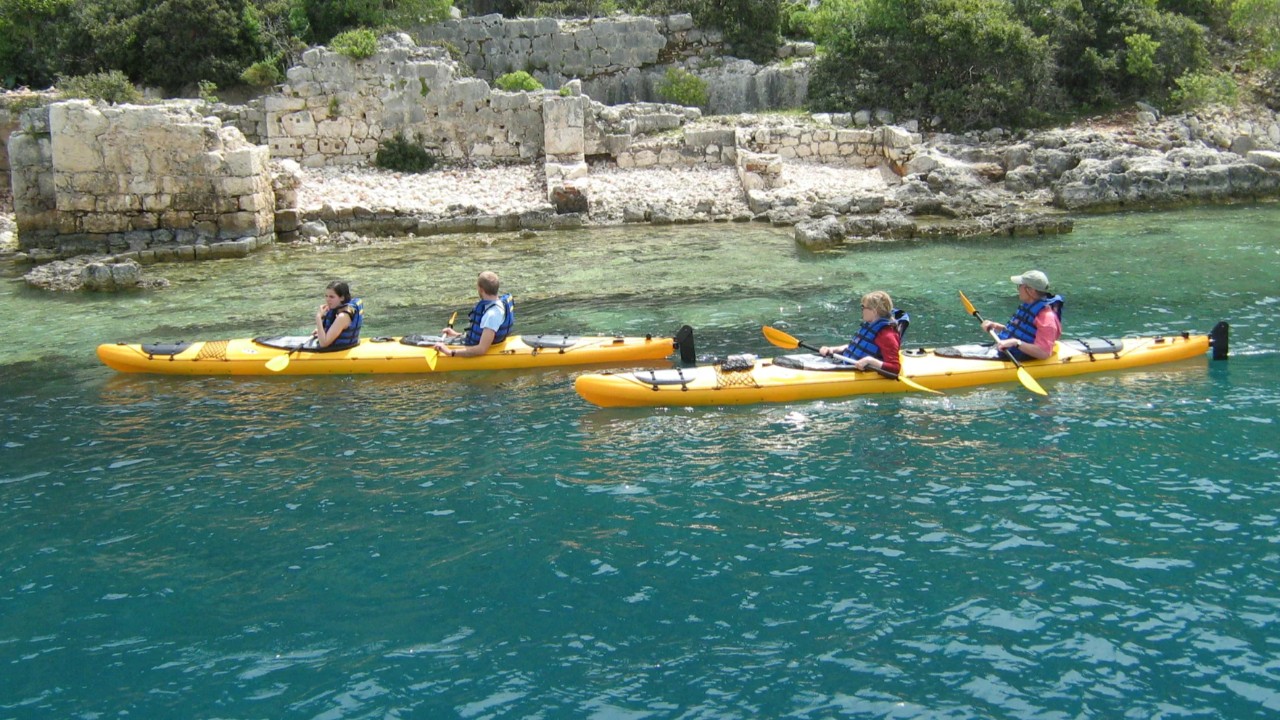
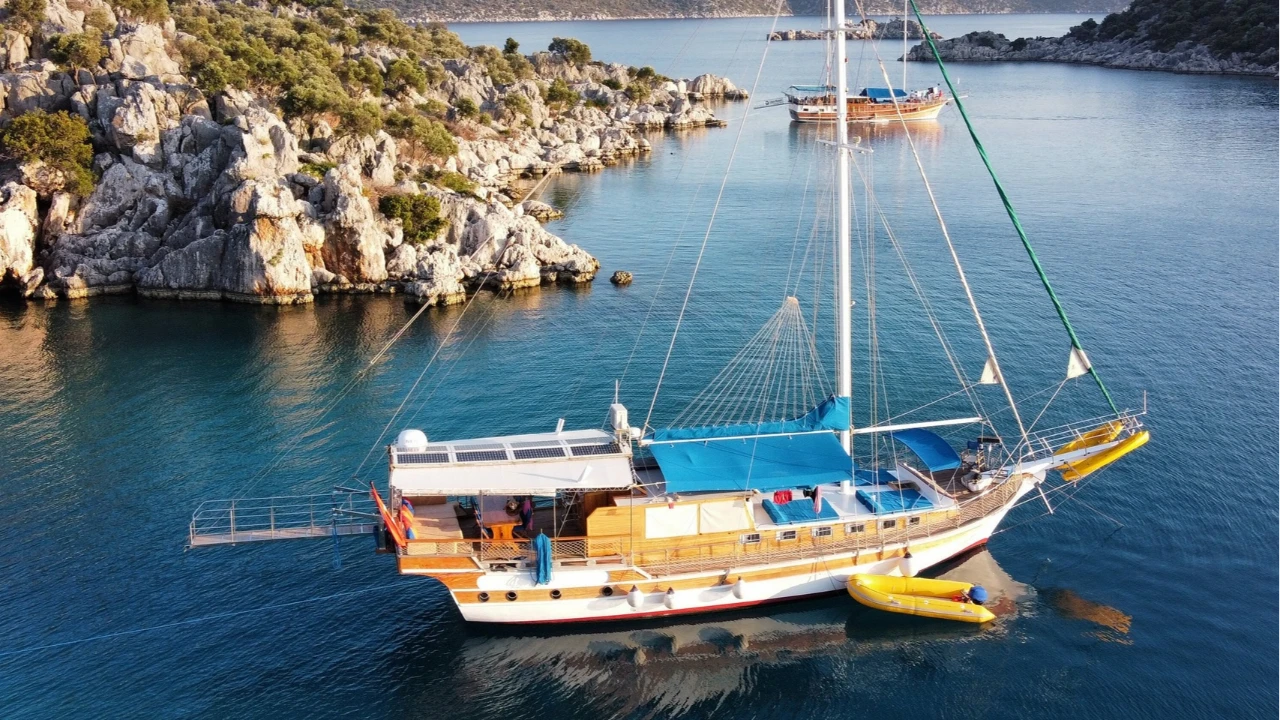
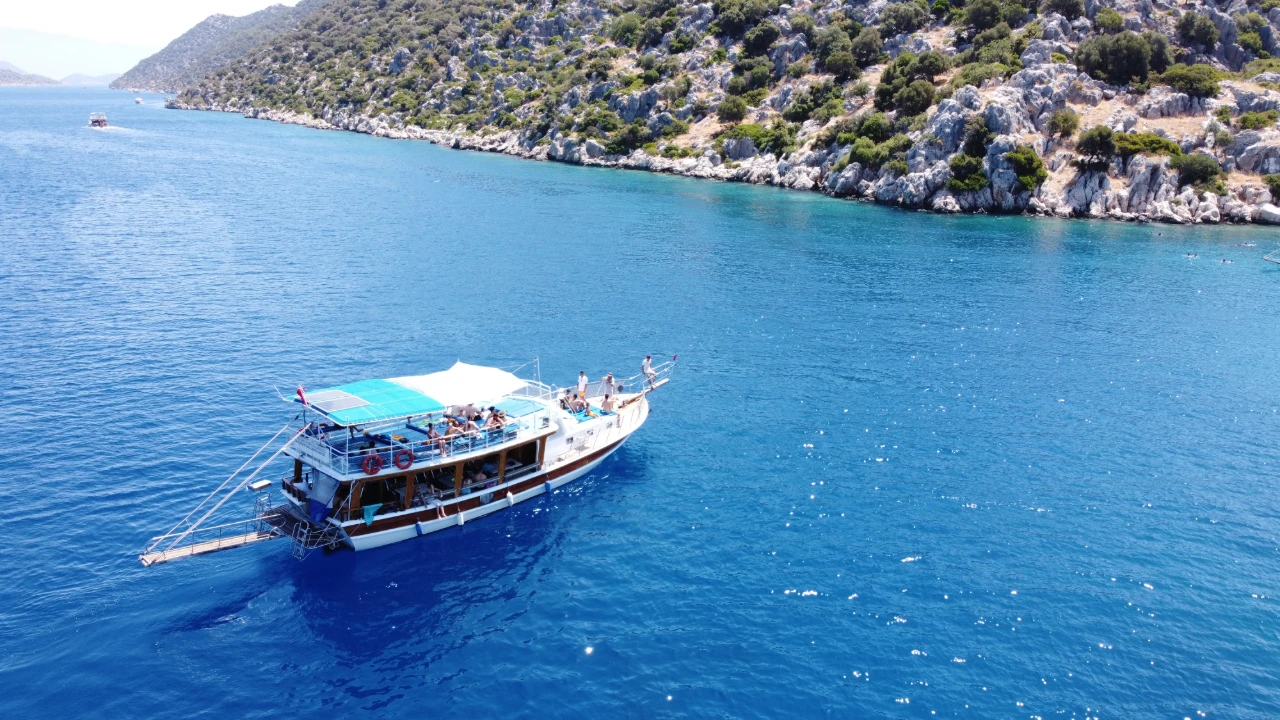
Kekova is the name of the protected marine area between Demre and Kaş, named after the long, uninhabited Kekova Island offshore. The ruins known as the sunken city stretch underwater and along the waterline of the island's northern coast: walls, steps, and building foundations submerged by earthquakes are viewed from the boat. A "Kekova tour" on a program page typically describes a day that includes not only the sunken city but also surrounding coves and villages.
The region is a Special Environmental Protection Area, so swimming and diving over the ruins are prohibited; swimming breaks are taken in neighboring coves. This rule also dictates the route itself: the boat slows down over the sunken city, then moves to another cove for a swimming break, so the duration of swimming depends on the captain's route choice.
Timing directly affects visibility. In morning excursions, the water surface has less reflection, making the ruins clearer. The strengthening wind in the afternoon can bring both waves and turbidity. Daily programs usually depart around 10:00 and return around 17:00, and lunch may be included; this detail should be clarified upon reservation.
Üçağız (Teimiussa): The Closest Departure Village to the Sunken City
Üçağız, officially Kaleüçağız, is the closest harbor to the sunken city area. It's approximately 35 to 40 kilometers from Kaş center, taking about 45 minutes by car. The ancient Teimiussa settlement lies beneath the village; Lycian sarcophagi and rock tombs lining the rocks near the jetty can be seen on foot before boarding the boat. Therefore, Üçağız is not just a parking lot added to a boat tour but a half-hour stop in its own right.
The departure point directly changes your two-day plan. Boats departing from Üçağız reach the ruins quickly, allowing more coves and longer swimming breaks within the same duration. Programs departing from Kaş harbor, however, spend travel time on the boat, saving you a 40-kilometer land drive. Those arriving by car leave their vehicle in Üçağız, as there is no road connection to Kaleköy, further along the route.
Restaurants line the jetty, and lunch is provided here or on the boat in most programs. Those wishing to catch the first boat of the morning should check the departure time upon reservation and plan the 45-minute drive accordingly; this means having an early breakfast on your second day.
Kaleköy (Simena): Castle, Underwater Sarcophagi, and Stepped Village
Kaleköy is a settlement built upon ancient Simena and is the most recognized stop on the Kekova route. There is no road connection to the village: access is by boat or a footpath starting from Üçağız, which keeps the village free from car noise for most of the day.
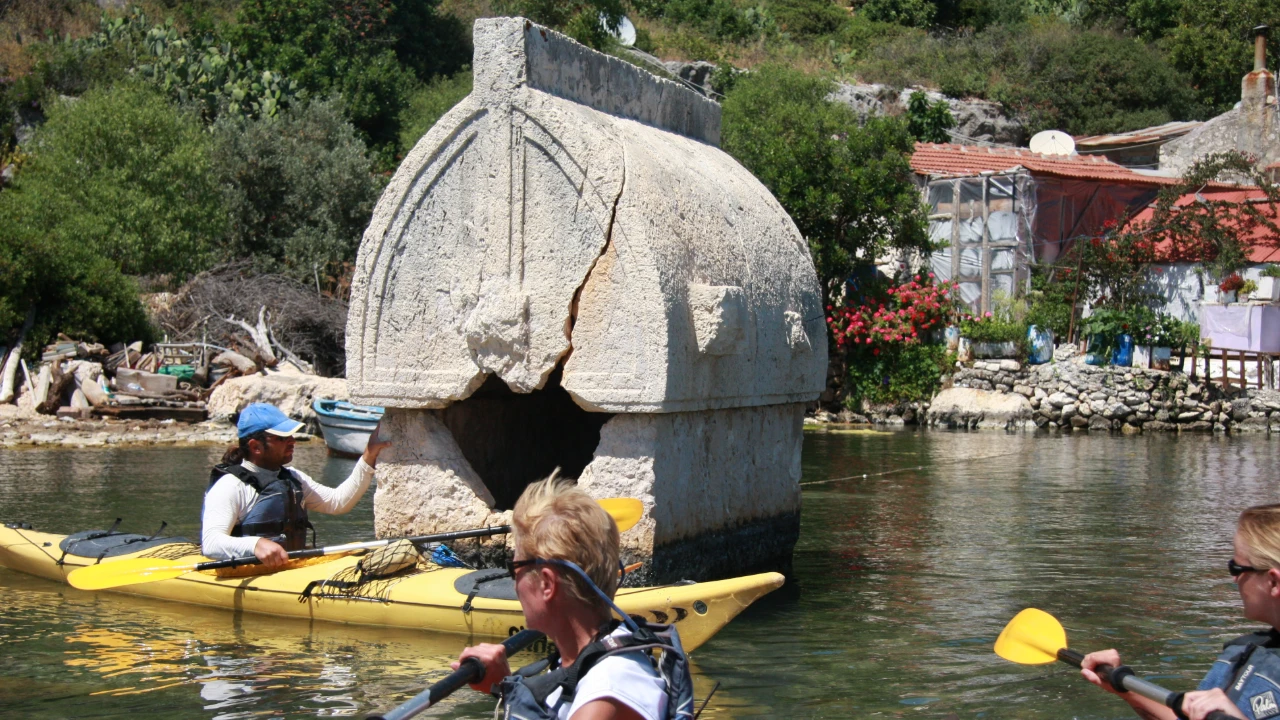
There are two main sights. First, Simena Castle on the hill: the climb is short and stepped, but as the steps are uneven, non-slip shoes make it easier. From the castle, Kekova Island, the strait, and the village rooftops are all visible in one frame. Second are the Lycian sarcophagi standing in the waters near the shore; these sarcophagi, both in the water and along the coastline, form the iconic image of the tour.
On programs that stop at Kaleköy, the boat waits at the jetty for a period, and this waiting time is the most critical detail of the day. Those planning to climb to the castle should ask about the duration of the stop when booking, as the time might not be enough if you also plan to sit at a restaurant on the jetty. On a two-day itinerary, Kaleköy is the busiest half-hour for a traveler choosing the boat tour on their second day.
Akvaryum Bay: Kekova Route's First Long Swimming Break
Akvaryum Bay (Aquarium Bay) gets its name from the clarity of its water; the seabed is clearly visible from the surface, confirming its name even before you enter the water. It's located in the western part of the Kekova region and is one of the early stops on routes heading east from Kaş harbor, so the first long swimming break of the day often happens here.
The duration of the break varies by program type. Short tours departing from Üçağız are often limited to the sunken city route, Kaleköy, and Akvaryum Bay trio, with a break here lasting around half an hour. Full-day programs departing from Kaş stay longer in the same cove. There is no natural shade on the shore, so if the break coincides with midday, the shaded area of the boat is more comfortable.
A word of caution: the same name is also used for other coves in the Göcek and Fethiye bays. If Akvaryum Bay is mentioned on the program page alongside the sunken city and Üçağız, it refers to the cove on the Kekova route. If it's mentioned with Yassıca Adalar or Ölüdeniz, it refers to a different region. Asking which Akvaryum Bay is meant during reservation will clear up any confusion.
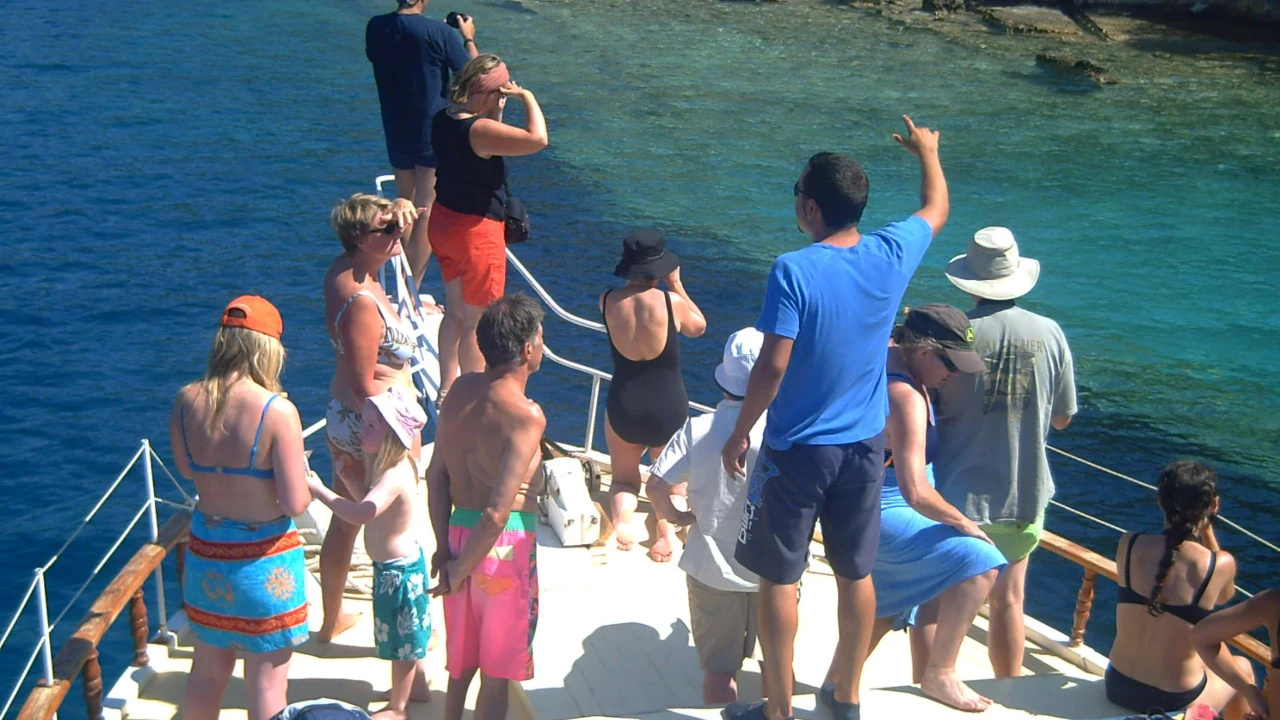
Kalkan and the Çukurbağ Scenic Route
Kalkan is a town with stone streets built on a hillside, approximately 27 kilometers from Kaş. Its harbor, surrounded by terrace restaurants, and its narrow streets with boutique shops are enough for a half-day trip. Kalkan's beach is pebbly and within walking distance of the center. For those who prefer to stay on the peninsula side, the Çukurbağ area, with its stepped paths leading down to coves and west-facing viewpoints, is suitable for an afternoon walk.
Leaving Kalkan for the afternoon and early evening aligns well with the flow of day two; morning hours are more valuable for sun-exposed Kaputaş. Since parking can be an issue in Kalkan center on summer evenings, it's practical to park in the upper parts of the town and walk down.
Demre: Myra and St. Nicholas Church
Demre is located approximately 45 kilometers east of Kaş and offers two significant stops: the ancient city of Myra, known for its rock tombs, and the church named after St. Nicholas, also known as Santa Claus. The theater at Myra and the house-type rock tombs carved into the hillside are seen side-by-side, making the area ideal for understanding Lycian tomb architecture. The church is a well-preserved structure with frescoes and floor mosaics, and as an indoor space, it's comfortable to visit during hot hours.
Since the two stops are close, half a day is sufficient; however, the return journey to Kaş must also be factored in. The Museum Pass is valid at both these sites, making it budget-friendly to combine two entrances on the same day. Current tariffs and visiting hours, as they are ministry sites, can be found on muze.gov.tr. Closing times are earlier in winter.
Which Tour Suits Which Day?
On a two-day itinerary, your choice of tour directly impacts how your days are divided. A full-day boat trip will completely fill your second day, while a half-day diving or snorkeling excursion fits well into the afternoon of your first day. This table offers a quick match-up based on duration and suitability.
| Tour Type | Duration | Best Day | Who it's for |
|---|---|---|---|
| Daily boat trip (Kekova, coves) | 6 to 7 hours | Day two | Those wanting swimming breaks |
| Diving and snorkeling program | Half day | Day one afternoon | Those seeking an underwater experience |
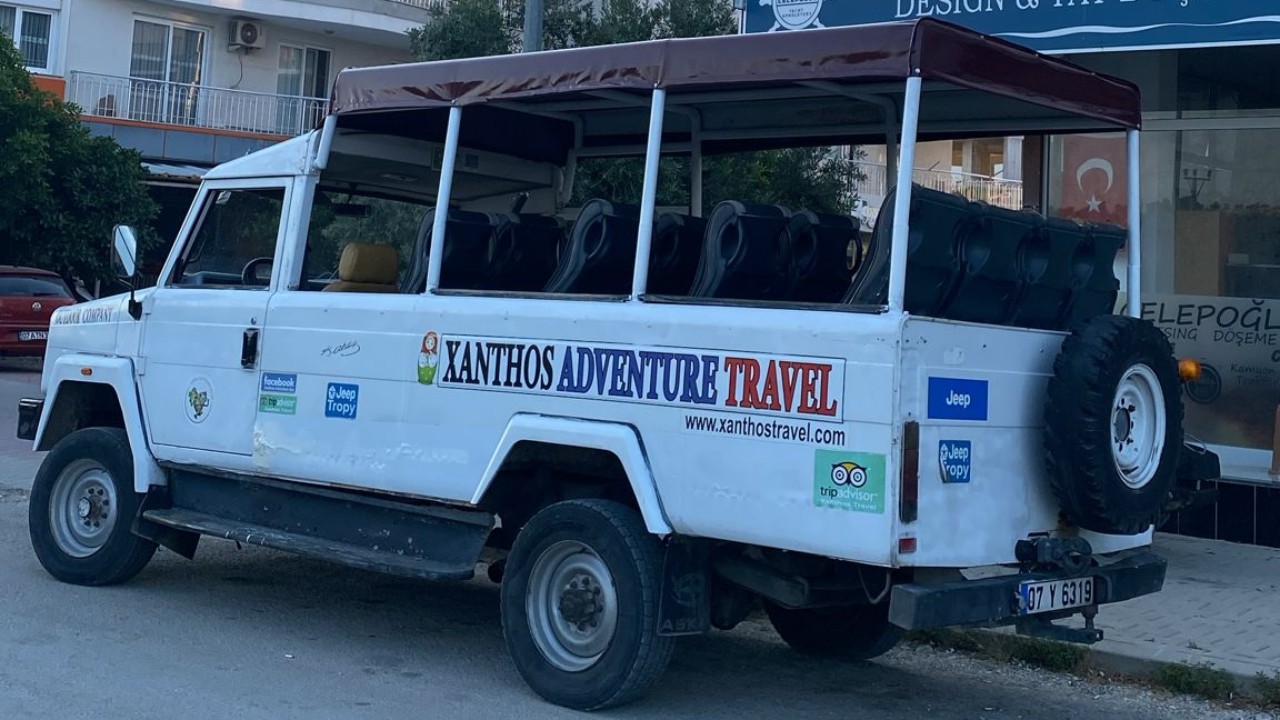
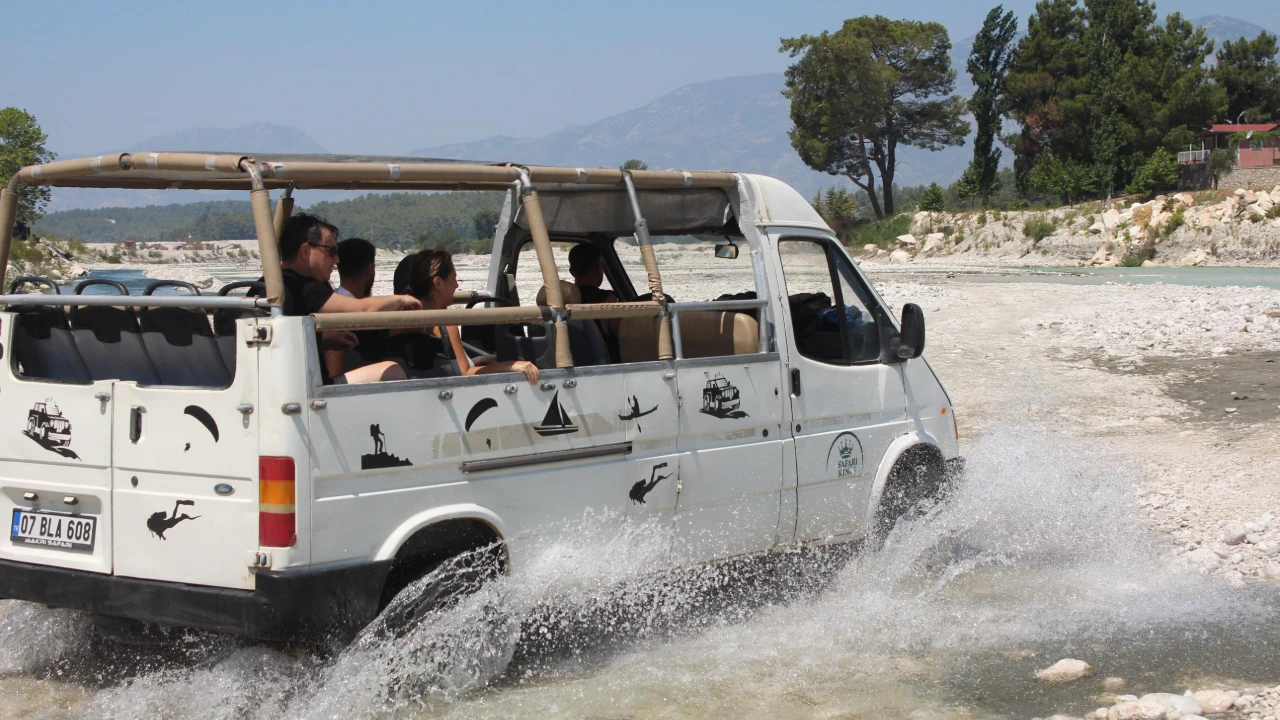
| Jeep safari (highlands and ancient sites) | Full day | Day two | Those wanting a guided land route |
| Canyon and nature walk | Full day | Day two | Those seeking coolness and hiking |
| Airport and hotel transfer | 2.5 to 3.5 hours | Arrival and departure day | Those traveling with luggage |
When deciding on a boat trip, the departure point comes before the price: a program departing from Kaş harbor saves you a land drive, while one departing from Üçağız allows you to spend more time on the Kekova route. Factors determining the price include boat type (shared or private), route length, group size, and whether lunch is included; current prices are live on program pages. To compare routes and departure times, you can check Kaş boat and yacht tours and plan your second day accordingly.
The jeep safari row in the table corresponds to Kaş jeep safari tours; this option combines ancient cities like Xanthos and highland villages into one day, making it an alternative for day two for those who prefer not to arrange their own land route.
2-Day Kaş Budget: What Affects Each Cost Item
The shape of a two-day budget in Kaş comes more from your choices within each category than from the number of items. The same itinerary can be experienced on a lower budget by opting for dolmuş and guesthouses, or on a higher budget with private transfers and peninsula hotels. In this guide, we won't list absolute figures, as tariffs are updated throughout the year and quickly become outdated. Instead, we'll explain what influences each cost item and how they rank relative to each other. For tour and activity prices, the Kaş boat and yacht tours page linked above shows live current prices.
| Item | Budget-Friendly Plan | Comfortable Plan | Factors Determining Price |
|---|---|---|---|
| Accommodation (1 night) | Bazaar area guesthouse | Çukurbağ Peninsula boutique hotel | Season, view, breakfast included |
| Intercity transport | Bus and dolmuş | Rental car or private transfer | Car class, season, distance, drop-off at different location |
| Ancient site entrances | Museum Pass with no extra payment | Ticket plus guide service | Museum Pass, local or foreign tariff, number of sites visited |
| Boat trip | Shared boat | Private boat rental | Departure point, boat type, route length, lunch included, group size |
| Food and drink | Gözleme and home-cooked meals | Seafood around the marina | Type of fish, season, location of establishment |
| Beach services | Day with towel at central public beach | Sun lounger and umbrella at Kaputaş | Beach operation rules, number of sun loungers, day and time |
Ranking the items relative to each other provides a more enduring guide than specific numbers:
- Accommodation is the largest item in a two-day budget; transport comes second, while ancient site entrance fees are lower on the list.
- Private boat rental is significantly more expensive than a shared daily boat trip; the per-person difference narrows as the group size increases.
- Private airport transfer is more expensive than taking the bus and dolmuş for the same journey; for four people, the difference narrows, and a rental car saves time on the second day's land route.
- A beach day at Kaputaş with rented sun loungers and umbrellas is more expensive than a day at the central public beach with your own towel.
- For a traveler with a Museum Pass, the entrance fees for day two will be limited to Saklıkent and Kaputaş, as ministry sites on the route are covered by the card.
Paid Entrances and Museum Pass: Where Each Card is Valid
| Stop | Fee Structure | Museum Pass | Local & Foreign Tariff | What affects it and where to confirm |
|---|---|---|---|---|
| Patara ancient site and beach | Ministry ancient site ticket; ticket includes beach | Valid | Separate tariffs apply | Annual tariff updates; muze.gov.tr and ticket office |
| Xanthos | Ministry ancient site ticket | Valid | Separate tariffs apply | If combined with Patara on same day, card used at both sites; muze.gov.tr |
| Myra and St. Nicholas Church | Ministry site, two separate entrances | Valid | Separate tariffs apply | Combining two entrances on same day; muze.gov.tr |
| Saklıkent Canyon | National park entrance | Not valid | Foreign fee by General Directorate of National Parks, local fee by Seydikemer Municipality | Visitor status and vehicle entry; entrance ticket office |
| Kaputaş Beach | Kaş Municipality operation; sun loungers and umbrellas charged separately | Not valid | Determined by municipal regulations | Seasonal decision and sun lounger preference; entrance point |
| Antiphellos theater and King's Tomb | No fee | Not needed | None | Open area, no extra conditions |
| Kaş Municipality Public Beach | Public beach operation; sun lounger and umbrella rental separate | Not needed | None | Sun lounger and umbrella preference |
The table shows three different management structures, and the difference isn't just in the cost, but also in which card is valid. Patara, Xanthos, Myra, and St. Nicholas are Ministry of Culture and Tourism sites: the Museum Pass is valid, and separate tariffs apply for local and foreign visitors. At Saklıkent National Park, entry is subject to national park regulations, and two different institutions determine the tariff. Kaputaş, on the other hand, is a municipal operation, and its regulations can change with seasonal decisions.
This distinction also informs the Museum Pass decision: for a traveler visiting two or three ministry sites in two days, the card is a worthwhile option. If only one site is visited, a regular ticket is more economical. Since the central stops on day one don't require fees, the two-day entrance budget effectively falls on day two. Planning accordingly will clarify how much cash to allocate for each day.
Factors Determining Transport and Boat Budget
The flexibility of a two-day budget in Kaş largely comes from transport. For airport transfers, the determining factors are distance (160 to 200 kilometers), vehicle type, and arrival time; for night arrivals, public transport is less frequent, so costs tend to be higher. For car rentals, July and August are peak periods, while the same class of vehicle is cheaper in May and October.
The decision ultimately depends on the number of people. For a two-person trip, a combination of dolmuş and walking in the center is usually the most economical solution, as the cost is per person, and two people take up less space. When you reach four people, the equation reverses: the daily cost of a rental car or private transfer, divided by the number of people, closes the gap with dolmuş fares, and a car saves time on the second day's land route. As the group grows, the same logic applies to boat trips; the per-person difference between a shared program and a private boat narrows.
For accommodation, the season is the determining factor. The difference between peak summer and May/October is evident in both central guesthouses and peninsula hotels. Rather than giving percentages, it's more accurate to say: don't expect to find the same room for the same price in August and October. View, whether breakfast is included, and distance from the center are other factors that determine the difference between price bands.
What to Eat and Where to Stay in Kaş
On a two-day itinerary, dining decisions are also budget decisions: dedicating one evening to seafood along the marina and another to home-cooked meals and meze spreads in the bazaar allows you to experience two different price points on the same trip. With Mediterranean seafood and highland herbs side-by-side on menus, these two evenings won't feel repetitive.
Dining in the Long Bazaar and Around the Marina
Restaurants around the marina offer sea bream, sea bass, grouper, and octopus according to the season; prices tend to be higher due to the scenic location. Smaller establishments in the Long Bazaar, however, offer more budget-friendly options with gözleme, home-cooked meals, and meze-heavy tables. The choice also depends on the time of evening: the marina area fills up after sunset, while tables in the bazaar remain empty for longer.
Local dishes feature stuffed zucchini flowers, olive oil dishes made with herbs like şevketibostan and sarıot, and samphire salad. The availability of these herbs is seasonal, and they may disappear from menus in winter. For breakfast, local honey, tahini, and village cheese are sought-after flavors. If you're heading out at 07:15 on day two, breakfast time becomes a critical part of your plan, as some bazaar establishments don't start serving early. Packing a snack the evening before solves this problem.
Seaside establishments around İnceboğaz, such as Ada Beach Restaurant, are a practical option for those wanting to combine a swimming break with lunch. When ordering fish, clarifying whether it's priced per portion or per kilogram avoids surprises on the bill; the type and season of the fish are the determining factors.
Accommodation Areas and Who They Suit
- Kaş center and Long Bazaar area: Practical for those traveling without a car; the bazaar, bus station, and beaches are within walking distance. The bazaar can be lively at night, so those seeking quiet might prefer inner streets.
- Çukurbağ Peninsula: A line of boutique hotels suitable for those seeking views and tranquility; 1.5 to 3 kilometers from the center, requiring a car or dolmuş for evening returns.
- Küçük Çakıl and Büyük Çakıl area: Ideal for those wanting beachfront accommodation; you can head straight to the beach after breakfast.
- Kalkan: 27 kilometers from Kaş; suits those who enjoy stone street architecture and terrace restaurants, and saves travel time for those planning their second day around Kaputaş and Patara.
- Gelemiş (Patara) and Üçağız: Logical for those seeking a rural guesthouse experience or dedicating their second day entirely to Patara or Kekova; staying in Üçağız makes it easier to catch the first boat of the morning.
Practical Tips Before You Go
- Water shoes and non-slip soles: Kaş coves are pebbly, the Kaputaş staircase is steep, Saklıkent's crossing is watery and slippery, and Simena Castle's steps are uneven. A pair of closed-toe shoes will determine the comfort of your two days.
- Dedicate mornings to open-air stops: In summer, 08:00 to 11:00 is the most comfortable time to find space in coves and ancient sites. Kaputaş and Patara ancient site should be scheduled for these hours; beach breaks, bazaar strolls, and canyon routes can be left for the afternoon.
- Carry cash: Cash is practical for dolmuş fares, small bazaar vendors, beach operators, and sun lounger rentals; card validity isn't consistent everywhere.
- Calculate your Museum Pass needs in advance: The card is valid at Patara, Xanthos, Myra, and St. Nicholas; it's not valid at Saklıkent National Park or Kaputaş Beach. The number of ministry sites you plan to visit in two days will determine your decision.
- Water and sun protection: Patara dunes, Xanthos site, and Kaputaş cove have no natural shade; a hat, sunglasses, and high-factor sunscreen are essential.
- Allow ample travel time: The coastal road is winding; planning with an extra 20 to 30 minutes added to map times will save your day.
- Clarify boat trip departure time and location: Programs usually depart around 10:00. Departures from Kaş versus Üçağız offer different numbers of stops within the same day, and routes might be shortened on windy days.
- Adhere to conservation rules: Staying on the wooden boardwalk at Patara dunes, observing the 20:00 rule on the beach, and not swimming over the sunken ruins in Kekova are legal requirements.
Quick Summary: How to Divide Your Two Days
The division follows your transport: day one is car-free, day two involves a car or boat. On day one, explore the town center, Antiphellos theater, King's Tomb, Küçük Çakıl and Büyük Çakıl beaches, the public beach area, and an evening at İnceboğaz. Dedicate midday to cool breaks and finish the evening around the marina and Cumhuriyet Square. For day two, choose either the Kaputaş and Patara land route or a full-day boat trip covering Kekova, Üçağız, and Kaleköy. By scheduling sun-exposed stops for the morning and stone-paved towns for the late afternoon, your day will be spent exploring, not just driving.
Regarding costs, keep two things in mind: the Museum Pass is valid at ministry sites like Patara and Xanthos but not at Saklıkent National Park or Kaputaş Beach. The Patara ticket also includes the beach, offering both history and sea for the same payment on day two. If you can add a third day, combine Saklıkent Canyon with Xanthos. For a fourth day, Demre and the highland villages await. If you're struggling to choose between stops, consult our Kaş attractions guide for site-specific details and narrow down your itinerary based on your interests.
Frequently Asked Questions 8
How should a 2-day Kaş itinerary be divided?
The division depends on transport: day one is car-free, covering the center and walkable coves, while day two involves a car or boat for surrounding attractions. Reversing the two days is also possible and makes sense if windy weather is forecast, as boat trips can be shortened or postponed in strong winds; the central day is least affected by weather conditions. If you arrive in the evening, scheduling the central day for the morning after your arrival allows you to make full use of both days.
Should I choose the land route or a Kekova boat trip for my second day?
The Kaputaş and Patara route combines history and beach, allowing you to set your own pace. A Kekova boat trip sets fixed departure and return times but eliminates the burden of driving. The decision hinges on three questions. If it's your first visit, the land route offers a broader introduction to the region; if you're returning, a boat trip reveals a new coastline. If traveling with small children, staying on a boat all day might be challenging. If someone is prone to seasickness, morning excursions are generally calmer than the afternoon when winds tend to pick up.
Do I need to rent a car for two days in Kaş?
You don't need a car for the central day; the bus station, bazaar, theater, marina, and Küçük Çakıl are all within walking distance. The decision comes down to day two and the number of people: for a two-person trip, a dolmuş is usually more economical because payment is per person; for four people, the daily cost of a rental car, divided by the number of people, closes the price gap, and a car saves time on the land route. For those planning different arrival and departure airports, there's an additional detail: dropping off a rental car at a different location than where it was picked up usually incurs an extra charge with most companies, which should be clarified during booking.
Which stops on a 2-day Kaş itinerary are paid, and where is the Museum Pass valid?
On day two, you'll encounter three different management structures. Patara and Xanthos are Ministry of Culture and Tourism ancient sites: the Museum Pass is valid, and separate tariffs apply for local and foreign visitors. The Museum Pass is not valid at Saklıkent National Park; the fee for foreign visitors is determined by the General Directorate of National Parks, and for local visitors by Seydikemer Municipality. Kaputaş Beach is operated by Kaş Municipality; the Museum Pass is not valid, sun loungers and umbrellas are charged separately per item, and entrance policies can vary by season. The central stops on day one do not require fees. Since the Museum Pass is valid nationwide, making a decision based solely on these two days can be misleading; for those making Kaş part of a longer Antalya itinerary, the card will pay for itself sooner.
How does the 2-day plan change if I arrive in Kaş in the evening?
An evening arrival effectively turns your first day into a travel day, as the journey between the airport and Kaş is 2.5 to 3.5 hours, and public transport is less frequent at night. In this scenario, the program is reversed: on the evening of arrival, only a bazaar and marina walk is done, the next morning you head directly to a surrounding attraction, and the central town exploration is moved to the afternoon of the second day. If your return flight is in the evening, you'll need to allocate the last half of your second day to travel; a plan that doesn't allow for delays on the coastal road risks missing your flight.
What can be done on a day trip in Kaş?
If you need to fit everything into one day, two main scenarios emerge. A sea-focused day: Kaputaş in the morning, followed by a cove tour or snorkeling trip departing from Kaş harbor in the afternoon. A history-focused day: Antiphellos and the bazaar in the morning, then Patara ancient site and beach in the afternoon. Combining both scenarios into the same day is not efficient due to travel times. Kekova does not fit into a day trip, as the program lasts a full day, and the closest departure village, Üçağız, is 45 minutes from the center.
Which month is most efficient for a 2-day Kaş itinerary?
Late May to June and September to October are the most balanced periods for a two-day plan: the sea is enjoyable, and open-air stops can be visited even at midday. In July and August, the plan shifts to morning activities. In October, an additional variable comes into play: as days shorten, sunset and evening activities move earlier, so you'll need to shift your day two return time forward by about an hour. Between November and March, boat trips become less frequent, and the itinerary focuses on the bazaar, museums, and ancient sites. The night-time ban on Patara beach operates between May 1st and September 30th, so it doesn't affect planning during this period.
What if I add a third day to my two-day trip?
When a third day is added, the most efficient division is to spread the land route and boat trip over separate days: a land day for Kaputaş and Patara, and a boat day for Kekova, Üçağız and Kaleköy. The remaining slot can comfortably accommodate Xanthos and Letoon in the same morning, as they are about 4 kilometers apart, and Letoon is a small site, requiring only an hour's visit. Letoon's unique limitation: due to high groundwater levels, parts of the site are covered by water in winter and spring, so late summer to autumn is more suitable to see all the ruins. For a fourth day, Demre and Saklıkent await.