
Widely regarded as one of the best-preserved Roman provincial cities in the world, Jerash (known in antiquity as Gerasa) stands as a monumental testament to history in northern Jordan. This magnificent urban center, once a vital outpost on the eastern frontier of the Roman Empire, allows visitors to step back two thousand years into the grandeur of classical Roman life.
Thanks to the arid desert climate, the city's colonnaded streets and sweeping theaters remained buried under layers of sand for centuries, shielding them from the ravages of time. To fully unlock the secrets of this site, we recommend our Jerash Ancient City Tours, which offer licensed expert guides and seamless departures from the capital, Amman.
As a prosperous hub of the Decapolis, a league of ten Hellenistic-Roman cities, Jerash perfectly blends the disciplined grid planning of Roman urbanism with the artistic elegance of Hellenistic architecture. From towering columns that pierce the skyline to limestone amphitheaters, every stone reveals the engineering genius of the era. In this comprehensive guide, we cover everything from the historical backdrop and must-see monuments to practical itineraries and insider travel tips.
Jerash Ancient City: Quick Facts for Travelers
The following summary provides a snapshot of the geographical, historical, and practical details you need to plan your visit to Jerash.
| Feature | Visitor Summary |
|---|---|
| Location & Distance | Jerash Governorate, Jordan; approx. 48 km north of Amman |
| Era & Character | Roman and Byzantine; Member of the Decapolis trade league |
| Key Landmarks | Hadrian's Arch, Oval Plaza, Cardo Maximus, Temple of Artemis |
| Average Visit Time | 3 to 4 hours for a comprehensive walking tour |
| Best Time to Visit | March to May and October to November (cooler months) |
| Terrain & Conditions | Ancient stone paving, slight limestone inclines, open sun exposure |
The Decapolis League and the Rise of Jerash
While the roots of Jerash stretch back to the Neolithic period, the city rose to global prominence following the conquests of Alexander the Great. Conquered by the Roman General Pompey in the 1st century BC, it became a cornerstone of the Decapolis federation, a strategic alliance of cities focused on trade and defense. Situated at the crossroads of the spice and incense routes, Jerash quickly evolved into a center of immense economic wealth.
During the reign of Emperor Trajan, the construction of military roads linked the city to Damascus and the port of Aqaba on the Red Sea, further boosting its commercial vitality. The city's prestige was cemented in 130 AD with the construction of a triumphal arch to honor the visit of Emperor Hadrian. Later, during the Byzantine era, the city flourished with the addition of numerous churches and intricate mosaics. However, devastating earthquakes in the 7th century buried the city in sand, effectively "freezing" it in time and protecting it from modern destruction.
If you are looking to explore other cultural gems in Jordan, feel free to browse our Jerash cultural programs to integrate Petra and Amman into your travel itinerary.
Architectural Highlights and Must-Visit Sites
The first sight to greet visitors at the entrance is the magnificent Hadrian's Arch, a three-arched gateway standing eleven meters high. Just beyond this monument lie the remains of the ancient Hippodrome, a massive arena that once hosted chariot races for up to 15,000 spectators.
Entering through the South Gate, you will encounter the breathtaking Oval Plaza. Rare in its elliptical design, this massive forum is encircled by 56 Ionic limestone columns and served as the city's primary ceremonial space and social hub.
Leading away from the Oval Plaza is the Cardo Maximus, the city's main artery. Stretching 800 meters to the north and lined with Corinthian columns, this street still bears the visible ruts of ancient chariot wheels and the sophisticated drainage grates that prove the Romans' mastery of urban planning.
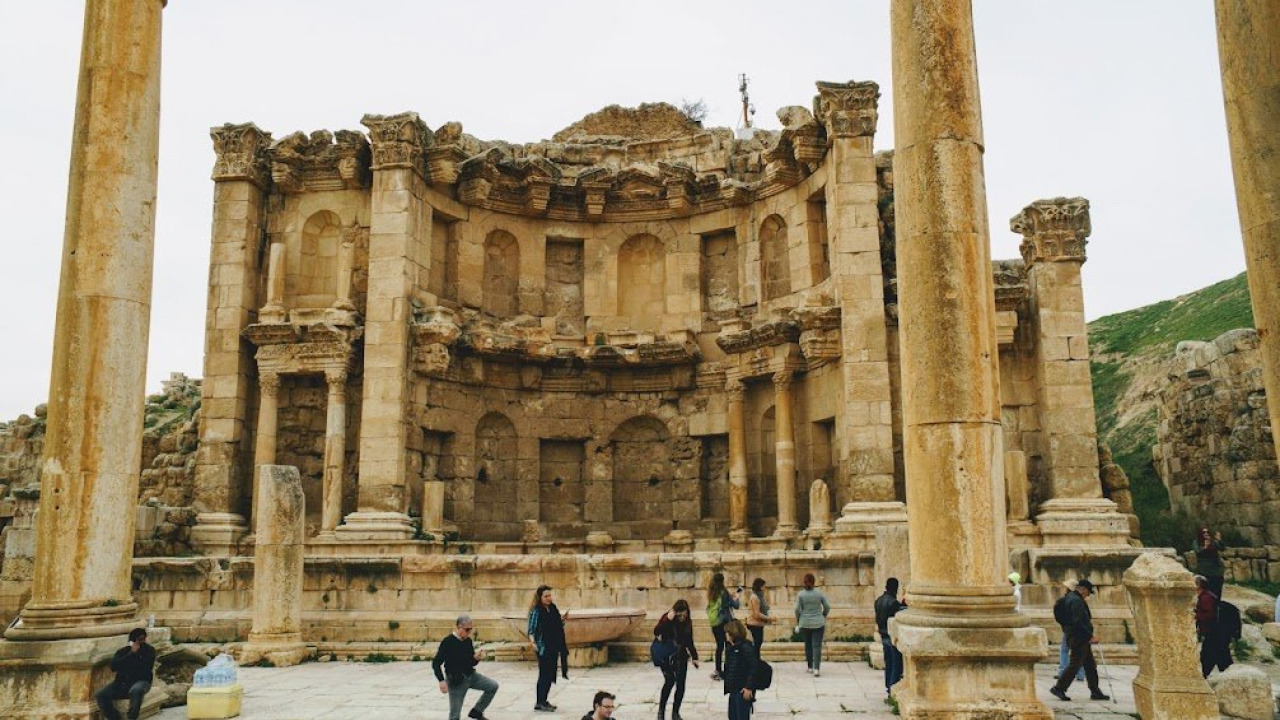
As you walk the Cardo Maximus, you'll find the Nymphaeum, a monumental public fountain, and the imposing Temple of Artemis, dedicated to the city's patron goddess. The Temple's massive columns were engineered with a unique interlocking system to absorb the shocks of earthquakes. Additionally, the South Theater, with its impeccable acoustics, continues to host performances today during the Jerash Festival of Culture and Arts.
Roman Water Engineering and Byzantine Artistry
Jerash is as much a marvel of engineering as it is of art. In the arid Middle Eastern landscape, the Romans established a sophisticated water distribution network. Water was piped from the mountains via terracotta conduits and collected at the Nymphaeum, a two-story marble fountain. Water flowed from seven lion-head spouts into underground channels, feeding the city's public baths and private residences.
The Byzantine era added a layer of spiritual and artistic richness, most notably in the Churches of Cosmos and Damian. The mosaic floors of these structures are stunning, depicting local flora, fauna, and vineyard scenes in vivid colors. These meticulously excavated floors showcase the aesthetic transition from classical Roman stone-work to the ornate style of Late Antiquity.
Comparative Matrix of Jerash Monuments
To help you distinguish between the various sites, we have compiled their periods, styles, and functions below.
| Monument | Period | Architectural Style | Historical Function |
|---|---|---|---|
| Hadrian's Arch | 129 - 130 AD | Classical Roman, Triple Arch | Imperial Welcome Monument |
| Oval Plaza | 1st Century AD | Elliptical Ionic Colonnade | Ceremonial & Trade Hub |
| Cardo Maximus | 2nd Century AD | 800m Corinthian Colonnade | Main Commercial Thoroughfare |
| Temple of Artemis | c. 150 AD | Corinthian Order, High Podium | Cult Center for the Patron Goddess |
| South Theater | c. 90 AD | Semi-circular Roman Cavea | 3,000-seat Theater & Assembly |
The Perfect 5-Step Itinerary for Jerash
To explore this open-air museum efficiently without getting overwhelmed, we recommend this five-stage route:
- Start at Hadrian's Arch and the Hippodrome, then make your way toward the monumental South Gate.
- Pass through the South Gate into the Oval Plaza. For the best panoramic photo of the plaza, climb the slopes toward the Temple of Zeus.
- Ascend the stone tiers of the South Theater to experience the legendary acoustics from the orchestra floor.
- Walk north along the colonnaded Cardo Maximus to visit the Nymphaeum and the towering columns of the Temple of Artemis.
- Conclude your journey by exploring the North Theater and the Byzantine mosaics before exiting through the North Gate.
Photography Tips: Light and Composition
The pale limestone of Jerash reacts beautifully to the shifting sun. In the early morning, the soft yellow light from the east creates long, dramatic shadows along the Cardo Maximus, providing a sense of depth and scale. Using a wide-angle lens while standing between the columns, framing the sky, is the best way to emphasize the city's monumentality.
In the late afternoon, the Temple of Artemis catches the western sun, turning a brilliant golden hue. This is the perfect time to sit on the temple podium and watch the sunset. For the most iconic shot of the Oval Plaza, head to the Temple of Zeus terrace to capture the entire ellipse and the stretching Cardo in one frame.
Practical Field Tips: - Footwear: Wear sturdy, rubber-soled walking shoes or sneakers to avoid slipping on the ancient stones. - Sun Protection: Shade is limited; a wide-brimmed hat and sunglasses are essential. - Hydration: Carry at least one liter of water to stay hydrated during the walk. - Preservation: Please do not climb on columns or marble friezes to help preserve these ancient treasures.
For more inspiration on Jordan's historical routes, visit our Jerash tours and travel programs to plan visits to the Amman Citadel and the mosaics of Madaba.
Practical Tips and Local Flavors
Just outside the archaeological site, the modern town of Jerash offers a wonderful opportunity to taste authentic Jordanian cuisine. We recommend visiting garden restaurants surrounded by olive groves to enjoy fresh pita bread with hummus, mutabbal, and a zesty tabbouleh salad. For a main course, try Mansaf, Jordan's national dish of tender lamb cooked in a fermented dried yogurt sauce and garnished with toasted almonds.
In the local markets, you'll find artisans selling handmade stone panels inspired by Roman mosaics and traditional olive oil soaps. A friendly chat with the vendors often leads to finding the most authentic souvenirs.
Frequently Asked Questions 6
How long does it take to get to Jerash from Amman?
From central Amman, the drive to the Jerash archaeological site takes approximately 45 to 50 minutes via a well-maintained highway heading north.
Is the museum pass valid at Jerash?
Yes, visitors holding the Jordan Pass (provided by the Jordan Tourism Board) can enter the Ancient City of Jerash directly without purchasing an additional ticket.
How much time should I allocate for the visit?
Because Jerash is a sprawling open-air site, we recommend spending at least 3 to 4 hours to comfortably explore the main streets, theaters, and temples.
What should I keep in mind when visiting during the summer?
Summer midday temperatures can be extreme. We suggest visiting in the early morning, wearing a hat, and carrying plenty of water.
Is the site accessible for strollers or wheelchairs?
While the Oval Plaza and parts of the Cardo have flat stone surfaces, the tiered theaters and temple terraces are not wheelchair accessible.
Is it worth hiring a guide in Jerash?
Absolutely. To fully appreciate the historical nuances, the secrets of Roman engineering, and the mythological stories behind the ruins, a licensed guide significantly enriches the experience.