
Bremen often enters most German itineraries overshadowed by Hamburg; yet, its manageable size is precisely what makes planning a visit so easy. In this Hanseatic city on the Weser River in northern Germany, all key attractions are clustered within its historic core, meaning there's no need for tram rides between them. This core boasts the UNESCO-listed Town Hall and Roland statue, the famous Town Musicians statue from the Brothers Grimm fairy tale, the medieval charm of Schnoor Quarter, and the old harbor district. Two days are ample to explore this list. The city's boundaries are also clear: you won't find a sprawling metropolis nightlife, dramatic mountain vistas, or seaside views here. The northern weather is fickle, and outdoor plans can easily be disrupted by rain. The following sections cover key attractions, transportation, the best time to visit, and a suggested two-day itinerary.
Quick Facts
| Topic | Information |
|---|---|
| Location | Northern Germany, on the Weser River |
| Key Attractions | Marktplatz, Rathaus, Roland, Town Musicians, Schnoor, Böttcherstraße, Schlachte |
| UNESCO Status | Rathaus and Roland inscribed on World Heritage List in 2004 |
| Airport | Approx. 3.5 km from city center, Tram Line 6 |
| City Transport | Tram and bus network, cycling popular due to flat terrain |
| Best Time to Visit | May-September for outdoors, late November-December for Christmas market |
| Recommended Duration | 2 days; 3 days if adding museums and a brewery tour |
What Bremen Offers for Every Traveler Profile
Your itinerary will vary based on your priorities; this table matches interests with relevant attractions.
| Profile | Key Attractions | Duration | Note |
|---|---|---|---|
| History & Architecture | Rathaus, Roland, Ratskeller, Cathedral | 2 days | Guided interior tours recommended |
| Families & Children | Town Musicians, Schnoor, Bürgerpark | 2 days | Tower climb might be challenging for kids |
| Art & Museums | Kunsthalle, Böttcherstraße | 1-2 days | Kunsthalle closed on Mondays |
| Gastronomy | Kohl und Pinkel, Klaben, Brewery Tour | 2 days | Cabbage season: November-February |
| Short Stopover | Marktplatz core | 1 day | Direct airport connection |
For those curious about German travel preferences, you can explore our article on the German tourist profile.
Around Marktplatz: The UNESCO Core and Cathedral
To truly grasp the essence of Bremen, look no further than Marktplatz. The square is flanked by the city's governance, the stone symbol of urban liberty, and the impressive episcopal cathedral.
Town Hall (Rathaus) and its Weser Renaissance Facade
The Old Town Hall was built as a Gothic hall building between 1405 and 1410, following Bremen's accession to the Hanseatic League. The ornate facade seen in photos was added later: in the early 1600s, Bremen master builder Lüder von Bentheim gave the structure a new face in the Weser Renaissance style. The building, along with the Roland statue, was inscribed on the UNESCO World Heritage List in 2004, cited as a tangible expression of the urban autonomy that flourished within the Holy Roman Empire.
Free exploration of the interior is not permitted; visits are conducted with a guide. On the tour, you'll see the Upper Town Hall, the ceremonial hall, and glimpse into the Golden Chamber (Güldenkammer). The Rathaus is closed to visitors on days when the Senate is in session, with schedules typically announced about a month in advance. For travelers seeking similar historic squares and monumental architecture, our historical city tours in Turkey category offers a great starting point.
Roland Statue
The Roland statue in front of the Rathaus was erected in 1404. The figure stands approximately 5.5 meters tall; with its 60-centimeter pedestal and Gothic baldachin, the total height reaches 10.21 meters, making it considered the largest standing statue of the German Middle Ages. The monument symbolizes market rights, urban jurisdiction, and imperial liberty; its wooden predecessor was destroyed by the archbishop's mercenaries in 1366.
Two narratives circulate regarding its gaze: according to legend, the city council had Roland face the cathedral to defy the church, while the city's official account states the figure faces Ostertor, the gate from which merchants entered the city.
Ratskeller: The Wine Cellars Beneath the Rathaus
A city wine cellar in Bremen was first mentioned in 1342; with the construction of the Town Hall in 1405, the cellar moved into the vaults of the building, and its UNESCO inscription also covers this section. In the Rosekeller, a private meeting room for council members, rests a 1653 Rüdesheimer, considered Germany's oldest barrel wine. In the Apostelkeller, opened around 1550, you'll find twelve oak barrels filled with 18th-century Rhine wines.
St. Petri Cathedral, South Tower & Bleikeller
St. Petri Cathedral, at the eastern end of the square, dominates the city skyline; a visit offers two distinct experiences. First is the south tower: a narrow spiral staircase of 265 steps leads past the bell chambers to a viewing platform (the tower height is approximately 98.5 meters). Second is the Bleikeller, the lead cellar, where preserved bodies are displayed.
Both are closed between December 24th and March 31st. The tower is open Wednesday-Saturday from 10:00 AM-5:00 PM, and on Sundays and public holidays, it opens around 11:30 AM after the service; it is closed on Mondays and Tuesdays. The Bleikeller can be visited Wednesday-Sunday from 11:00 AM-5:00 PM. Combined tickets are available in addition to individual ones; check the cathedral's official website for current prices and daily opening status.
Fairy Tale Statue, Narrow Alleys & Riverside Charm
Beyond the main square, the city unfolds into three distinct areas: the home of the fairy tale, the medieval quarter, and the old harbor front.
The Bremen Town Musicians Statue
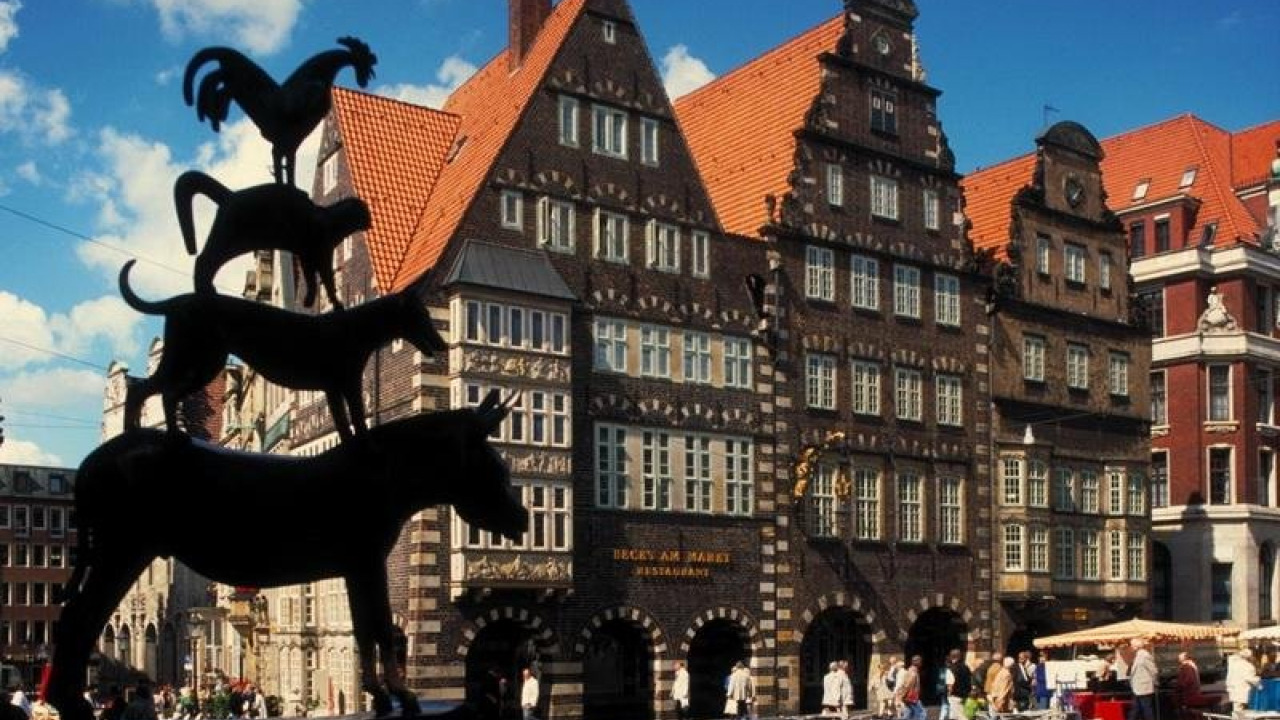
The bronze group, featuring a donkey, dog, cat, and rooster, was created by sculptor Gerhard Marcks and installed on September 30, 1953; the figures stand approximately two meters tall. Its location is often mistaken: the group is on the western facade of the Old Town Hall, to the left when facing it from Marktplatz, not between the cathedral and the Town Hall.
Local tradition dictates: you should grasp both front hooves of the donkey with both hands and make a wish. Bremen locals joke that if you only touch one hoof, "one donkey is shaking hands with another." The polished sheen on the hooves is a testament to this custom; those seeking photos without crowds should aim for early hours.
Schnoor Quarter
Schnoor is the city's oldest residential area and was first mentioned in written records in the 13th century; the oldest surviving buildings date back to the 14th century. 111 historic buildings are listed for protection within the quarter. The name comes from the Low German word for "string" or "cord": the area was a center for rope production, and the houses are lined up like beads on a string.
In the streets a few hundred meters from Marktplatz, you'll find workshops for handmade goods, small galleries, cozy cafes, and souvenir shops; a city history museum and a theater stage are also located here.
Böttcherstraße and its Porcelain Carillon
Böttcherstraße is a short street, only about 110 meters long, but it is one of the rare places where Expressionist architecture can be seen collectively. The idea of transforming the street into a work of art belonged to coffee merchant Ludwig Roselius; brick facades and hidden courtyards are integral to this design.
A highlight is the Glockenspiel House: the mechanism, installed in 1934, consists of 30 bells made of Meissen porcelain. The bells chime hourly between 12:00 PM and 6:00 PM from April to December; from January to March, the schedule is reduced to a few hours a day. They do not chime during frost to protect the porcelain.
Schlachte: The Old Harbor, Today's Riverside Promenade
The name Schlachte, on the Weser riverbank, was first recorded in 1250 and derives from the piling work done in the 13th century to reinforce the riverbank. For centuries, this served as the city's main port; goods were unloaded, weighed, and transported to warehouses here. When sea transport shifted further downriver, the quay lost its function; the current layout is a result of the Expo 2000 renovation.
The riverside is now lined with restaurants, beer gardens, and river tour piers; historic ships moored at the quay, including a three-masted bark built in 1906, define its character. In December, this same stretch transforms into a festive Christmas market.
Art & Green Spaces: A Step Beyond the Core
Kunsthalle Bremen
The Kunsthalle is affiliated with the Bremen Art Association, founded in 1823, which still operates the museum as a private institution today. The collection, spanning seven centuries, centers on its extensive print cabinet, housing over 200,000 drawings and prints. The museum is open Tuesday 10:00 AM-9:00 PM, Wednesday-Sunday 10:00 AM-5:00 PM, and closed on Mondays.
Bürgerpark
Bürgerpark begins immediately north of the main train station and, together with the adjacent city forest, covers 202 hectares. Its distinguishing feature isn't just its size, but its unique funding model: the association, founded in 1865, has maintained the park almost entirely through private funds—donations, membership fees, and lottery proceeds—since 1866. It's an ideal spot to spend any free hours before your departure.
Getting to Bremen & Around the City
Visa requirements vary by nationality and are updated periodically; please confirm with Germany's official diplomatic missions before your trip.
From the Airport to the City Center
Bremen Airport is approximately 3.5 kilometers from the city center. Tram line 6 awaits directly in front of the terminal; this line goes to the central Domsheide stop and the main train station. The journey from the terminal to Domsheide takes approximately eleven minutes; the main train station is further along the line. As service frequency varies, confirm departure times at the stop. Direct flight options from Turkey are available, with frequencies changing seasonally; check the airport's official flight schedule for current timings.
Train Connections, Trams & the BremenCARD
Bremen's main train station is on the long-distance rail line connecting via Hamburg and Hannover; connections are frequent throughout the day, making it easy to plan a North German tour by train. As train times and line works change periodically, plan your route using the railway operator's current timetable.
Within the city, the tram and bus network covers all core attractions. For those staying a few days, the BremenCARD is practical: the card provides free travel from 6:00 PM the evening before its validity begins until 3:00 AM the day after its last valid day, and covers two children under fourteen years old. It also includes discounts of up to fifty percent on guided tours, theater, museums, and river cruises, as well as Weser ferry crossings. The card is personal and valid with identification.
What's Open When? Seasonal Overview
Seasonal differences are often more about which attractions are open than just the weather.
| Period | Highlights | Limitations |
|---|---|---|
| April-May | Tower and Bleikeller open, carillon chimes hourly | Weather is changeable, raincoat needed |
| June-August | Long days, riverside terraces, park | Accommodation can be tight during trade fair weeks |
| September-October | Crowds thin out, museum programs intensify | Days noticeably shorter |
| Nov 23-Dec 23 | Christmas market and Schlachte-Zauber | Accommodation fills up early |
| January-March | Cabbage dishes, indoor activities | Tower and Bleikeller closed, carillon chimes infrequently |
Bremen's Culinary Delights & Accommodation Areas
Kohl und Pinkel, Klaben & Beck's
Cabbage forms the winter backbone of North German cuisine. In Bremen, the dish is called Kohl und Pinkel; Pinkel is a smoked sausage made with coarse grain grits, served alongside the cabbage with Kasseler (cured pork loin) and boiled sausages. Locals refer to it as "brown cabbage" rather than green cabbage. The season begins with the first frosts in November and ends in late February; the Kohlfahrt tradition sees groups go for a rural walk, culminating in a hearty feast.
On the sweet side, Bremer Klaben stands out: a rich yeast dough mixed with rum-soaked raisins, candied orange and lemon peel, and almonds, spiced with cardamom. Its name has been protected by a European Union geographical indication since December 2009, meaning it can only be produced in Bremen and its defined neighboring area. For beer enthusiasts, there's the Beck's visitor center: tours are held several times a day from Monday to Saturday, with a short tour lasting about ninety minutes and a comprehensive tour three hours. For those looking for similar cultural experiences in Turkey, our cultural tours in Turkey category offers a point of comparison.
Where to Stay
Since attractions are close by, your choice depends on the neighborhood's character; no matter where you stay, you'll find yourself exploring on foot.
| Area | Character | Best For |
|---|---|---|
| Marktplatz & Altstadt | Minutes from the square, quiet evenings | Intensive two-day itineraries |
| Schnoor & Cathedral Area | Narrow alleyways, small businesses | Those prioritizing atmosphere |
| Schlachte & Weser Riverside | River views, lively evenings | Night owls and socializers |
| Station & Bürgerpark Line | Excellent train and tram connections | Travelers connecting by train |
Two Days: Starting at the Square, Ending by the River
This itinerary is designed with opening hours and crowd patterns in mind.
- Start your first morning at Marktplatz: admire the Rathaus facade, the Roland statue, and the Town Musicians before the crowds gather.
- Join a guided interior tour of the Rathaus or a Ratskeller cellar tour, based on a pre-confirmed time.
- Before noon, head to the Cathedral; if it's in season, climb the south tower and explore the Bleikeller.
- In the afternoon, stroll down Böttcherstraße; try to catch the hourly carillon performance between April and December.
- Spend the late afternoon at Schlachte: enjoy a riverside walk and view the historic moored ships.
- Dedicate your second morning to Schnoor; wander the streets before the shops open.
- Around lunchtime, visit the Kunsthalle; if it's Monday, postpone this step to another day.
- In the afternoon, take a leisurely walk in Bürgerpark, pausing here until your return train.
- Conclude your evening based on the season: a traditional cabbage dinner between November and February, or the lively riverside promenade during other months.
For those considering extending their European journey southwards, our Italy travel guide offers insights into regional exploration.
Essential Information Before You Go
This table compiles crucial timing details that often cause issues during trips.
| Attraction | Visit Details | Season Window |
|---|---|---|
| Rathaus Interior | Guided tour, schedule announced one month in advance | Year-round, cancelled during events |
| Cathedral South Tower | 265 steps, tower height 98.5 meters | April 1-December 23, closed Mondays & Tuesdays |
| Bleikeller | Wednesday-Sunday 11:00 AM-5:00 PM | April 1-December 23 |
| Glockenspiel | Hourly between 12:00 PM-6:00 PM | April-December, not played during frost |
| Kunsthalle | Tuesday 10:00 AM-9:00 PM, Wednesday-Sunday 10:00 AM-5:00 PM | Year-round, closed Mondays |
| Brewery Tour | Monday-Saturday, several times daily | Year-round, reservation required |
When planning your itinerary, also consider these points:
- Pack a waterproof outer layer; northern weather can change quickly throughout the day.
- Avoid scheduling too many museum and tower visits on Mondays and Tuesdays, as many attractions are closed.
- Confirm the Rathaus tour time for your chosen day before arriving in the city.
- Choose comfortable, sturdy shoes; the ground in Schnoor and Böttcherstraße is cobblestone.
- Cycling is practical as the city is flat, but be mindful of tram tracks.
- The BremenCARD is personal; carry your identification with you.
Frequently Asked Questions 6
How many days are enough to spend in Bremen?
Since the attractions are within walking distance, two days will cover Marktplatz, Schnoor, Böttcherstraße, and the Schlachte promenade. If you add the Kunsthalle, Bürgerpark, and a brewery tour, a third day would be well spent.
What is the best time to visit Bremen?
For outdoor activities, May to September is ideal; days are long, and the riverside is lively. The Cathedral tower and Bleikeller are open from April 1st to December 23rd. The Christmas market runs from November 23rd to December 23rd.
Where exactly is the Bremen Town Musicians statue?
The statue is located on the western facade of the Old Town Hall, to the left when viewed from Marktplatz, not between the cathedral and the Town Hall. Gerhard Marcks's bronze group was installed in 1953.
Can the interior of Bremen Town Hall be visited?
Yes, it can be visited, but free entry is not permitted; the interior is seen via a guided tour. The tour includes the Upper Town Hall, the ceremonial hall, and a glimpse into the Güldenkammer. Visits are not conducted on days when the Senate is in session.
What should I eat in Bremen?
In winter, Kohl und Pinkel, a cabbage dish served with smoked grain sausage, is prominent; the season runs from November to February. For dessert, try Bremer Klaben, protected by a European Union geographical indication. The city is also home to a well-known brewery.
How can I get to Bremen from Turkey?
Direct flight options to Bremen Airport are available, with frequencies varying seasonally. The airport is approximately 3.5 kilometers from the city center, and Tram Line 6, departing from directly in front of the terminal, reaches the center in about eleven minutes. It's also possible to fly to Hamburg or Hannover and continue by train.