
Carved directly into the vibrant sandstone cliffs of southern Jordan, near the town of Wadi Musa, Petra stands as a breathtaking architectural legacy of the Nabataeans. For nearly two thousand years, this "Rose City" has captivated the world. Today, as a UNESCO World Heritage site, Petra operates as a managed park with specific entry fees, visiting hours, and trails categorized by difficulty. To make the most of your journey, careful planning regarding timing and routes is essential. This comprehensive guide provides everything you need to know, from ticket prices and Jordan Pass tiers to the Al-Siq passage, the climb to Aldayr (The Monastery), and the magical Petra by Night experience, all verified by official sources.
Quick Facts
| Category | Details |
|---|---|
| Location | Southern Jordan, Wadi Musa |
| Geography | Situated between the Dead Sea and the Gulf of Aqaba |
| Status | UNESCO World Heritage Site, New Seven Wonders of the World |
| Founded | Nabataeans, 4th Century BC |
| Roman Era | Annexed by the Roman Empire in 106 AD |
| Rediscovery | 1812, by Johann Ludwig Burckhardt |
| Visiting Hours | Summer: 06:00-18:00, Winter: 06:00-16:00 |
| Main Route | 3.9 km, 1.5 to 1.75 hours, Easy |
| Entry Fee | 50 JOD for 1 day (for visitors staying in Jordan) |
| Payment | Jordanian Dinar (Cash) and Visa |
Where is Petra and Why Visit?
Petra was strategically established at the crossroads of the incense and spice trade routes between the Dead Sea and the Gulf of Aqaba. Beyond its stunning rock-cut temples and tombs, Petra is a marvel of ancient engineering. Its sophisticated water collection and distribution system allowed a permanent capital to thrive in the heart of the desert, a key reason for its UNESCO designation.
From Nabataean Capital to Roman Province
The Nabataeans, a nomadic Arab tribe, settled here in the 4th century BC, carving their city into the walls of the Wadi Musa canyon. In 106 AD, the kingdom was absorbed into the Roman Empire, becoming the center of the province of Arabia Petraea. This era added grand monuments, temples, and a majestic colonnaded street. Later, during the Byzantine period, churches were added, before the city was gradually abandoned due to shifting trade routes and devastating earthquakes.
The 1812 Rediscovery by Burckhardt
For centuries, Petra's location was a secret known only to the local Bedouins. In 1812, Swiss explorer Johann Ludwig Burckhardt successfully reached the ruins and introduced the city to the Western world. For those looking to dive deep into these historical layers, we offer specialized Petra ancient city culture tours.
How to Get There
There are no direct flights to Petra; the journey typically begins in Amman.
- Fly into Queen Alia International Airport (AMM) in Amman.
- Travel south via the Desert Highway to Wadi Musa: approximately 210-235 km, taking about 3 hours by car.
- Stay in Wadi Musa; since the Visitor Center is within the town, you can easily arrive for the park's opening.
- Purchase your ticket at the Visitor Center with a valid passport or present your Jordan Pass.
- Enter the main route via the Bab as-Siq section, pass the Djinn Blocks, and proceed into Al-Siq.
If you prefer a seamless, pre-arranged itinerary, check out our Petra ancient city day trip culture tours.
Entry Fees, Jordan Pass, and Ticketing Rules
Ticket pricing depends on whether you are staying overnight in Jordan. All prices are in Jordanian Dinars (JOD).
| Ticket or Service | Price (JOD) |
|---|---|
| 1-Day Entry | 50 |
| 2-Day Entry | 55 |
| 3-Day Entry | 60 |
| 1-Day Entry (Non-residents/Day trippers) | 90 |
| Arab National Citizens | 30 |
| Jordan Residents | 10 |
| Jordanian Citizens | 1 |
| Guide: Main Route | 50 |
| Guide: Main Route & Monastery | 100 |
| Guide: Main Route & High Place of Sacrifice | 100 |
| Club Car: Visitor Center to Treasury (4 km) | 15 |
| Club Car: Visitor Center to Treasury Round Trip (8 km) | 25 |
| Club Car: Petra Theatre to Qasr al-Bint (1 km) | 10 |
| Club Car: Petra Theatre to Qasr al-Bint Round Trip (2 km) | 15 |
| Treasury Viewpoints | 15 |
| 4x4 Transfer: Nabataean Culture Village to Monastery (One way) | 5 |
| Petra by Night Show | 30 |
Is the Jordan Pass Worth It?
The Jordan Pass is a comprehensive card covering over 40 archaeological sites and museums. Options include: Jordan Wanderer (70 JOD) for 1 day in Petra, Jordan Explorer (75 JOD) for 2 consecutive days, and Jordan Expert (80 JOD) for 3 consecutive days. Crucially, the pass waives the tourist visa fee, provided you purchase it before arrival and stay at least two nights in Jordan. Since a standard Petra ticket is 50 JOD, the pass is a bargain if you also plan to visit Jerash or Wadi Rum.
Essential Ticketing Tips
- A valid passport is required at the ticket office.
- Children under 12 enter for free during daytime hours.
- Two and three-day tickets must be used on consecutive days.
- Payments are accepted in cash (JOD) and via Visa.
- The Visitor Center offers an additional day for 5 JOD for those in the 50 JOD and 30 JOD categories.
- 4x4 transfers to the Monastery trail operate between 07:30 and 15:00.
- Jordan Pass holders using the back-route must show their pass at the gate.
Al-Siq: The Dramatic Gateway
Al-Siq is the natural geological fault that leads visitors from the Bab as-Siq section to the Treasury. Spanning just over 1.2 kilometers, it is not a river canyon but a tectonic split in the rock. The passage narrows in several places, with the towering walls almost meeting overhead, creating a mystical atmosphere.
Along the walls, you will see ancient water channels, some featuring 2,000-year-old terracotta pipes. You will also notice the dam structure built to prevent flash floods from entering the city. We recommend walking the Siq in the early morning for cooler temperatures and fewer crowds.
The Treasury and Main Route Highlights
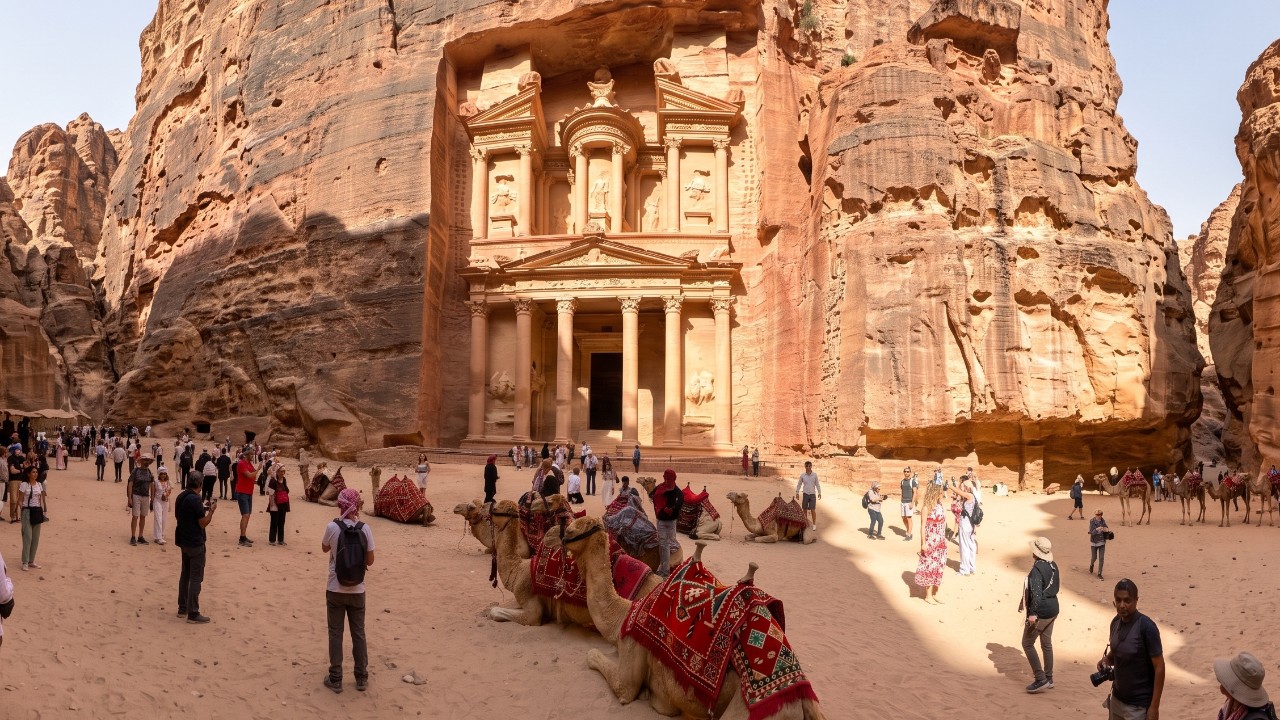
At the end of the Al-Siq, the iconic Al-Khazneh (The Treasury) reveals itself through a narrow sliver of rock. This Hellenistic facade stands approximately 39 meters high and shifts in color from deep red to golden yellow throughout the day. While the interior is closed to the public, the plaza offers a stunning vantage point. Arrive early to capture photos without the crowds.
| Route | Length & Duration | Difficulty |
|---|---|---|
| Main Trail | 3.9 km, 1.5 to 1.75 hours | Easy |
| Al-Khubtha Trail | 4 to 5 hours | Hard |
| Aldayr (Monastery) Back Route | 4 to 5 hours | Hard |
Djinn Blocks and the Theatre
Before entering the Siq, you'll encounter the Djinn Blocks, square-cut monuments dating back to the 2nd century BC, among the city's earliest monumental tombs. After the Treasury, continue along the Street of Facades to reach the Theatre, carved during the reign of King Aretas IV, which could seat 4,000 people across 45 rows.
Colonnaded Street and Qasr al-Bint
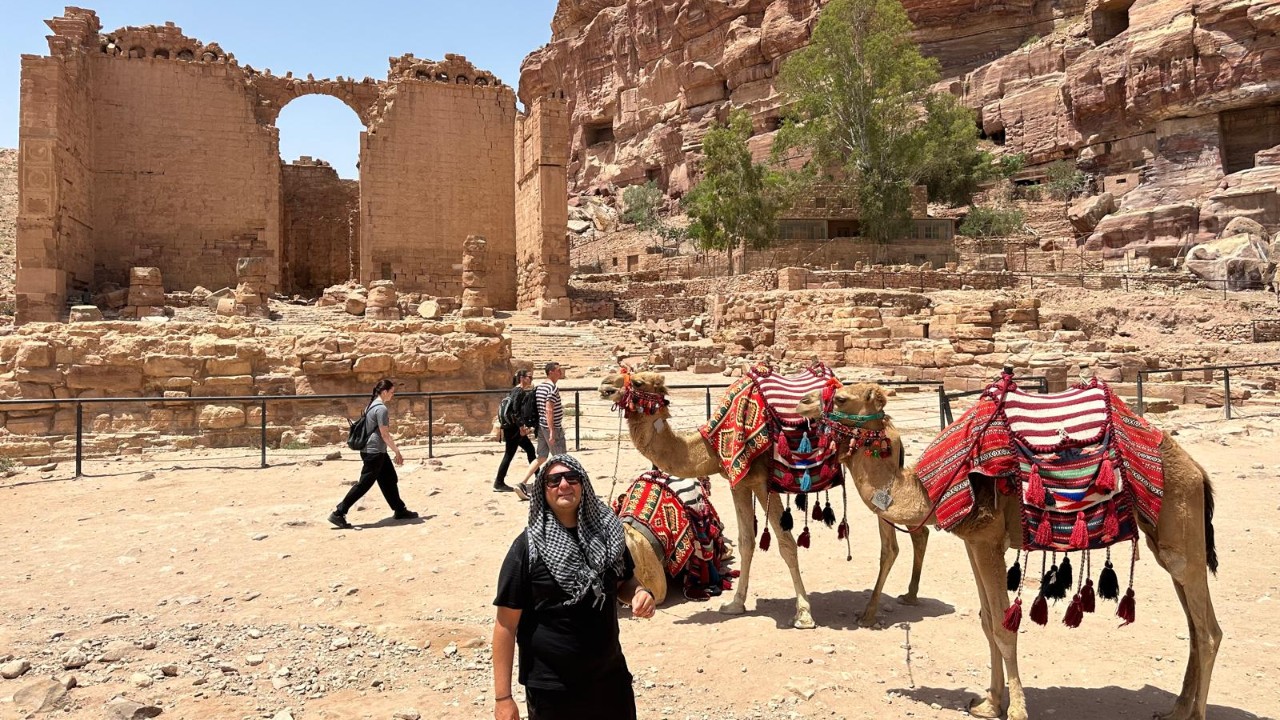
The Colonnaded Street was the commercial heart of the city, a Roman-era thoroughfare lined with shops. At the end of this street stands Qasr al-Bint, a 23-meter-high temple and one of the most significant early temple complexes in Petra.
Byzantine Church Petra
Located on the slope north of the Colonnaded Street, the Byzantine Church showcases Petra's Christian era. Its floors are adorned with stunning 6th-century mosaics, each roughly 70 square meters, depicting daily objects, mythological animals, and personifications of the seasons and the earth.
Hiking to Aldayr (The Monastery)
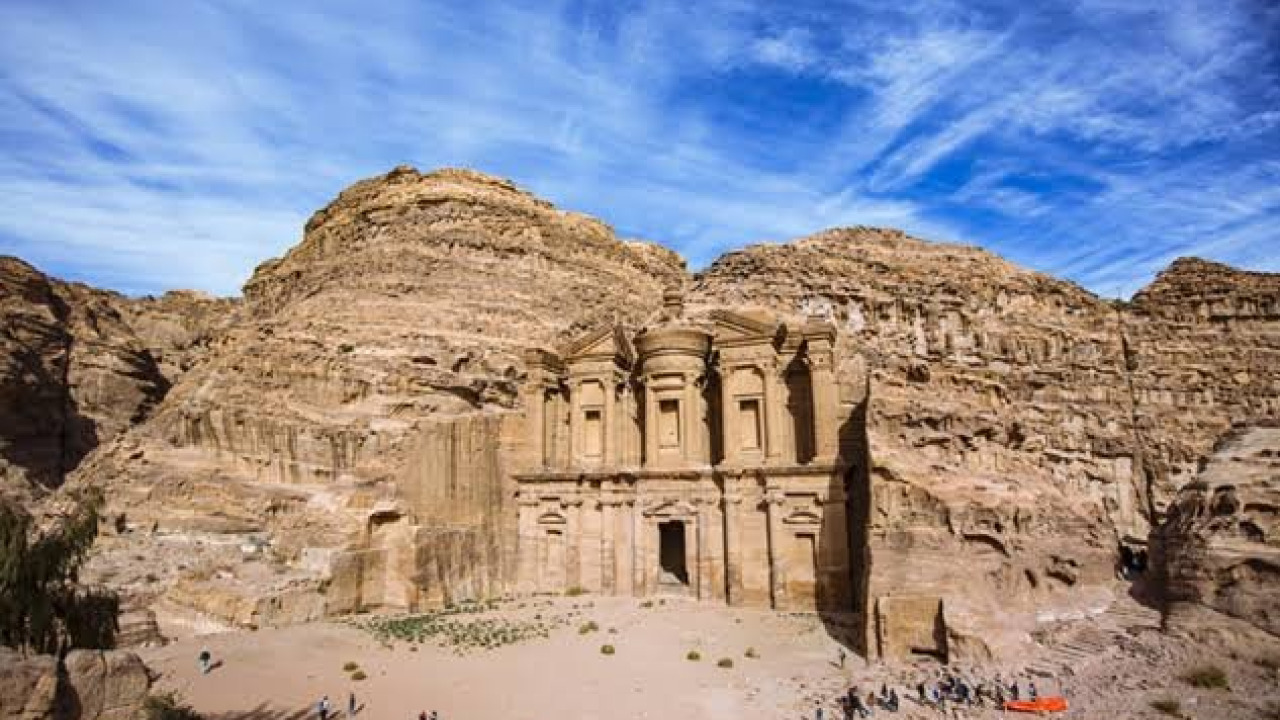
Aldayr is one of Petra's most massive rock-cut structures, measuring 47 meters wide and 48 meters high. Carved in the mid-1st century AD, it earned the name "Monastery" due to Byzantine-era crosses carved into its interior walls.
The path from the end of the main route to Aldayr consists of approximately 800 steps. For those unable to climb, donkeys are available. Alternatively, the "back route" via Beidha takes 4 to 5 hours and is classified as hard; it offers a more scenic journey through farmland and vistas overlooking Wadi Araba.
Al-Khubtha Trail: The Treasury from Above
The Al-Khubtha Trail is the premier route for those seeking the famous "bird's-eye view" of the Treasury. Starting near the Royal Tombs and the Palace Tomb, the path climbs the Jabal al-Khubtha massif via rock-cut steps. Along the way, you can look down upon the Street of Facades, the Theatre, and the Royal Tombs (Urn, Silk, Corinthian, and Palace).
The full loop from the Visitor Center takes 4 to 5 hours and is considered difficult. Due to the elevation, an early start is highly recommended. From the summit, you can capture the Treasury, the exit of the Al-Siq, and the plaza in a single frame. For those wanting a professional guide for this ascent, explore our Petra ancient city historical city tours.
Visiting Hours, Seasons, and Petra by Night
The park is open from 06:00-18:00 in summer and 06:00-16:00 in winter. Ticket sales close approximately 45 minutes before the park shuts. Jordan's climate varies wildly: scorching summers and cold, rainy winters with occasional snow at higher altitudes.
| Season | Conditions | Planning Tip |
|---|---|---|
| Spring (March-May) | Mild (20-30°C) | Ideal for long hiking routes |
| Summer (June-August) | High heat, limited shade | Enter at opening; seek shade at noon |
| Autumn (Sept-Nov) | Mild (20-30°C) | Great light for photography and climbing |
| Winter (Dec-Feb) | Cold, rainy, possible snow | Plan early as the park closes at 16:00 |
Petra by Night
Petra by Night is a magical experience where the Al-Siq is illuminated by thousands of candles. It takes place Sunday through Thursday from 20:30 to 22:30 and lasts about two hours. The cost is 30 JOD per person (free for children under 10). This is a walking experience; please check official calendars for seasonal changes.
Note that a daytime ticket is required to participate, and the Jordan Pass does not cover Petra by Night. Club cars are extremely limited (usually only three) and reserved for the elderly or disabled, so do not rely on them for the night program. For a fully curated archaeological experience, consider our Petra ancient city ruins tours.
Frequently Asked Questions 6
Where does the main route in Petra start and end?
The main route runs from the Visitor Center to Qasr al-Bint. It is 3.9 km long, easy to navigate, and takes about 1.5 to 1.75 hours (excluding stops). If you add the 800-step climb to Aldayr or the 4-5 hour Al-Khubtha trail, the visit will take a full day.
How much is the entry fee for Petra?
For visitors staying in Jordan, a 1-day ticket is 50 JOD, 2-day is 55 JOD, and 3-day is 60 JOD. For day-trippers not staying overnight in Jordan, the 1-day fee is 90 JOD. Children under 12 enter free during the day.
Does the Jordan Pass cover Petra entry?
Yes. The Jordan Wanderer (70 JOD) covers 1 day, Jordan Explorer (75 JOD) covers 2 consecutive days, and Jordan Expert (80 JOD) covers 3 consecutive days. It also waives the tourist visa fee if purchased before arrival and if you stay at least two nights. Petra by Night is not included.
How difficult is the hike to Aldayr (The Monastery)?
The path from the main route involves about 800 steps and requires a steady climb. The back route via Beidha is a 4-5 hour hike and is rated as difficult. Donkeys are available for those who prefer not to walk, and 4x4 transfers to the start of the trail are available for 5 JOD per person.
When does Petra by Night take place?
The night program runs Sunday through Thursday from 20:30 to 22:30. It lasts approximately two hours and costs 30 JOD (free for children under 10). A daytime ticket for the same day is required to attend.
What are the club car fees in Petra?
The 4 km trip from the Visitor Center to the Treasury is 15 JOD, and the round trip (8 km) is 25 JOD. The 1 km trip from the Petra Theatre to Qasr al-Bint is 10 JOD, and the round trip (2 km) is 15 JOD. Club cars operate daily from 07:00 to 18:00 and do not require advance booking.