
For adrenaline junkies looking to push their limits on the open sea during summer vacation, choosing between water sports can be a tough call. On one hand, you have high-speed Jet Ski tours that allow you to slice through waves and race toward the horizon, perfect for those seeking pure speed and freedom. On the other, Flyboard tours offer a futuristic, gravity-defying experience, using powerful water jets to lift you high into the air for breathtaking acrobatics. In this comprehensive guide, we break down both popular activities by their technical, physical, and safety dynamics.
Your satisfaction on the water depends on more than just your craving for adrenaline. Your body coordination, sense of balance, and comfort in the water will play a major role in your choice. While Jet Ski tours promise a practical and exhilarating ride, Flyboard requires a technical mastery of balance using your feet. By analyzing your expectations, you can easily decide which aquatic adventure best suits your holiday.
Jet Ski vs. Flyboard: Comparison Matrix
The following table summarizes these two popular water sports in terms of mobility, physical effort, and safety standards. The data is based on the operational criteria of commercial water sports stations along the Turkish coast.
| Comparison Criteria | Jet Ski (PWC, Horizontal Speed & Wave Riding) | Flyboard (Hydro-Propelled Board, Vertical Altitude & Acrobatics) |
|---|---|---|
| Movement & Dynamics | High speed on a horizontal axis, sharp turns, and wave jumping | Vertical lift, dives, and acrobatic aerial maneuvers |
| Learning Curve & Difficulty | Very easy; a 3-minute briefing on throttle and steering is sufficient | Moderate to difficult; requires practice to maintain balance and ankle control |
| Average Session Duration | Typically 10 to 20-minute high-speed circuits | Typically 15 to 25-minute sessions under direct instructor supervision |
| Physical Effort & Fatigue | Moderate; arms and legs work to stabilize against waves | High; intense engagement of leg muscles, core, and ankles |
| Altitude & Max Speed | Stays at sea level; can reach speeds of 70 to 90 km/h | Can rise vertically from sea level to 5–12 meters |
| Passenger Capacity | Single rider or tandem (driver + one passenger) | Strictly individual; one person at a time |
| Instructor Support | Driver manages the vehicle; station monitors from a distance | Instructor controls the throttle via the connected Jet Ski |
As the table shows, these two activities cater to very different skill sets. Jet Ski is ideal for those seeking raw speed and the sensation of wind on a horizontal plane, whereas Flyboard is an art of balance focused on conquering gravity vertically.
Driving Mechanics and Balance: Horizontal Speed or Vertical Acrobatics?
The fundamental difference between these two sports lies in the dimension of movement and how mechanical power is transferred to your body. This completely changes your perception of control on the water.
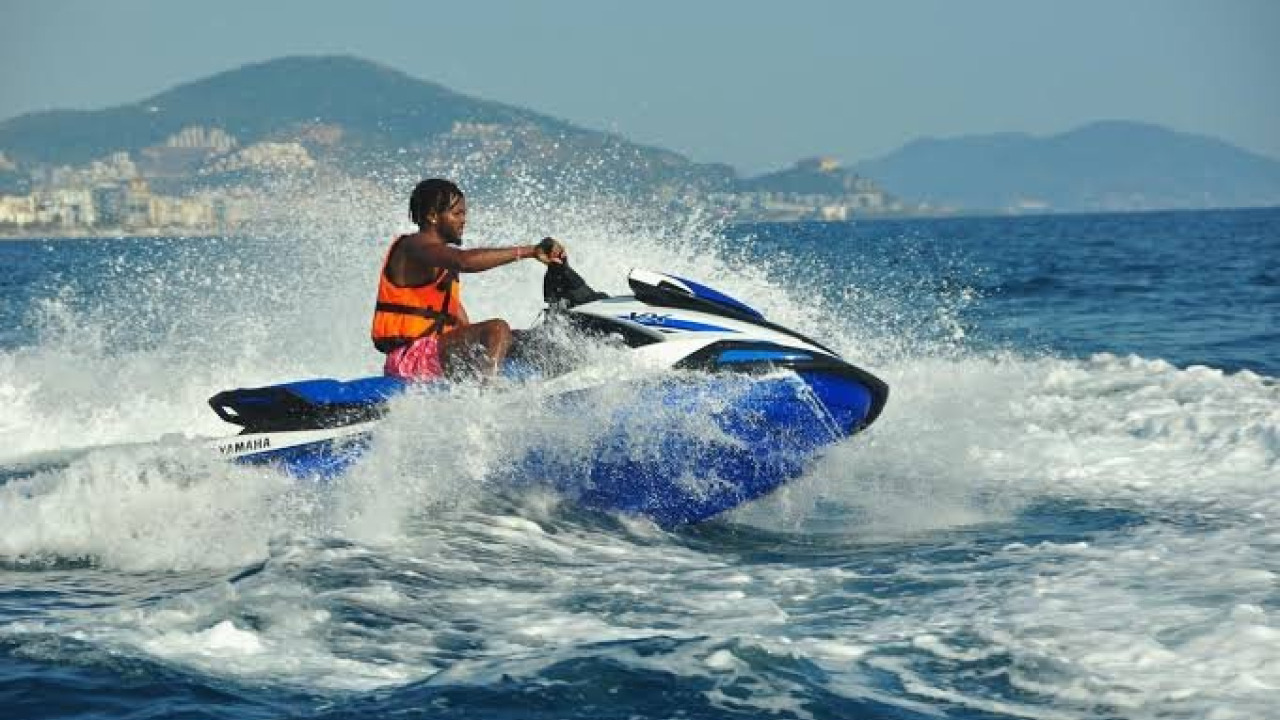
In Jet Ski tours, the rider sits on the seat or stands up for a more sporty ride, much like a land-based motorcycle. As you pull the throttle on the handlebar, the water turbine ejects high-pressure water from the rear, propelling the craft forward. Steering is direct via the handlebars, and thanks to a low center of gravity, the vehicle remains highly stable. Even a traveler who has never operated a marine vehicle can accelerate safely within minutes.
The Flyboard, however, consists of a specialized footboard connected to a powerful Jet Ski turbine via a long, thick hose. The high-volume water pressure generated by the Jet Ski is channeled through the hose to two nozzles under the participant's feet. To stay upright, the participant must keep their ankles steady, much like a skier, and constantly adjust their center of gravity. Even a slight lean forward or backward can cause you to plunge into the water or fall backward.
If you want to glide swiftly across the waves against the wind, the Jet Ski is much more effortless and comfortable. But if you want to soar above the water like a superhero and experience the thrill of hovering in mid-air, the Flyboard is unrivaled.
Physical Effort, Learning Process, and "Fall Tolerance"
Both activities demand a certain level of physical endurance, but the experience during the learning phase differs significantly.
The likelihood of falling during a Jet Ski ride in calm bays is quite low. A rider might only lose balance during extremely sharp turns or uncontrolled entries into high waves. Thanks to the safety lanyard attached to the rider's wrist, the engine stops immediately if the rider falls into the water. Anyone with basic fitness can enjoy this activity without needing a specialized athletic background.


In the Flyboard experience, falling into the water is a natural and inevitable part of the process. For the first five to ten minutes, participants usually dive in and out of the sea repeatedly while trying to stay upright. Maintaining vertical ankles, keeping knees slightly bent, and staying balanced without fear of the water requires intense effort. However, the sense of achievement when you finally rise above the surface and hover for a few seconds makes all the fatigue worth it.
For those seeking an effortless start and instant adrenaline, the Jet Ski is a risk-free choice. For travelers who aren't afraid of falling, enjoy learning new motor skills, and possess patience, the Flyboard is a fantastic challenge.
Safety Measures, Life Jacket Standards, and Boundary Limits
Safety rules are applied without exception in activities involving high speeds and high altitudes. The Coast Guard and Turkish Water Sports Federation strictly monitor these standards.
In Jet Ski tours, wearing a life jacket and attaching the engine safety lanyard to your wrist is a legal requirement. The moment the lanyard is released, the vehicle stops to prevent it from running out of control. Riders must stay within designated open-sea corridors and avoid swimming areas. In the event of dangerous maneuvers, station officials have the authority to stop the engine remotely via a remote control system.
For Flyboard tours, in addition to a life jacket, it is mandatory to wear a shock-absorbing helmet to protect the head and ears from water impact. The participant's safety is directly in the hands of the licensed instructor operating the connected Jet Ski. The instructor increases the water pressure gradually and cuts the throttle immediately if the participant loses balance to prevent hard impacts. Flights are always conducted in deep-water tracks far away from rocks.
When choosing professional stations for either sport, the risk of accident is extremely low. While the Jet Ski involves more individual responsibility, the Flyboard provides a highly controlled environment under expert supervision.
Age Limits, Tandem Riding, and Session Lengths
Whether you are enjoying the sea with a partner or family, participant limitations will directly affect your decision. The social aspects of these two sports differ greatly.
Jet Ski vehicles have a two-person seating capacity. This allows you to share the excitement with loved ones by riding together. While a minimum age of 16 or 18 is usually required for the driver, children over 10 can safely ride in the passenger seat. Tandem Jet Ski tours are incredibly popular for couples wanting to enjoy the sea together.
The Flyboard, however, is designed to be attached only to a single person's feet. Therefore, it is physically impossible to share the activity simultaneously with someone else. To fly, the participant must have the appropriate foot size to carry the board and the maturity of at least 16 years of age. Your friends or family can only watch you with admiration and take photos from the pier or a nearby boat.
For those who want to experience the joy of the sea side-by-side with loved ones, the Jet Ski is the unrivaled choice. For those who want all the spotlight on them and wish to perform an individual stage show, the Flyboard is perfect.
Budget, Equipment, and Cost Comparison
Pricing for water sports is shaped by fuel consumption, equipment technology, and instructor expertise. Both activities can be compared on a minute-by-minute cost basis.
Jet Ski tours are generally priced in 10 or 15-minute blocks. This price includes high-octane fuel, a life jacket, and a basic briefing. For tandem rides, a small additional fee is usually charged, or two people can benefit from the single vehicle price. Since Jet Skis are widely available along the coastline, price competition is higher, making them very accessible.
Flyboard tours are priced for sessions lasting approximately 15 to 25 minutes. This session fee includes the fuel for the Jet Ski powering the participant, full-time coaching from a professional instructor, and specialized protective gear. Because there are fewer stations on the coast equipped with Flyboard hardware and certified instructors, session prices tend to be somewhat higher than Jet Ski tours.
The following budget and equipment table summarizes the basic cost components you will encounter in these two popular water sports.
| Service & Equipment Item | Jet Ski (Compact Speed Session) | Flyboard (One-on-One Instructor Session) |
|---|---|---|
| Average Session Duration | 10 to 20 minutes of continuous riding | 15 to 25 minutes of training and flight |
| Tandem Riding Options | Tandem/Two-person riding available | Individual flight only |
| Mandatory Protective Gear | Certified life jacket and safety lanyard | Life jacket, protective water helmet, and hydro-board |
| Instructor Service Scope | 3-minute usage briefing before departure | Full-time coaching via Jet Ski throughout the session |
In terms of overall spending balance, the Jet Ski offers high efficiency because it can be shared by two people and offers longer riding tracks. The Flyboard, however, provides excellent value for the budget through its unique visual spectacle and personalized coaching service.
Who Should Choose Which Water Sport?
Both activities will add a high dose of adrenaline to your holiday on the Mediterranean and Aegean coasts. Your travel expectations will help you choose the right one.
Jet Ski tours are a perfect fit for travelers who love high speeds, want to feel the wind on the water, and don't want to waste time with complex learning processes. Those who want to ride with a spouse or child, cruise through bays, and splash through waves will find great joy in the Jet Ski experience.
The Flyboard is an excellent choice for adventurers who want to push the limits of water sports, trust their body balance, and desire to perform acrobatic figures in the air. Those who want to rise meters above the water, dive back into the sea, capture futuristic holiday photos, and master a new skill will find an unforgettable pleasure in Flyboard tracks.
Final Decision: The 5-Step Selection Protocol
If you are still undecided, follow these five evaluation steps:
- Determine your sharing intent: Choose Jet Ski to ride with a partner or child; choose Flyboard for an individual performance.
- Assess your learning patience: Choose Jet Ski if you want to hit the throttle and go immediately; choose Flyboard if you are willing to balance and fall.
- Clarify your desired dimension of movement: Choose Jet Ski for high speed on a horizontal plane; choose Flyboard for vertical altitude and hovering.
- Weigh your physical fatigue threshold: Choose Jet Ski for a comfortable, moderate-effort ride; choose Flyboard for an intense sport that challenges your core and legs.
- Evaluate your budget and time plan: Choose Jet Ski for widely available and economical packages; choose Flyboard for a premium, professional coaching experience.
Frequently Asked Questions 5
Which is harder, Jet Ski or Flyboard?
Flyboard is significantly harder than Jet Ski because it requires intense balance control and body coordination. While a Jet Ski rider can start immediately after a few minutes of briefing, staying upright on a Flyboard usually requires about ten minutes of intense practice and several falls into the sea.
Do I need prior experience to do Flyboard?
No prior experience in water sports or flying is required to do Flyboard. During the session, an experienced instructor manages the water pressure via the Jet Ski, providing power gradually according to the participant's level. Most participants manage to stand on the water within the first fifteen minutes of their first session.
Do I need a license to ride a Jet Ski?
For short-term Jet Ski rentals conducted within designated safety corridors at tourist water sports stations, an amateur sailor certificate or driver's license is not required. Station instructors provide basic safety and steering training to all participants. However, riding outside the station boundaries is strictly prohibited.
What are the safety and life jacket rules for water sports?
In both activities, wearing a high-buoyancy life jacket is a legal requirement, even if you are a strong swimmer. For Jet Skis, an emergency stop lanyard is also attached to the wrist. For Flyboard tours, a protective helmet is mandatory in addition to a life jacket to protect against water impact and falls.
How high can you go with a Flyboard?
Depending on water pressure, professional athletes can reach heights of 10 to 15 meters with Flyboard equipment. However, for the safety of beginners and amateur participants, instructors typically limit the altitude to a controlled range of 3 to 6 meters.